
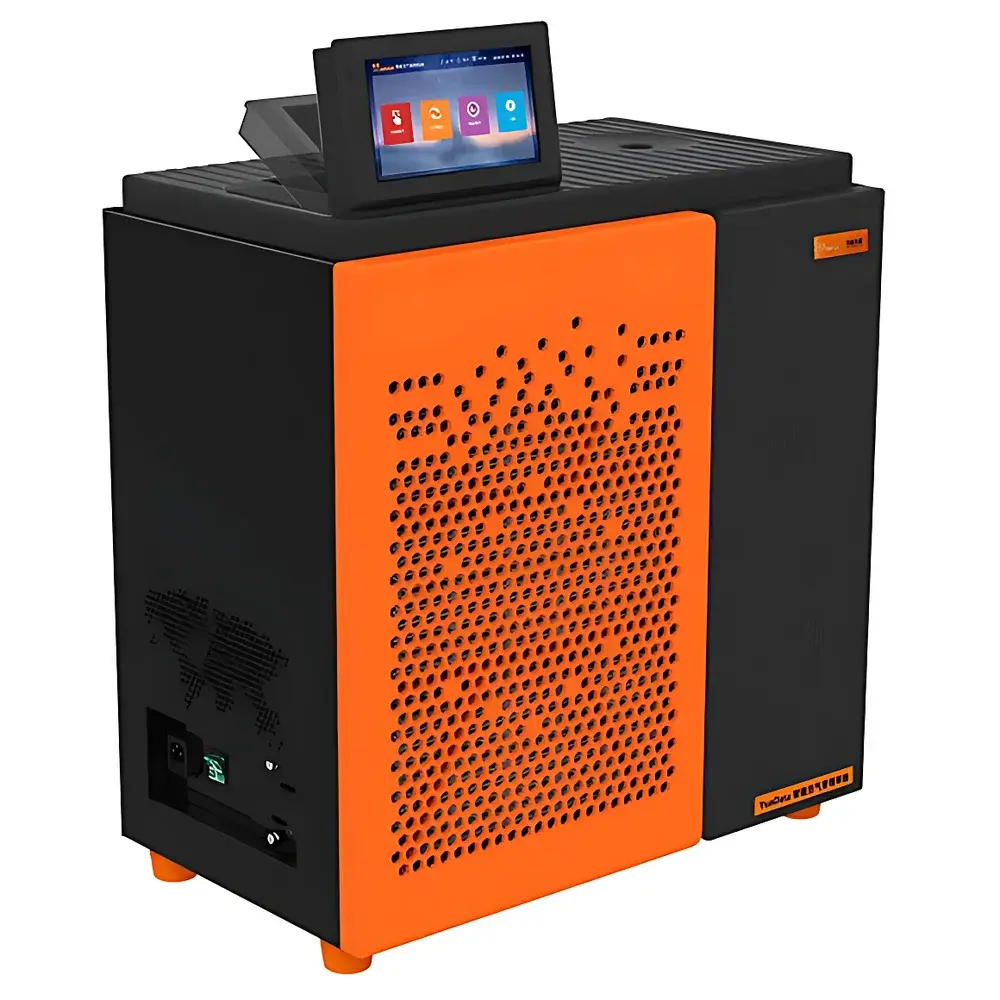
Hanon Yundata Smart Air Management System
| Brand | Hanon |
|---|---|
| Origin | Shandong, China |
| Manufacturer Type | Authorized Distributor |
| Country of Origin | China |
| Model | Yundata |
| Instrument Category | Biological Degradation Air Purification System |
| Suitable Area | ≤60 m² |
| Noise Level | 55 dB(A) |
| Air Velocity | 7.4 m/s |
| Dimensions (W×D×H) | 542.6 × 320 × 577.5 mm |
Overview
The Hanon Yundata Smart Air Management System is an engineered air purification platform designed specifically for laboratory environments where volatile organic compounds (VOCs), formaldehyde, and airborne particulates pose occupational health and safety risks. Unlike conventional adsorption-based purifiers that merely trap or mask contaminants, this system employs a catalytic liquid-phase degradation mechanism—utilizing a proprietary aqueous reactive solution—to chemically decompose gaseous pollutants at the molecular level. The core process follows a three-stage sequence: (1) aerosolized dispersion of the degradant solution into the breathing zone; (2) molecular capture of target analytes—including aldehydes, aromatic hydrocarbons, and other TVOC species—via selective chemical affinity; and (3) oxidative conversion of captured molecules into thermodynamically stable end products: carbon dioxide, water, and trace inorganic salts. This approach eliminates secondary emissions and avoids filter saturation or regeneration cycles typical of activated carbon or HEPA-only systems. The unit operates continuously within ambient temperature and humidity ranges typical of ISO Class 8 cleanrooms and general-purpose analytical laboratories.
Key Features
- Catalytic liquid-phase degradation technology—no consumable filters required for VOC removal
- Integrated multi-sensor array: real-time monitoring of formaldehyde (HCHO), total volatile organic compounds (TVOC), PM2.5, and ambient temperature/humidity
- Fire hazard early warning via optical smoke detection with immediate mobile notification via Wi-Fi-connected app
- Three operational modes: Manual (independent雾化/filtration control), Scheduled (time-based activation), and Adaptive Intelligence Mode (auto-triggered upon exceedance of user-defined threshold limits)
- Remote management through dedicated iOS/Android application supporting firmware updates, log export, and audit-ready event history
- Acoustically optimized enclosure design compliant with ISO 7779 for laboratory noise-sensitive zones (≤55 dB(A) at 1 m)
Sample Compatibility & Compliance
The system is validated for continuous operation in laboratories handling common organic solvents (e.g., methanol, acetone, toluene, formalin solutions), reagent-grade aldehydes, and polymerization by-products. It meets structural and electrical safety requirements per GB 4706.1–2005 (equivalent to IEC 60335-1) and electromagnetic compatibility standards per GB/T 17626 series (IEC 61000-4). While not certified under UL or CE for medical device use, its performance aligns with OSHA PEL and ACGIH TLV guidelines for formaldehyde (<0.016 ppm) and TVOC (<0.5 mg/m³) in indoor laboratory workspaces. Data logging functionality supports GLP-compliant record retention when paired with time-stamped sensor exports.
Software & Data Management
The Hanon AirManager™ mobile application provides role-based access control, configurable alert thresholds, and CSV-formatted environmental logs timestamped to UTC. All sensor readings—including HCHO concentration (ppb), TVOC index (µg/m³), PM2.5 mass concentration (µg/m³), and runtime statistics—are stored locally on-device and optionally synced to secure cloud storage (AES-256 encrypted). Audit trails include operator ID, mode transitions, manual overrides, and alarm acknowledgments—facilitating internal QA reviews and alignment with FDA 21 CFR Part 11 principles for electronic records where local policy permits. Firmware updates are delivered over-the-air with SHA-256 signature verification.
Applications
- Chemistry and biochemistry labs processing formaldehyde-fixed tissues or conducting solvent-based extractions
- Quality control laboratories performing residual solvent analysis (e.g., ICH Q3C compliance testing)
- Pharmaceutical R&D facilities maintaining low-VOC environments during stability studies
- Materials science labs using monomers, resins, or adhesives emitting aldehydic off-gassing
- Core facility shared labs requiring autonomous air quality maintenance between user sessions
FAQ
Does the system require replacement filters or cartridges?
No—this is a non-filter-based air management system. The degradant solution is replenished periodically (typical interval: 3–6 months depending on VOC load), but no physical filtration media is used.
Can sensor data be integrated into a building management system (BMS)?
Yes—via optional Modbus TCP or MQTT protocol gateway (sold separately), enabling interoperability with Siemens Desigo, Honeywell EBTS, or Schneider EcoStruxure platforms.
Is the degradant solution hazardous or regulated under GHS?
No—the solution is classified as non-toxic, non-corrosive, and non-flammable per UN GHS criteria. SDS documentation is available upon request and confirms full compliance with REACH Annex XVII restrictions.
What is the expected service life of the unit under continuous laboratory operation?
Rated for ≥20,000 hours of cumulative runtime (approx. 8 years at 7 h/day), with scheduled calibration recommended annually per ISO/IEC 17025 traceable procedures.
How does the system handle high-humidity environments (>70% RH)?
The aerosol generation module includes humidity-compensated dosing control to maintain consistent droplet size distribution and reaction kinetics across 30–80% RH operating range.



