
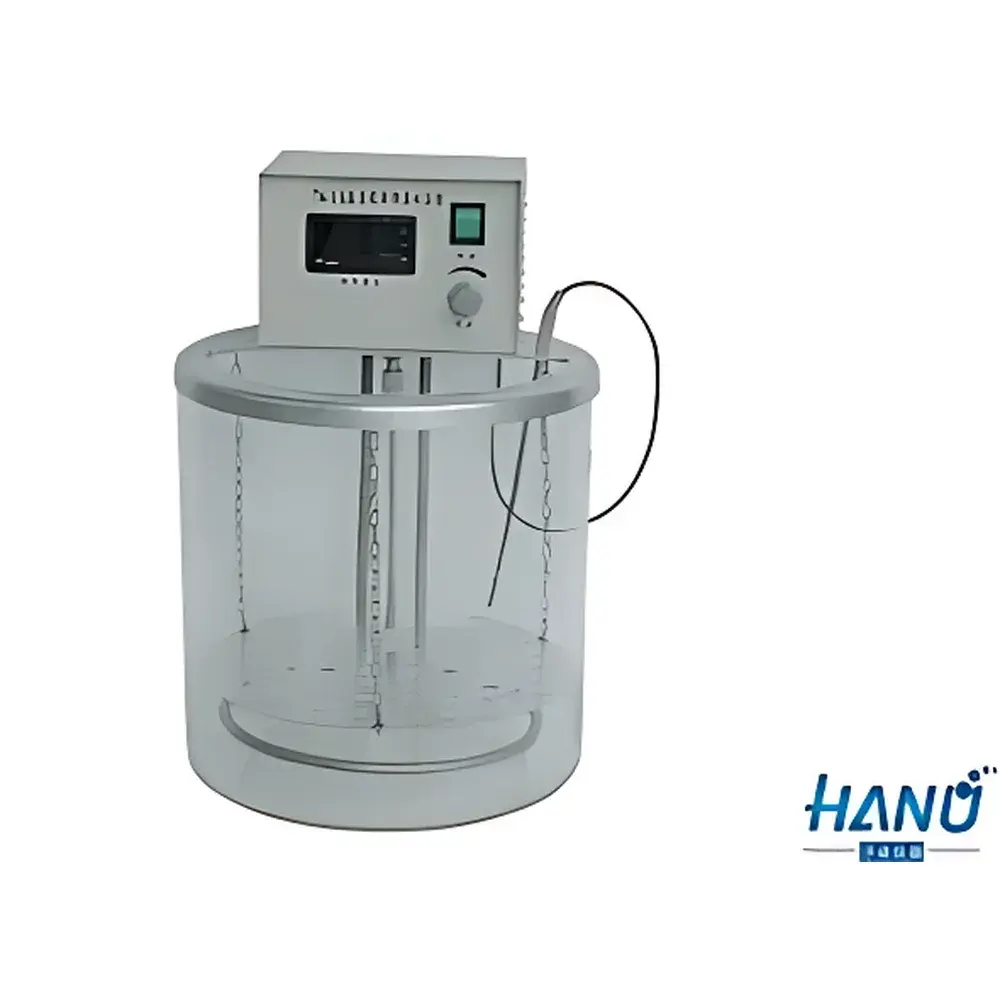
Hanuo 76-1A Transparent Glass Bath Circulator
| Brand | Hanuo |
|---|---|
| Model | 76-1A |
| Temperature Range | Ambient to 100 °C |
| Temperature Stability | ≤ ±0.5 °C |
| Heating Power | 0.9 kW |
| Stirring Power | 30 W |
| Stirring Speed | Continuously Adjustable |
| Tank Dimensions | Ø300 × 300 mm (D × H) |
| Voltage/Frequency | 200 V / 50 Hz |
| Display Resolution | 0.1 °C |
| Sensor Type | Imported Precision RTD Sensor |
| Circulation | Internal Only (No External Pump Port) |
Overview
The Hanuo 76-1A Transparent Glass Bath Circulator is a precision-engineered laboratory temperature control instrument designed for applications requiring visual monitoring, uniform thermal distribution, and stable setpoint maintenance within the ambient-to-100 °C range. Constructed with borosilicate glass walls, it enables real-time observation of sample behavior—critical for reaction monitoring, dissolution studies, calibration procedures, and biological incubation protocols where optical access is essential. Its operational principle relies on resistive heating combined with motor-driven mechanical stirring to achieve rapid thermal equilibration and minimize axial/radial temperature gradients. Unlike sealed metal baths, the open-top glass configuration supports direct immersion of reaction vessels, thermometers, electrodes, or probes without interference—making it especially suitable for teaching laboratories, QC/QA validation workflows, and method development under GLP-compliant environments.
Key Features
- Optically transparent borosilicate glass tank (Ø300 × 300 mm) for unobstructed process visualization and in-situ instrumentation insertion
- Digital LED dual-display interface showing both setpoint and actual bath temperature with 0.1 °C resolution
- Imported high-stability platinum resistance temperature detector (RTD) ensuring long-term repeatability and traceable accuracy
- Continuously variable DC stirring motor (30 W) delivering uniform convective heat transfer across the entire working volume
- Microprocessor-based PID temperature controller with auto-tuning capability, enabling fast ramp-up and minimal overshoot
- Robust stainless-steel heating element encapsulated in aluminum housing for corrosion resistance and thermal efficiency
- Over-temperature cut-off protection and dry-run safety shutdown to prevent heater damage during low-fluid conditions
Sample Compatibility & Compliance
The 76-1A accommodates standard laboratory glassware including Erlenmeyer flasks (up to 2 L), beakers, test tubes, and jacketed reactors. Its open-bath geometry allows simultaneous use of multiple sensors (e.g., pH, DO, conductivity) and manual sampling without system interruption. The unit complies with IEC 61010-1:2010 for electrical safety in laboratory equipment and meets CE marking requirements for electromagnetic compatibility (EMC Directive 2014/30/EU). While not certified for hazardous location use, its design aligns with general Good Laboratory Practice (GLP) expectations for temperature-controlled ancillary equipment. For regulatory submissions involving thermal validation (e.g., USP , ISO/IEC 17025), users may perform IQ/OQ/PQ using NIST-traceable reference thermometers and documented calibration logs.
Software & Data Management
The 76-1A operates as a standalone analog-controlled instrument without embedded data logging or USB/RS-232 connectivity. However, its stable analog output signal (0–5 V or 4–20 mA optional upon request) can be interfaced with third-party DAQ systems (e.g., National Instruments, LabVIEW-compatible modules) for time-series recording, alarm triggering, or integration into larger environmental control networks. All control parameters—including setpoint, measured temperature, and stirring status—are continuously visible on the front panel display, supporting manual audit trails required under FDA 21 CFR Part 11 when paired with controlled procedural documentation. Calibration certificates for the integrated RTD sensor are available upon request and include uncertainty budgets per ISO/IEC 17025 guidelines.
Applications
- Calibration of liquid-in-glass thermometers, thermocouples, and RTDs against reference standards
- Controlled-temperature extraction, hydrolysis, and enzymatic digestion in molecular biology and clinical diagnostics
- Accelerated stability testing of pharmaceutical formulations per ICH Q1A(R3)
- Viscosity measurement support for rotational rheometers requiring thermostatted sample conditioning
- Pre-heating and thermal equilibration of reagents prior to GC, HPLC, or spectrophotometric analysis
- Teaching demonstrations of heat transfer kinetics, phase transitions, and Arrhenius behavior in undergraduate physical chemistry labs
- Environmental simulation for materials testing (e.g., polymer swelling, gelation onset, surfactant cloud point determination)
FAQ
Is the 76-1A suitable for oil bath operation?
Yes—the bath is chemically resistant to common silicone and mineral oils up to 100 °C; however, prolonged exposure above 80 °C requires verification of oil flash point and vapor pressure compatibility.
Can external circulation be added post-purchase?
No—the 76-1A lacks pump ports and internal plumbing for external loops; models with recirculation capability (e.g., SC-series) must be selected at time of order.
What is the recommended maintenance interval for the stirring mechanism?
Inspect bearing lubrication and impeller alignment every 6 months under continuous operation; replace carbon brushes if motor exhibits intermittent stall or audible arcing.
Does the unit support programming ramps or soak profiles?
No—it provides only single-setpoint temperature control; multi-step thermal profiles require external programmable controllers interfaced via analog input.
How is temperature uniformity verified across the bath volume?
Per ASTM E1137/E1137M, users should map spatial variation using ≥9 calibrated probes placed in a 3×3 grid at mid-depth; typical deviation across the 76-1A’s working zone is ≤ ±0.3 °C at 37 °C and ≤ ±0.45 °C at 95 °C after 30 minutes stabilization.



