
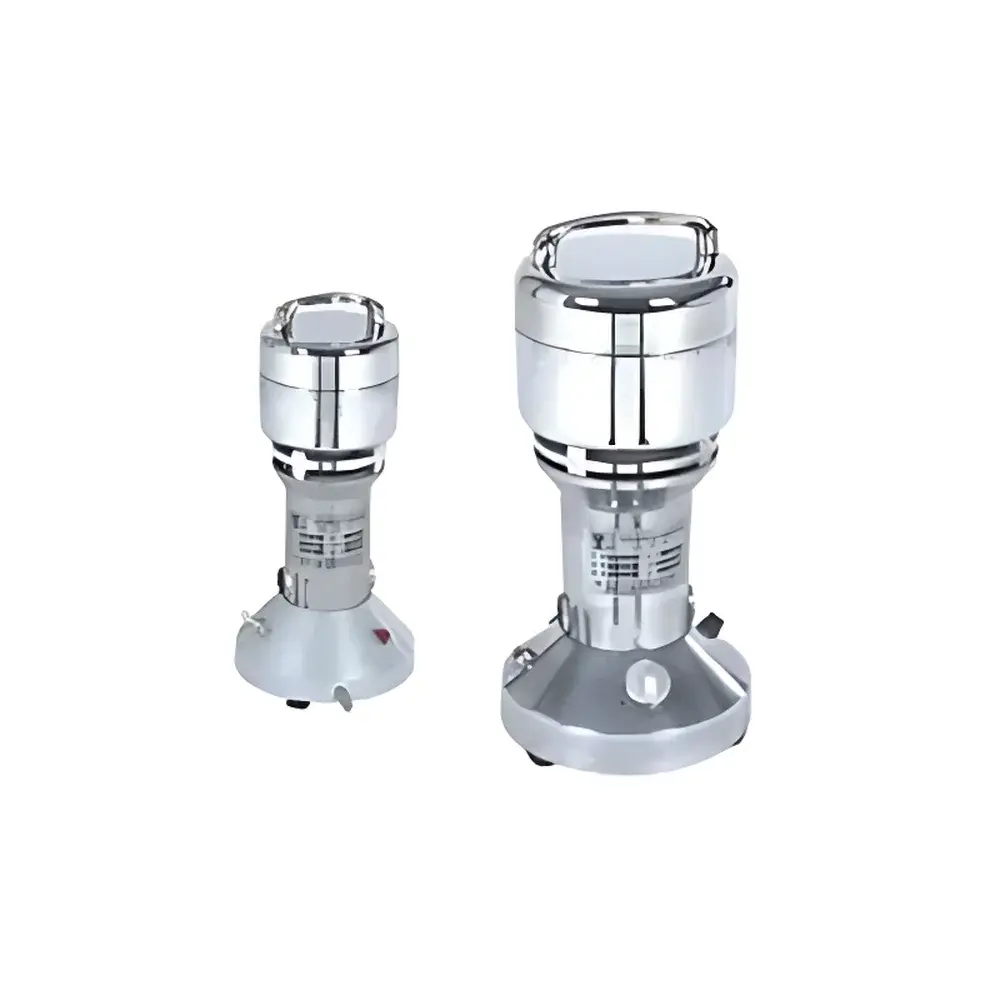
Hanuo DFT Series Portable High-Speed Solid Sample Grinder
| Brand | Hanuo |
|---|---|
| Origin | Shanghai, China |
| Model | DFT-100A / DFT-200A / DFT-250A |
| Motor Speed | 25,000 rpm |
| Power | 400 W (DFT-100A) / 900 W (DFT-200A & DFT-250A) |
| Capacity | 100 g / 200 g / 250 g |
| Particle Size Range | 30–200 mesh |
| Bowl Dimensions | Ø115×75 mm / Ø134×97 mm / Ø147×98 mm |
| Overall Dimensions | 14×14×28 cm / 16×16×30 cm |
| Construction | Stainless Steel Grinding Chamber & Blade |
| Sample Type | Hard, brittle, dry solid materials |
| Compliance | CE-marked for laboratory use under IEC 61000-6-3 (EMC) and IEC 61000-6-2 (Immunity) |
Overview
The Hanuo DFT Series Portable High-Speed Solid Sample Grinder is a compact, benchtop-capable mechanical comminution device engineered for rapid size reduction of hard, brittle, and dry solid samples in research laboratories, quality control facilities, and herbal medicine preparation workflows. It operates on the principle of high-speed rotor–stator impact grinding: a precision-balanced stainless steel blade rotates at 25,000 rpm within a sealed, corrosion-resistant grinding chamber, subjecting feed material to repeated shear, impact, and attrition forces. This mechanism enables reproducible particle size reduction—typically from coarse chunks to fine powders in 3 seconds to 2 minutes—without external cooling or solvent assistance. Unlike cryogenic or planetary ball mills, the DFT series emphasizes operational simplicity, minimal footprint, and immediate readiness, making it especially suited for intermittent, low-to-medium throughput tasks where sample integrity (e.g., avoiding thermal degradation of thermolabile botanicals) and cross-contamination control are critical.
Key Features
- Three scalable models (DFT-100A, DFT-200A, DFT-250A) with graduated capacity and power output—400 W for light-duty applications, 900 W for sustained operation with denser or more fibrous materials.
- Full stainless steel construction of grinding bowl and blade ensures chemical resistance, ease of cleaning, and compliance with basic hygiene requirements for multi-sample use.
- Optimized blade geometry and chamber internal profile promote uniform energy transfer and reduce particle agglomeration during processing.
- Integrated safety interlock prevents motor activation unless the lid is fully secured, meeting IEC 60335-1 mechanical safety provisions.
- No external vacuum or exhaust required; self-contained design minimizes lab infrastructure dependencies.
- Low acoustic signature (<75 dB(A) at 1 m) enables use in shared analytical workspaces without dedicated sound-dampened enclosures.
Sample Compatibility & Compliance
The DFT grinder accommodates hard, non-oily, low-moisture solids—including dried plant tissues (e.g., Astragalus membranaceus, Panax notoginseng), mineral-based traditional medicines (e.g., pearl powder, calcined oyster shell), and brittle polymers. It is unsuitable for wet, sticky, oily, or highly elastic materials (e.g., fresh roots, gums, rubber). While not certified for GMP manufacturing environments, its stainless steel contact surfaces support routine cleaning validation per ISO 14644-1 Class 8 cleanroom protocols. The unit bears CE marking, confirming conformity with EU Electromagnetic Compatibility Directive 2014/30/EU and Low Voltage Directive 2014/35/EU. It is not FDA 510(k)-cleared nor intended for clinical diagnostic use.
Software & Data Management
The DFT Series operates as a manual, analog-controlled instrument with no embedded firmware, touchscreen interface, or digital data logging capability. Timing is managed externally using standard laboratory stopwatches or integrated timer functions in LIMS or ELN platforms. Users record processing parameters—including batch ID, sample mass, grind duration, and post-grind sieve analysis results—manually or via structured electronic templates compliant with ALCOA+ principles. For auditability, laboratories may configure SOPs requiring timestamped operator signatures and visual verification of lid engagement prior to activation, supporting GLP-aligned documentation practices.
Applications
- Rapid preparation of homogenized reference standards for HPLC, UV-Vis, or FTIR analysis of herbal extracts.
- Size reduction of brittle calibration standards (e.g., NIST-traceable metal oxides) prior to XRF or ICP-OES digestion.
- Pre-analytical processing in pharmacognosy labs for microscopic identification and macroscopic characterization of powdered crude drugs.
- On-site field sampling support: lightweight chassis and absence of coolant lines enable transport to remote collection points for immediate stabilization of botanical specimens.
- Teaching laboratories: demonstrates mechanical energy transfer principles, particle size distribution fundamentals, and equipment safety protocols without complex setup.
FAQ
What types of samples are incompatible with the DFT grinder?
Samples with moisture content >10%, high oil content (e.g., sesame seeds, flaxseed), or viscoelastic behavior (e.g., chitosan films, gelatin capsules) will cause blade clogging, inconsistent particle size, or motor overload.
Can the DFT be used for sterile grinding?
No. The unit lacks autoclavable components or HEPA-filtered inlet/outlet ports; sterility must be achieved via pre-sterilized bowls and aseptic handling in laminar flow hoods.
Is the 30–200 mesh range achievable across all sample types?
Mesh distribution depends on hardness, friability, and initial particle geometry. Softer materials (e.g., dried licorice root) readily reach 200 mesh; harder minerals (e.g., calcite) typically yield 30–80 mesh under identical settings.
How often should the stainless steel blade be replaced?
Under typical academic QC use (≤5 batches/day), blade service life exceeds 1,000 operating minutes. Visual inspection for nicks, rounding, or microcracks is recommended before each high-value sample run.
Does Hanuo provide calibration certificates or traceable performance verification?
No. As a mechanical grinder—not a metrological instrument—the DFT does not undergo factory calibration. Users are advised to perform in-house verification using certified reference sieves (ISO 3310-1) and digital particle analyzers.



