
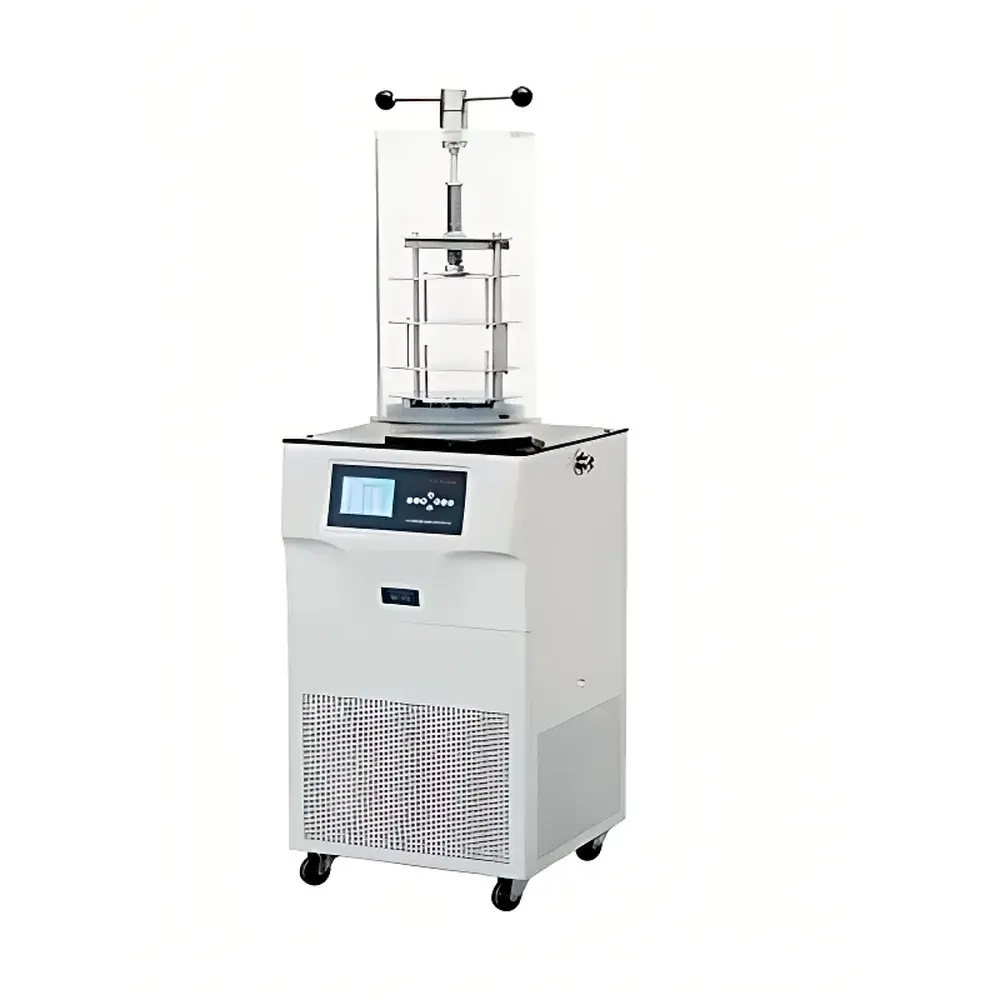
Hanuo FD-2B Benchtop Pressure-Lid Freeze Dryer with Shelf Heating
| Brand | Hanuo |
|---|---|
| Origin | Shanghai, China |
| Model | FD-2B |
| Instrument Type | Pressure-Lid Freeze Dryer |
| Application Scale | Pilot-Scale Laboratory Use |
| Freeze-Drying Area | 0.1 m² |
| Ultimate Vacuum | < 13 Pa |
| Condenser Temperature | ≤ −70 °C |
| Water Capture Capacity | 6 kg/24 h |
| Dimensions (W×D×H) | 540 × 640 × 920 mm |
| Power Supply | 220 V, 50 Hz, 1800 W |
| Sample Tray | Φ200 mm, 3-layer stackable |
| Tray Volume Capacity | 1.0 L |
| Condenser Chamber | Φ280 × 420 mm |
| Compliance | Designed for GLP-aligned laboratory workflows |
Overview
The Hanuo FD-2B is a benchtop pressure-lid freeze dryer engineered for reproducible, controlled lyophilization of thermolabile biological and pharmaceutical materials in pilot-scale laboratory environments. It operates on the fundamental principle of sublimation—removing water from frozen samples under deep vacuum while maintaining product integrity through precise thermal management. Unlike basic condenser-only systems, the FD-2B integrates electrically heated shelves to enable active control of primary drying rates and secondary drying kinetics. This shelf-heating capability supports process optimization, cycle development, and formulation stability studies—critical for early-stage bioprocess development, QC release testing, and small-batch clinical material preparation. Its compact footprint and modular design make it suitable for shared core facilities, university research labs, and contract development organizations requiring scalable, instrumented freeze-drying capability without full production-line infrastructure.
Key Features
- Shelf heating system with programmable temperature ramping (range: ambient to +60 °C), enabling precise control over heat input during primary and secondary drying phases
- High-efficiency dual-stage cascade refrigeration system achieving stable condenser temperatures ≤ −70 °C, optimized for rapid ice capture and low residual moisture
- Pressure-lid sealing mechanism with manual or optional automated actuation, ensuring consistent vial stoppering post-drying under inert gas or vacuum
- Large backlit LCD interface with multi-step program memory—supports up to 32 user-defined freeze-drying cycles with independent setpoints for shelf temp, chamber pressure, and time
- Robust stainless-steel chamber and condenser housing, corrosion-resistant and compatible with standard cleaning protocols (e.g., 70% ethanol, hydrogen peroxide vapor)
- Integrated vacuum monitoring via Pirani gauge, calibrated for accurate pressure readout across the 0.1–100 Pa range essential for sublimation rate control
Sample Compatibility & Compliance
The FD-2B accommodates standard Φ200 mm sample trays stacked across three tiers, supporting up to 1.0 L total loading volume—ideal for vials (10–30 mL), serum bottles, or custom containers used in preclinical and analytical workflows. Its design conforms to common laboratory safety and operational standards, including IEC 61010-1 for electrical safety and ISO 22000-aligned hygiene principles. While not certified as GMP-compliant out-of-the-box, the system’s programmable logic, data logging, and repeatable performance support validation activities required under FDA 21 CFR Part 11 when paired with compliant software extensions. It is routinely deployed in environments adhering to GLP documentation practices for stability-indicating method development and excipient screening.
Software & Data Management
The FD-2B includes embedded firmware capable of recording real-time shelf temperature, chamber pressure, and condenser temperature at user-configurable intervals (1–60 sec). All cycle data are stored internally and exportable via USB to CSV format for offline analysis in MATLAB, Python, or Excel. Optional PC-based software (sold separately) provides enhanced visualization, alarm configuration, electronic signature support, and audit trail generation—facilitating compliance with 21 CFR Part 11 requirements for regulated environments. Raw data files include timestamps, operator ID fields, and cycle metadata, enabling traceability across multiple users and experimental batches.
Applications
- Lyophilization of monoclonal antibodies, recombinant proteins, and plasmid DNA for long-term storage and stability assessment
- Process development for vaccine candidates, including adjuvant-containing formulations sensitive to thermal degradation
- Drying of microbial cultures, probiotics, and diagnostic reagents requiring high viability retention
- Preparation of reference standards and calibration materials for HPLC, LC-MS, and ELISA assays
- Food science research involving functional ingredient preservation, such as enzymes, peptides, and polyphenols
- Material science applications including porous scaffold fabrication and cryo-structured hydrogel synthesis
FAQ
What is the maximum allowable sample volume per cycle?
The FD-2B supports up to 1.0 L of aqueous solution across three Φ200 mm trays—equivalent to approximately 120 × 10 mL vials or 60 × 20 mL vials when uniformly distributed.
Can the shelf heating function be disabled for non-heated freeze-drying protocols?
Yes—the heating system can be deactivated independently, allowing operation in passive cooling mode identical to conventional condenser-driven freeze dryers.
Is remote monitoring or Ethernet connectivity available?
Standard configuration includes USB data export only; optional RS-485 or Ethernet modules are available upon request for integration into facility-wide SCADA or LIMS platforms.
Does the system meet ISO 5 or cleanroom compatibility requirements?
The FD-2B is not rated for ISO Class 5 environments; however, its smooth stainless-steel interior and absence of internal fans minimize particle shedding—making it suitable for use inside laminar flow hoods or adjacent to classified spaces.
What maintenance is required for sustained vacuum performance?
Routine maintenance includes annual oil change for the rotary vane vacuum pump, quarterly inspection of O-rings and door gaskets, and periodic cleaning of the condenser coil using non-abrasive solvents per manufacturer guidelines.



