
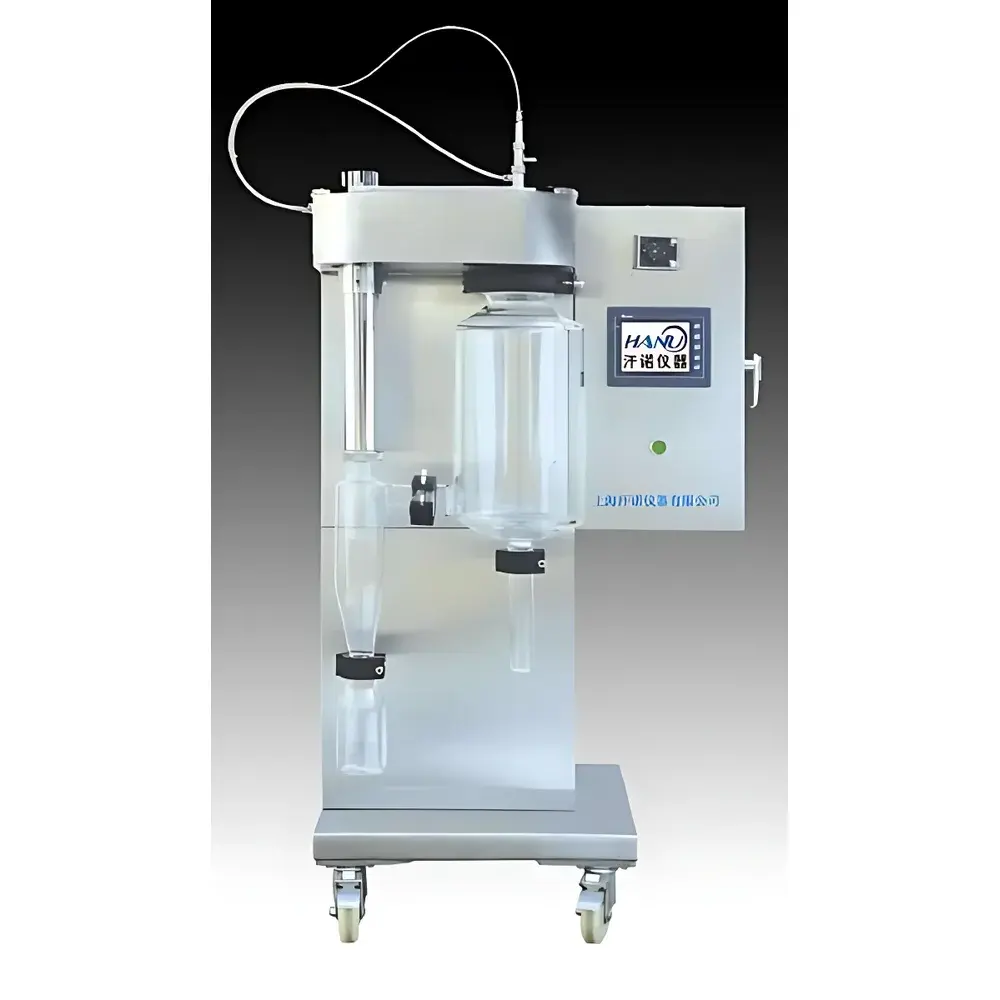
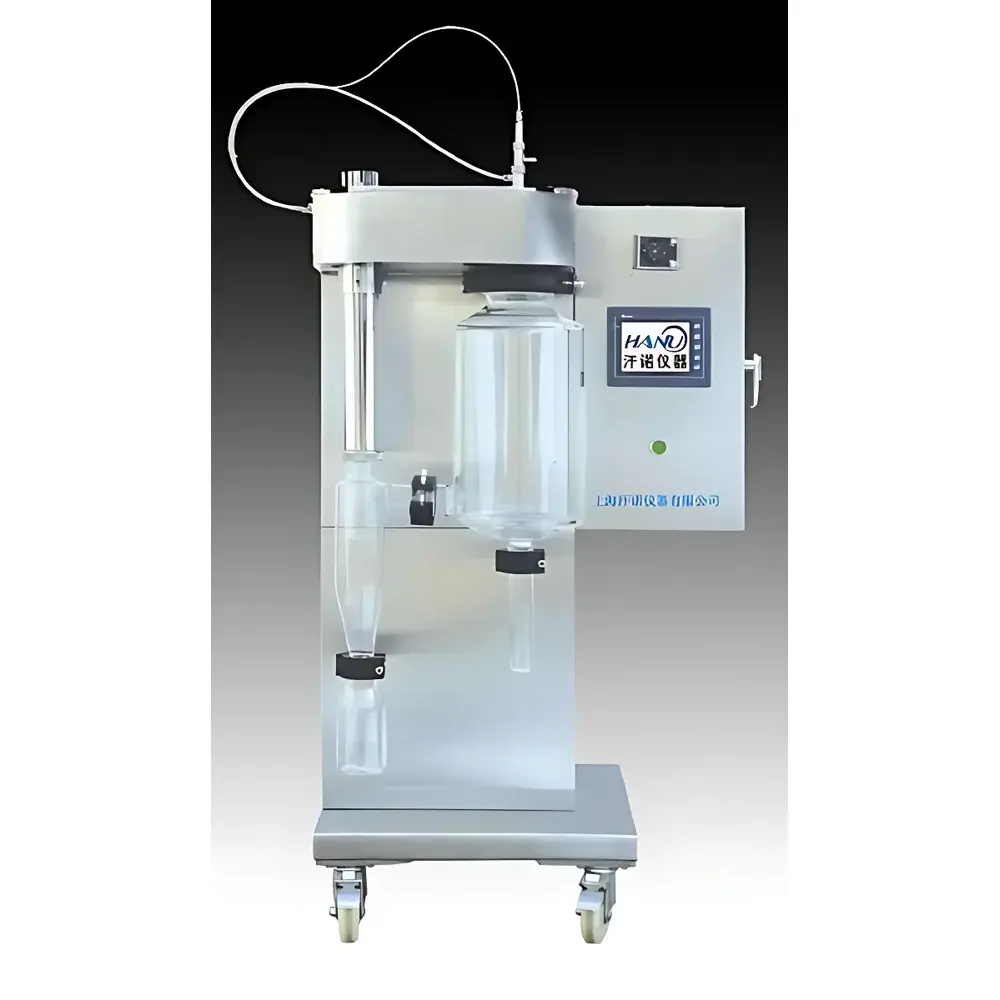
Hanuo HN-1500P Laboratory Spray Dryer
| Brand | Hanuo |
|---|---|
| Model | HN-1500P |
| Origin | Shanghai, China |
| Construction | Full 316L stainless steel frame & high-borosilicate glass drying chamber |
| Inlet Temp Range | 30–300 °C |
| Outlet Temp Range | 30–140 °C |
| Max Feed Rate | 2500 mL/h |
| Min Feed Volume | 30 mL |
| Drying Time | 1.0–1.5 s |
| Evaporation Capacity | 1500–2500 mL/h |
| Temp Control Accuracy | ±1 °C (PID) |
| Power Supply | 3 kW / 220 V |
| Dimensions (H×L×W) | 1300 × 650 × 500 mm |
| Sample Compatibility | Aqueous solutions, organic solvents, emulsions, suspensions |
| Particle Size Output | ~100 µm (typical, dependent on feed properties and process parameters) |
Overview
The Hanuo HN-1500P is a benchtop two-fluid nozzle spray dryer engineered for precise, reproducible powder synthesis in research laboratories and pilot-scale development environments. It operates on the principle of flash evaporation: liquid feed is atomized into fine droplets via compressed air-assisted dual-fluid nozzles, then rapidly dried by concurrent hot air flow within a vertical cylindrical drying chamber. This short residence time (1.0–1.5 seconds) minimizes thermal degradation—making it especially suitable for thermolabile compounds including proteins, enzymes, probiotics, microencapsulated actives, and pharmaceutical intermediates. The system integrates real-time PID-controlled inlet/outlet temperature regulation, programmable peristaltic feed delivery, and automatic nozzle clearance—enabling robust, operator-independent operation under GLP-aligned workflows.
Key Features
- Two-fluid pneumatic nozzle with precision-machined 316L stainless steel cap and interchangeable orifice inserts for optimized atomization across diverse viscosities and surface tensions
- Full 316L stainless steel structural frame and collection housing; high-borosilicate glass drying tower and cyclone collector (ISO 3585 compliant) for visual process monitoring and contamination-free handling
- Color TFT-LCD touchscreen interface displaying simultaneous real-time values: inlet temperature, outlet temperature, peristaltic pump speed (RPM), airflow rate (m³/h), and needle cleaning frequency
- Intelligent needle-cleaning system (‘clearing pin’) with adjustable activation interval and dwell time—prevents nozzle clogging during extended runs with viscous or particulate-laden feeds
- Thermal safety protocol: automatic shutdown sequence de-energizes heater and atomization system upon stop command while sustaining fan operation to dissipate residual heat—eliminating risk of overheating or charring
- PID-based temperature control with ±1 °C stability over full operating range (30–300 °C inlet); independent calibration ports for traceable sensor verification
- Modular feed delivery: digital peristaltic pump (0–2500 mL/h range) with linear flow response and minimum dispensing volume of 30 mL—ideal for precious or low-yield formulations
Sample Compatibility & Compliance
The HN-1500P accommodates aqueous, alcoholic, acetonic, ethanolic, and other low-to-medium volatility solvent systems—including water-in-oil and oil-in-water emulsions, colloidal suspensions, and polymer solutions up to 5,000 cP viscosity (with appropriate nozzle selection). Its inert wetted path (glass + 316L SS) complies with USP , ISO 10993-1 (biocompatibility screening), and FDA-recommended material contact standards for early-phase formulation development. While not certified for GMP manufacturing, its design supports audit-ready documentation: temperature logs, pump speed records, and run timestamps are exportable via USB for 21 CFR Part 11–aligned data integrity practices. All electrical components meet CE/IEC 61000-6-3 EMC and IEC 61000-6-2 immunity requirements.
Software & Data Management
The embedded controller stores up to 100 complete drying protocols with user-defined names, setpoints, and ramp profiles. Each run generates a timestamped CSV file containing second-by-second inlet/outlet temperatures, feed rate, airflow, and system status flags—exportable via USB-A port for post-run analysis in MATLAB, Python (Pandas), or Excel. Optional RS-485 Modbus RTU interface enables integration into centralized lab automation networks (e.g., LabVantage, STARLIMS) for automated batch reporting and electronic batch record (EBR) linkage. Audit trail functionality logs all parameter modifications, user logins, and emergency stops—supporting GLP compliance and internal quality reviews.
Applications
- Pharmaceutical R&D: Production of inhalable dry powders, amorphous solid dispersions, and nanoparticle-loaded microparticles
- Food & Nutraceuticals: Encapsulation of omega-3 oils, probiotics, vitamins, and natural extracts with controlled release profiles
- Materials Science: Synthesis of metal oxide precursors (e.g., LiCoO₂, SiO₂), catalyst supports, and battery electrode slurries
- Agrochemical Development: Formulation of water-dispersible granules (WDG) and controlled-release pesticide carriers
- Academic Research: Kinetic studies of particle formation, solvent evaporation dynamics, and morphology–process parameter correlations
FAQ
What solvent types are compatible with the HN-1500P?
Aqueous buffers, ethanol, methanol, acetone, isopropanol, ethyl acetate, and dichloromethane are routinely processed. Chlorinated or highly corrosive solvents (e.g., HF, fuming nitric acid) require prior consultation and optional Hastelloy-wetted part upgrades.
Can the system handle heat-sensitive biologics without activity loss?
Yes—due to sub-second droplet residence time and tunable outlet temperature (as low as 30 °C), enzymatic activity retention >90% has been verified for lysozyme, β-galactosidase, and monoclonal antibody fragments under optimized conditions.
Is the glass drying chamber resistant to thermal shock during rapid temperature transitions?
The borosilicate glass (Schott Duran® equivalent) meets ISO 3585 specifications and withstands ΔT ≥ 120 °C without fracture when preheated per standard startup procedure.
Does the unit support continuous unattended operation?
It supports up to 8-hour uninterrupted runs with stable feed supply and adequate cooling airflow; however, manual inspection of nozzle integrity and cyclone loading is recommended every 2–3 hours for optimal yield consistency.
What maintenance intervals are recommended for long-term reliability?
Daily: Glass component cleaning with IPA and lint-free wipes; weekly: nozzle inspection and ultrasonic bath cleaning; quarterly: PID sensor calibration verification and peristaltic pump tubing replacement.



