
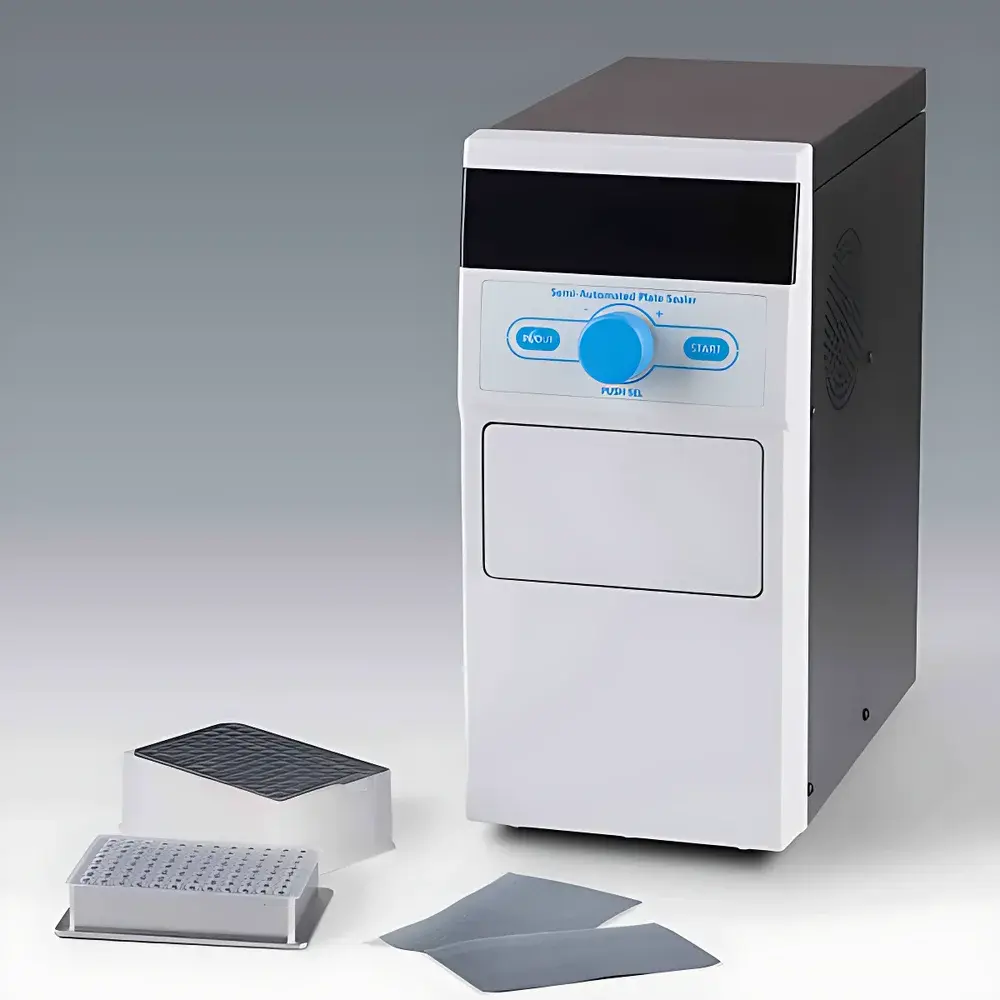
Hanuo HSP1000 Microplate Heat Sealer
| Brand | Hanuo |
|---|---|
| Origin | Shanghai, China |
| Model | HSP1000 |
| Automation Level | Semi-Automatic |
| Sealing Temperature Range | 80–200 °C |
| Temperature Accuracy | ±1 °C |
| Sealing Time | 0.5–10.0 s (adjustable in 0.1 s increments) |
| Plate Height Accommodation | 9–48 mm |
| Max Input Power | 300 W |
| Dimensions (D×W×H) | 370 mm × 180 mm × 330 mm |
| Weight | 12 kg |
| Compatible Plate Types | Standard microplates (96-well, 384-well), PCR plates (full-skirted, half-skirted, non-skirted), deep-well storage plates, cell culture plates, ELISA plates |
| Compatible Plate Materials | Polypropylene (PP), Polystyrene (PS), Polyethylene (PE) |
| Compatible Sealing Films | Adhesive foil, thermal sealing film, pierceable thermal film, optical-grade transparent film (for qPCR) |
Overview
The Hanuo HSP1000 Microplate Heat Sealer is an engineered solution for reliable, reproducible thermal sealing of standard and specialized microplates used across molecular biology, clinical diagnostics, and high-throughput screening laboratories. It operates on the principle of controlled conductive heating—applying precisely regulated temperature and dwell time to thermoplastic sealing films, inducing localized polymer softening and adhesion to plate rims without deformation or delamination. Unlike manual sealing or pneumatic systems, the HSP1000 delivers consistent thermal energy distribution across all wells via a uniform-heating aluminum sealing head, eliminating edge lift, channeling, or incomplete seal formation. Its design targets critical pre-analytical integrity requirements: prevention of sample evaporation during extended incubation or thermal cycling, suppression of cross-contamination between wells, and maintenance of assay stability under variable ambient humidity. As a companion device to real-time PCR instruments, digital PCR platforms, and automated liquid handlers, it supports workflows requiring strict environmental containment—particularly for low-volume, high-sensitivity applications such as gene expression profiling, SNP genotyping, and NGS library preparation.
Key Features
- Intelligent motorized door actuation with obstacle detection: Reverses direction upon contact with hands or foreign objects, meeting IEC 61000-4-2 ESD immunity and ISO 13857 safety clearance standards.
- Rapid thermal ramp-up: Achieves stable setpoint temperature (e.g., 170 °C) within ≤300 seconds, minimizing workflow downtime between sealing cycles.
- Auto-height sensing: Detects plate height (9–48 mm) without mechanical adjustment—enabling seamless transition between PCR plates, deep-well blocks, and cell culture formats.
- Dual-stage power management: Enters low-power standby mode (heater reduced to 60 °C) after 60 minutes of inactivity; transitions to deep-sleep mode (display off, heater power fully cut, control board in ultra-low-power state) after 120 minutes—compliant with ENERGY STAR® v8.0 idle-mode specifications.
- Modular sealing head assembly: The door mechanism detaches cleanly from the main chassis for routine cleaning and calibration verification of the heating surface—reducing scheduled maintenance intervals by up to 40% versus fixed-head designs.
- OLED interface with real-time feedback: Displays actual sealing temperature, elapsed time, and plate presence status—supporting GLP-compliant documentation when paired with external audit logging software.
Sample Compatibility & Compliance
The HSP1000 accommodates industry-standard microplate geometries defined in ANSI SLAS/ANSI/SBS 1–2012, including 96-well, 384-well, and 1536-well formats. It seals plates fabricated from polypropylene (PP), polystyrene (PS), and polyethylene (PE)—materials commonly specified in ASTM D5229 for thermal bonding performance. Compatible films include non-pierceable adhesive foils (ISO 8573-1 Class 4 purity), pierceable thermal films (validated per USP endotoxin limits), and optical-grade polyester-laminated films certified for qPCR transparency (absorbance <0.005 at 260 nm per ASTM E1137). The instrument meets CE marking requirements under Directive 2014/30/EU (EMC) and 2014/35/EU (LVD), and its thermal control architecture complies with IEC 61010-1:2010 for laboratory electrical equipment safety.
Software & Data Management
While the HSP1000 operates as a standalone benchtop unit with no embedded PC or network interface, its OLED interface provides timestamped event logging (seal start/end time, setpoint, actual temperature, plate height detected) exportable via USB-C to CSV format. When integrated into regulated environments, users may pair the device with third-party LIMS or ELN systems using RS-232 serial output (optional adapter). Audit trail functionality—including user ID entry, parameter change history, and failure event codes—is supported through external middleware compliant with FDA 21 CFR Part 11 Annex 11 requirements for electronic records and signatures.
Applications
- qPCR and RT-qPCR plate sealing prior to thermal cycling—ensuring vapor-tight closure for accurate Cq determination and inter-run comparability.
- Sealing of compound libraries in 384-well deep-well plates for automated HTS assays, preventing solvent evaporation during robotic dispensing and incubation.
- Clinical microbiology workflows: sealing blood culture plates and antimicrobial susceptibility testing arrays under biosafety cabinet conditions—no compressed air required.
- Biobanking: long-term storage sealing of cryovial racks and sample plates at −80 °C, validated for seal integrity after thermal shock cycling (−80 °C to +25 °C, 5 cycles).
- Cell-based assay preparation: sealing adherent and suspension culture plates prior to imaging or metabolic readouts, maintaining sterility without membrane interference.
FAQ
Does the HSP1000 support programmable protocols for different plate types?
Yes—up to 10 user-defined sealing profiles (temperature, time, height offset) can be saved and recalled via the OLED menu.
Is calibration traceable to national standards?
Temperature sensor calibration is performed using NIST-traceable dry-block calibrators (±0.2 °C uncertainty); certificate provided with each unit.
Can the HSP1000 seal plates containing volatile organic solvents?
It is rated for use with aqueous and ethanol-based solutions only; sealing of DMSO, acetone, or chloroform-containing plates is not recommended due to film compatibility limitations.
What maintenance is required for long-term accuracy?
Monthly visual inspection of the sealing head surface and quarterly verification of temperature uniformity across the 120 mm × 80 mm active zone using calibrated IR thermography.
Is the device compatible with robotic arm integration?
Yes—the motorized door includes TTL-level I/O triggers (open/close status, ready signal) for synchronization with third-party automation controllers.





