
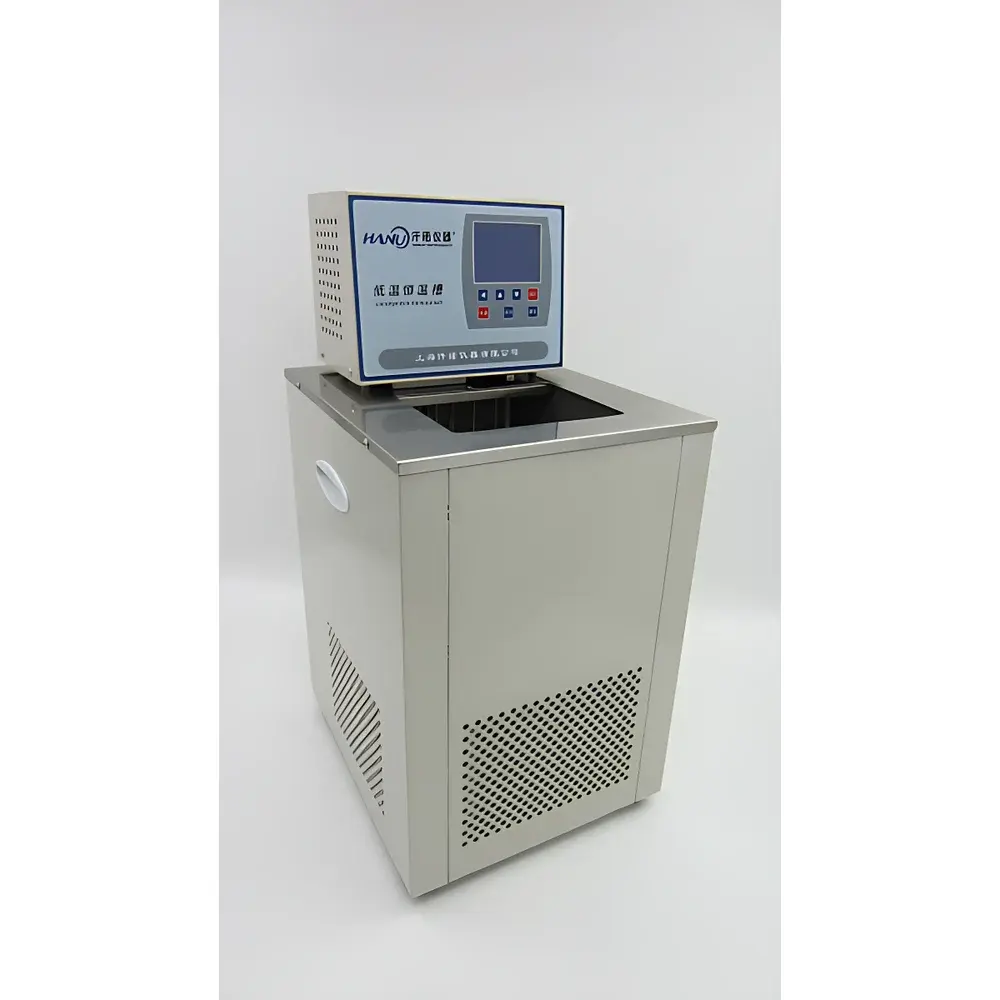
Hanuo HX-4015 Low-Temperature & High-Temperature Circulating Chiller
| Brand | Hanuo |
|---|---|
| Origin | Shanghai, China |
| Model | HX-4015 |
| Instrument Type | Constant-Temperature Bath Circulator |
| Temperature Range | −40 °C to +105 °C |
| Temperature Stability | ±0.1 °C |
| Bath Volume | 15 L |
| Circulation Mode | Internal & External |
| Temperature Control | Dual-mode (Heating & Refrigeration) |
| Display Resolution | 0.1 °C |
| Construction | Stainless Steel Interior |
| Cooling System | Air-Cooled Hermetic Compressor |
| Safety Protections | Overheat, Overcurrent, and Temperature Overshoot Cut-off with Audible Alarm |
Overview
The Hanuo HX-4015 Low-Temperature & High-Temperature Circulating Chiller is an engineered thermal management system designed for precise, stable, and reproducible temperature control across demanding laboratory applications. Operating on a closed-loop liquid circulation principle, it delivers conditioned heat transfer fluid—typically water, water-glycol mixtures, or silicone oil—to external equipment such as rotary evaporators, spectrophotometer cells, reaction jackets, calorimeters, and material testing chambers. Its dual-mode thermoelectric-compressor hybrid architecture enables seamless transition between active cooling and heating within a broad operational range of −40 °C to +105 °C, making it suitable for cryogenic synthesis, accelerated stability studies, polymer processing, and high-temperature catalysis workflows. The unit maintains thermal equilibrium through PID-controlled feedback loops, ensuring minimal thermal drift and high inter-run repeatability—critical for GLP-compliant method validation and ISO/IEC 17025-accredited laboratories.
Key Features
- Robust stainless steel bath tank (304 grade) resistant to corrosion, thermal shock, and chemical exposure—ensuring long-term integrity and ease of cleaning per cGMP hygiene standards.
- Air-cooled, hermetically sealed refrigeration compressor with optimized condenser airflow, delivering rapid cooldown from ambient to −40 °C in under 65 minutes (typical, with 15 L load and 30% ethylene glycol solution).
- Microprocessor-based digital controller with real-time temperature display (0.1 °C resolution), programmable setpoint memory, and adjustable ramp/soak profiles for multi-step thermal protocols.
- Integrated safety architecture: triple-stage thermal protection (compressor overheat, circuit overcurrent, and bath temperature overshoot), automatic power cutoff, and audible alarm activation upon fault detection.
- Bidirectional fluid circulation system supporting both internal bath homogenization and external recirculation via adjustable flow pump (max. 16 L/min, pressure-rated to 0.3 bar)—compatible with standard 1/2″–3/4″ tubing interfaces.
- Thermal calibration offset function allows user-defined correction of sensor bias (±9.9 °C range), enabling traceable alignment with NIST-traceable reference thermometers during IQ/OQ qualification.
Sample Compatibility & Compliance
The HX-4015 accommodates a wide spectrum of thermal transfer media—including deionized water, aqueous glycol solutions (up to 50% v/v), and low-viscosity silicone oils—enabling application-specific optimization of thermal conductivity, freezing point depression, and flash point safety. Its design adheres to IEC 61010-1:2010 for electrical safety in laboratory equipment and incorporates grounding continuity, reinforced insulation, and leakage current suppression. While not certified for hazardous area use (ATEX/IECEx), the unit meets CE marking requirements for EMC (EN 61326-1) and low-voltage directive compliance. It supports audit-ready documentation for FDA 21 CFR Part 11 when integrated with validated third-party data acquisition software—particularly relevant for pharmaceutical stability chambers and QC release testing environments.
Software & Data Management
The HX-4015 operates autonomously via its front-panel interface but is fully compatible with RS232/RS485 serial communication (optional USB-to-serial adapter). When connected to PC-based monitoring platforms (e.g., LabVIEW, MATLAB, or custom SCADA systems), it transmits real-time temperature readings, setpoint status, alarm flags, and pump RPM at configurable intervals (1–60 s). Raw time-series data can be logged in CSV format for post-acquisition analysis, statistical process control (SPC), and trending per ISO 9001 clause 8.5.2. Audit trail functionality—including operator ID, timestamped parameter changes, and event logs—is achievable when paired with compliant electronic lab notebook (ELN) or LIMS integration middleware.
Applications
- Temperature control of jacketed reactors and crystallizers in fine chemical and API manufacturing.
- Cooling support for high-power laser sources, CCD detectors, and X-ray diffractometers requiring thermal stabilization below ambient.
- Calibration of temperature-sensitive sensors (RTDs, thermistors, infrared pyrometers) across extended ranges.
- Accelerated aging studies per ASTM D3045 (thermal oxidative degradation of plastics) and ICH Q1A(R3) guidelines.
- Viscometry and rheometry sample conditioning where bath-induced thermal gradients must remain < ±0.05 °C over 24 h.
- Material testing per ISO 6721 (dynamic mechanical analysis) and ASTM D696 (coefficient of linear expansion).
FAQ
What fluids are compatible with the HX-4015 bath system?
Deionized water, 20–50% ethylene or propylene glycol–water mixtures, and low-viscosity silicone oils (e.g., Dow Corning PMX-200 series) are routinely used. Avoid halogenated solvents, strong acids/bases, and fluids with flash points below 60 °C.
Can the unit maintain ±0.1 °C stability while supplying external equipment?
Yes—when external load thermal mass and flow resistance are within specified limits (≤1.5 kW heat exchange capacity; ≤0.2 bar backpressure), stability of ±0.1 °C is maintained at setpoints ≥−20 °C. At −40 °C, stability is ±0.2 °C under equivalent conditions.
Is remote monitoring and control supported out of the box?
The base model includes RS232; RS485 and Ethernet modules are optional add-ons. Communication protocol documentation (ASCII command set) is provided for OEM integration.
Does the chiller meet GLP or GMP requirements for regulated labs?
It supports GLP/GMP workflows via hardware-level safety features, calibration traceability, and compatibility with validated data logging systems—though formal qualification (IQ/OQ/PQ) must be performed by the end user per their SOPs.
What maintenance intervals are recommended?
Compressor oil and refrigerant levels should be verified annually; air filter cleaning every 3 months; stainless steel bath inspection and passivation every 6 months in corrosive-use environments.



