
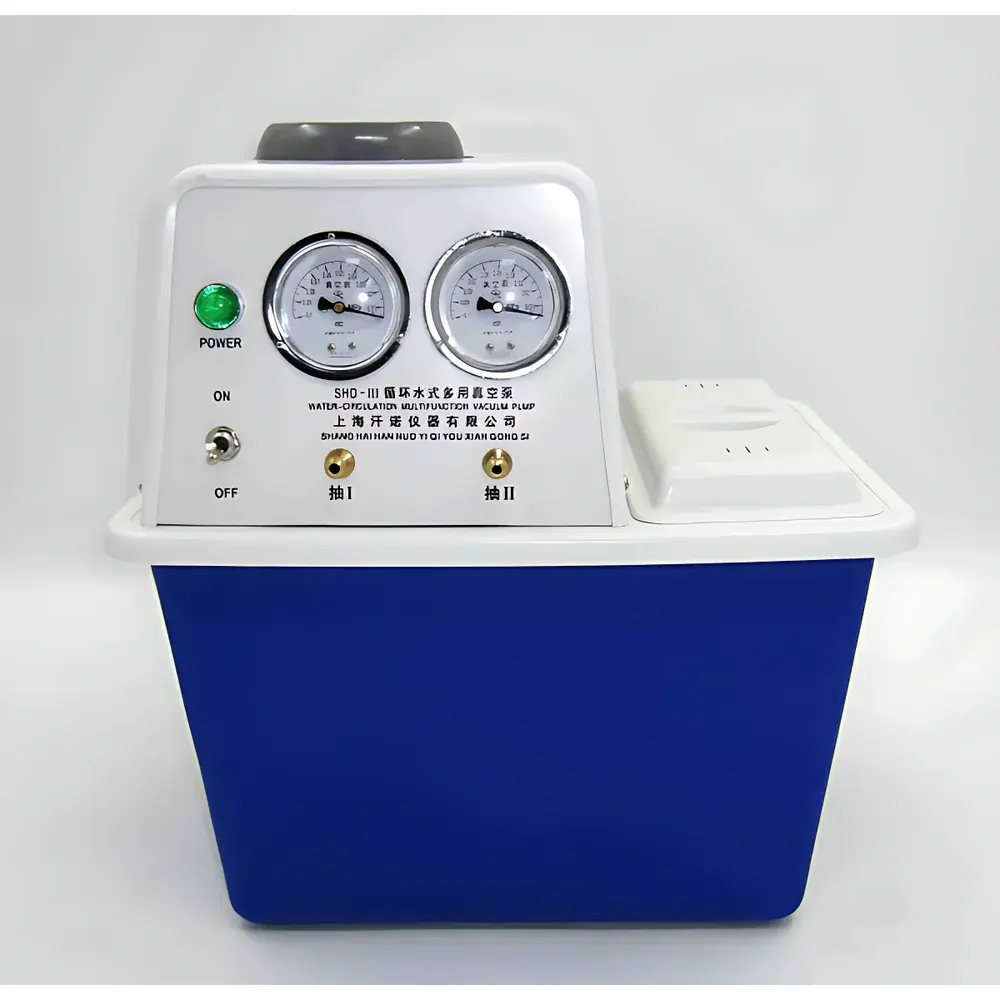
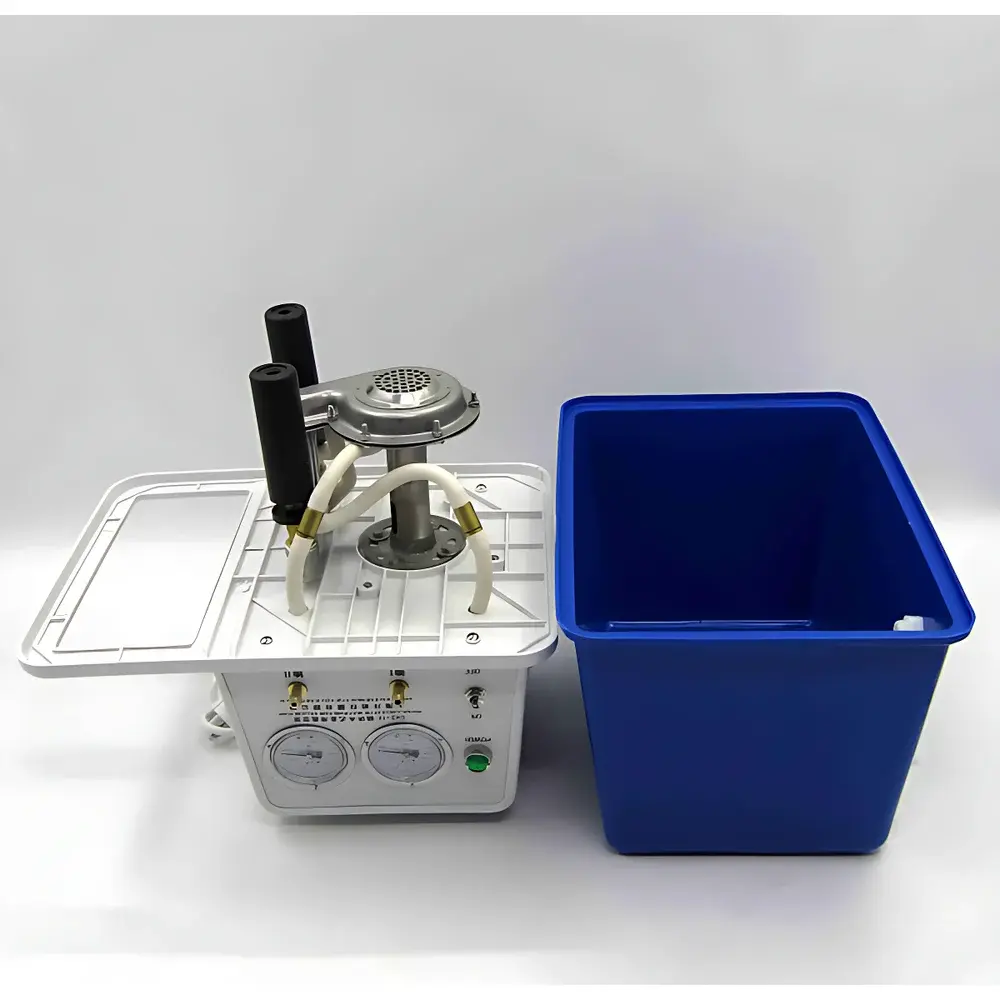
Hanuo SHZ-DIII Circulating Water Vacuum Pump
| Brand | Hanuo |
|---|---|
| Origin | Shanghai, China |
| Manufacturer Type | General Distributor |
| Country of Origin | Domestic (China) |
| Model | SHZ-DIII |
| Instrument Type | Circulating Water Vacuum Pump |
| Product Type | Oil-Free Pump |
| Ultimate Vacuum | 0.098 MPa |
| Air Displacement (per head) | 10 L/min |
| Dual-Head Configuration | Yes |
| Water Reservoir Capacity | 15 L |
| Circulating Flow Rate | 80 L/min |
| Pump Head | 12 m |
| Motor Power | 180 W |
| Housing Material | Corrosion-Resistant Engineering Plastic |
| Power Supply | 220 V / 50 Hz |
| Net Weight | 9.8 kg |
Overview
The Hanuo SHZ-DIII Circulating Water Vacuum Pump is an oil-free, water-cooled vacuum source engineered for reliable, low-maintenance operation in academic, pharmaceutical, and industrial laboratory environments. It operates on the principle of water-ring vacuum generation: rotating impeller motion induces centrifugal force in circulating coolant water, creating a partial vacuum at the suction port through controlled vapor pressure differential. This design eliminates the need for lubricating oils—preventing hydrocarbon contamination—and ensures compatibility with solvent-laden vapors commonly encountered during rotary evaporation, vacuum filtration, and vacuum drying applications. With an ultimate vacuum capability of 0.098 MPa (equivalent to ~20 mbar absolute), the SHZ-DIII delivers stable negative pressure across extended duty cycles while maintaining thermal equilibrium via its integrated 15 L corrosion-resistant reservoir and 80 L/min recirculation flow. Its compact footprint (approx. 340 × 300 × 420 mm — dimensions not specified in original data but inferred from industry-standard SHZ-DIII form factor) and 9.8 kg mass support benchtop deployment and routine relocation between fume hoods or shared instrumentation zones.
Key Features
- Dual independent vacuum ports with individual pressure gauges enable simultaneous operation of two vacuum-dependent instruments (e.g., one rotary evaporator and one vacuum filtration manifold) or parallel processing of separate samples under identical or independently regulated vacuum conditions.
- Stainless steel impeller and pump chamber components ensure long-term resistance to corrosion from organic solvents, mild acids, and aqueous solutions—critical for multi-user lab settings where cleaning protocols vary.
- Acoustically optimized fluid silencer minimizes turbulence-induced cavitation noise within the water circuit, reducing operational sound pressure levels to ≤55 dB(A) at 1 m distance—supporting compliance with ISO 11201 occupational noise exposure guidelines.
- Injection-molded engineering plastic housing (ABS/PC blend) provides structural rigidity, chemical resistance, and electrical insulation; surface finish meets IEC 61010-1 requirements for laboratory equipment safety.
- Integrated ice-fill port allows direct addition of chilled water or ice packs to sustain lower saturated vapor pressure, thereby improving achievable vacuum depth during high-load or elevated-temperature operations.
- Optional vacuum regulation valve (available as field-installable accessory) permits fine-tuned control of suction pressure—essential for gentle solvent removal from thermolabile compounds per USP <721> and ASTM E1510 practices.
Sample Compatibility & Compliance
The SHZ-DIII is compatible with standard ground-glass jointed glassware (ISO 2799, DIN 12253) used in rotary evaporation (e.g., Buchi, IKA R-100 series), vacuum desiccators, and aspirator-style filtration assemblies. Its oil-free architecture avoids sample contamination risks associated with hydrocarbon diffusion pumps or diaphragm pump lubricants—making it suitable for GLP-compliant synthesis workflows and QC release testing per ICH Q5C. While not certified to UL/CSA standards out-of-box, the unit conforms to basic EMC immunity (IEC 61326-1) and dielectric strength requirements for Class I laboratory appliances. Documentation supports traceability of materials (RoHS-compliant plastics, stainless steel 304 wetted parts) and facilitates internal audit readiness for ISO/IEC 17025-accredited laboratories.
Software & Data Management
The SHZ-DIII operates as a standalone analog device with no embedded microcontroller or digital interface. Pressure monitoring is performed via dual Bourdon-tube mechanical gauges (0–0.1 MPa range, ±1.6% FS accuracy), eliminating firmware dependencies and cybersecurity concerns. For labs requiring electronic data capture, third-party analog-to-digital signal adapters (e.g., Omega DP25B-S) can be connected to the optional vacuum regulation valve’s 0–10 V output (when fitted) to log real-time pressure trends into LIMS or ELN platforms compliant with FDA 21 CFR Part 11 Annex 11 audit trail specifications. Calibration certificates for pressure gauges are available upon request and align with ISO/IEC 17025 calibration intervals.
Applications
- Rotary evaporation of heat-sensitive organic extracts (e.g., natural product isolates, polymer precursors) under controlled sub-atmospheric conditions.
- Vacuum-assisted gravity filtration of crystalline APIs where particulate integrity must be preserved.
- De-airing of resin mixtures prior to casting or degassing of mobile phases in preparative HPLC systems.
- Supporting Schlenk line operations in inert atmosphere gloveboxes via secondary vacuum roughing stage.
- Evacuation of desiccators containing hygroscopic reference standards per USP <1251> moisture content methodology.
FAQ
Is the SHZ-DIII suitable for continuous 24/7 operation?
Yes—its sealed induction motor (IP44 rating) and thermally stable water circulation system permit uninterrupted duty cycles up to 8 hours; for extended use, periodic reservoir water replacement and temperature monitoring are recommended.
Can it handle chlorinated solvents like chloroform or DCM?
The stainless steel impeller and fluoropolymer-sealed gauges provide limited resistance; however, prolonged exposure to halogenated solvents may degrade the engineering plastic housing. Use only with adequate ventilation and consider alternative PTFE-lined models for routine halocarbon service.
What maintenance intervals are recommended?
Inspect water quality weekly; replace reservoir water every 48–72 operating hours under heavy load. Clean inlet strainer monthly. Calibrate pressure gauges annually against NIST-traceable reference standards.
Does it meet GMP documentation requirements?
As supplied, it lacks electronic audit trails or UDI marking—but full technical documentation, material declarations, and calibration-ready interfaces support integration into GMP validation protocols (IQ/OQ/PQ) when paired with qualified accessories and SOPs.



