
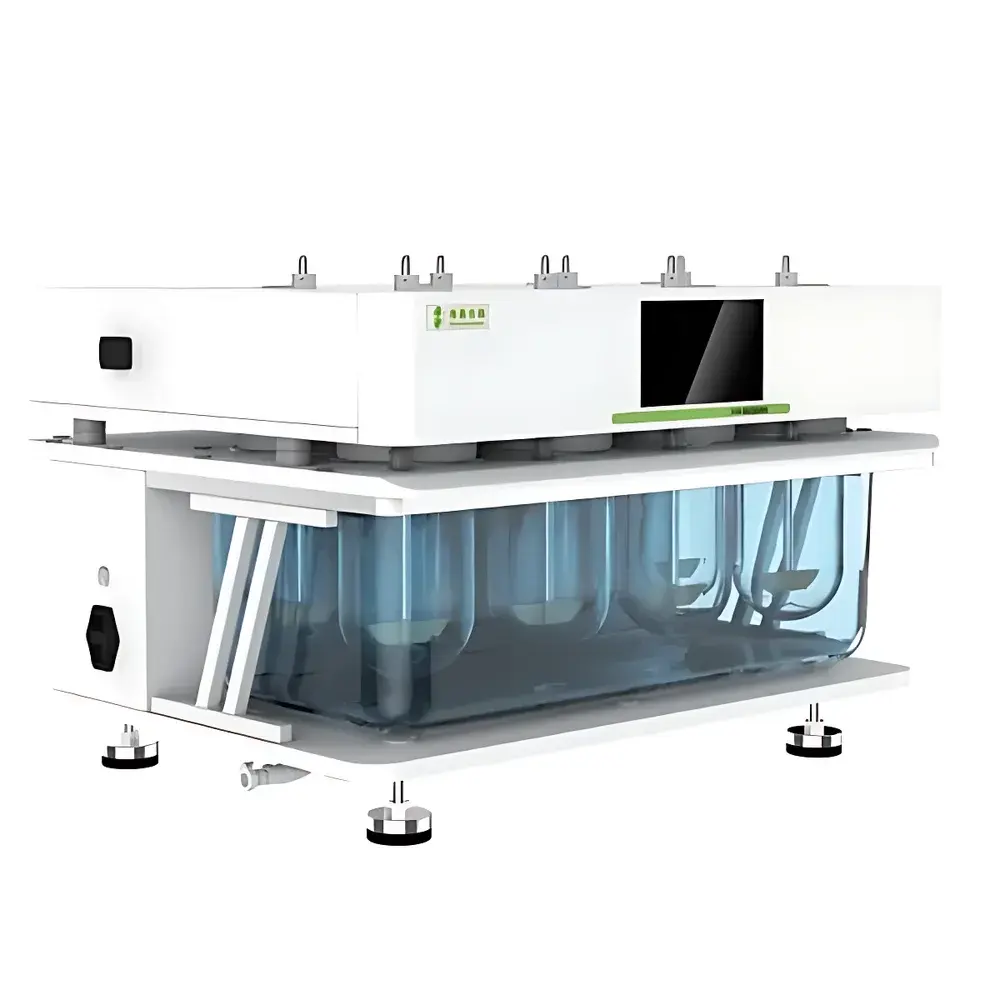
Haosoo DT06 Automated Dissolution Tester
| Brand | Haosoo |
|---|---|
| Origin | Shandong, China |
| Model | DT06 |
| Type | Offline Dissolution Tester |
| Display | 7-inch HD color touchscreen (Android OS) |
| Connectivity | USB port + Wi-Fi interface |
| Temperature Control | High-precision real-time thermostatic control with calibration function |
| Safety Features | Power-on self-test, automatic preheating, multi-level overheat protection |
| Mechanical Design | Low-profile head assembly with integrated sealed cup lid |
| Sanitation | Built-in bacteriostatic device in recirculating tubing |
| Software | Method editing, storage and recall |
| Compliance Support | Designed to support 21 CFR Part 11-compliant workflows (with optional software configuration), GLP/GMP-aligned data integrity architecture |
Overview
The Haosoo DT06 Automated Dissolution Tester is an offline, benchtop dissolution testing system engineered for pharmaceutical quality control laboratories requiring regulatory-compliant, repeatable, and operator-independent performance. It operates in accordance with the United States Pharmacopeia (USP) , European Pharmacopoeia (Ph. Eur.) 2.9.3, and Japanese Pharmacopoeia (JP) 17 methodologies—supporting both basket (Apparatus 1) and paddle (Apparatus 2) configurations. The system employs a closed-loop water bath with PID-controlled heating and integrated temperature sensors at multiple points—including vessel bottom and bath inlet/outlet—to ensure ±0.2 °C thermal stability across all 6 or 8 vessels (configurable per regional installation). Its low-profile mechanical head minimizes ambient heat loss and evaporation from dissolution media, while the fully sealed cup lid eliminates uncontrolled solvent loss during extended runs (e.g., 24–72 h delayed-release profiles).
Key Features
- Integrated sealed cup lid design reduces solvent evaporation by >95% compared to open-bath systems, ensuring consistent medium volume and drug concentration throughout test duration.
- Automatic vessel centering mechanism guarantees precise alignment of baskets/paddles within ±0.2 mm tolerance—critical for hydrodynamic reproducibility per USP requirements.
- Built-in bacteriostatic module (UV-C + silver-ion coated filter) in the recirculation loop inhibits microbial proliferation in deionized water reservoirs, eliminating biofilm formation and reducing maintenance frequency.
- Real-time temperature monitoring with NIST-traceable calibration capability allows on-site verification and adjustment without external instrumentation.
- Android-based embedded OS delivers intuitive workflow navigation, drag-and-drop method programming, and responsive touchscreen feedback—even with gloved operation.
- Multi-tiered access control supports role-based permissions (e.g., Operator, Supervisor, Administrator), enabling separation of duties for method execution, parameter modification, and audit log review.
Sample Compatibility & Compliance
The DT06 accommodates standard USP-compliant dissolution vessels (1000 mL cylindrical glass), as well as mini-vessels (250 mL) for low-dose or pediatric formulations. It supports routine use with sinkers, disc assemblies, and flow-through cells (with optional adapter kits). All mechanical components—including shafts, baskets, paddles, and vessel holders—are manufactured from 316L stainless steel and PTFE-coated hardware to prevent leaching and corrosion. The system meets ISO 9001:2015 manufacturing standards and is validated for use in environments adhering to ICH Q5C, Q7, and WHO TRS 986 Annex 5 guidelines. When deployed with validated software modules, it satisfies ALCOA+ data integrity principles and supports 21 CFR Part 11 compliance through electronic signatures, immutable audit trails, and time-stamped event logging.
Software & Data Management
The embedded dissolution software provides full lifecycle method management: creation, versioning, validation status tagging, and secure archiving. All raw sensor data—including temperature, rotation speed (±0.5 rpm accuracy), and elapsed time—is timestamped and stored locally on encrypted internal flash memory (32 GB). Wi-Fi connectivity enables seamless synchronization with LIMS or ELN platforms via HTTPS/FTP(S) protocols. Remote firmware updates are delivered over-the-air with SHA-256 signature verification. Audit logs record every user action—including login/logout, method edits, start/stop commands, and calibration events—with irreversible write-once storage. Data export formats include CSV, PDF reports (with digital signature fields), and XML-compatible structured outputs for regulatory submission.
Applications
- Immediate- and extended-release solid oral dosage form (SODF) dissolution profiling per ICH Q4B and Q5E.
- Comparative dissolution testing for generic product development and bioequivalence support studies.
- Stability-indicating dissolution assays under stressed conditions (e.g., pH-shifted media, surfactant-containing buffers).
- In-process quality control during tablet coating or granulation scale-up.
- Excipient interaction screening using discriminatory dissolution media (e.g., simulated gastric/intestinal fluids).
FAQ
Does the DT06 support Apparatus 3 (reciprocating cylinder) or Apparatus 4 (flow-through cell)?
The base configuration supports Apparatus 1 and 2 only. Apparatus 4 integration is available via optional flow-cell mounting kit and pump module (sold separately); Apparatus 3 is not supported.
Can audit trail data be exported independently of test results?
Yes—audit logs are stored in a segregated database partition and can be exported as encrypted ZIP archives containing SQLite files and cryptographic hashes for forensic verification.
Is temperature calibration traceable to national metrology institutes?
Calibration routines include prompts for reference probe input (e.g., Fluke 1523 or equivalent); users may document calibration against accredited secondary standards per ISO/IEC 17025 laboratory requirements.
What is the maximum allowable deviation for paddle wobble per USP?
The DT06’s mechanical alignment system maintains radial runout ≤0.2 mm at 100 rpm, satisfying USP limits for both basket and paddle assemblies.
How frequently must the bacteriostatic module be serviced?
UV-C lamps require replacement every 9,000 operating hours; silver-ion filters are rated for 6 months continuous use in DI water at 37 °C and should be replaced per maintenance schedule or after visible biofilm detection.






