
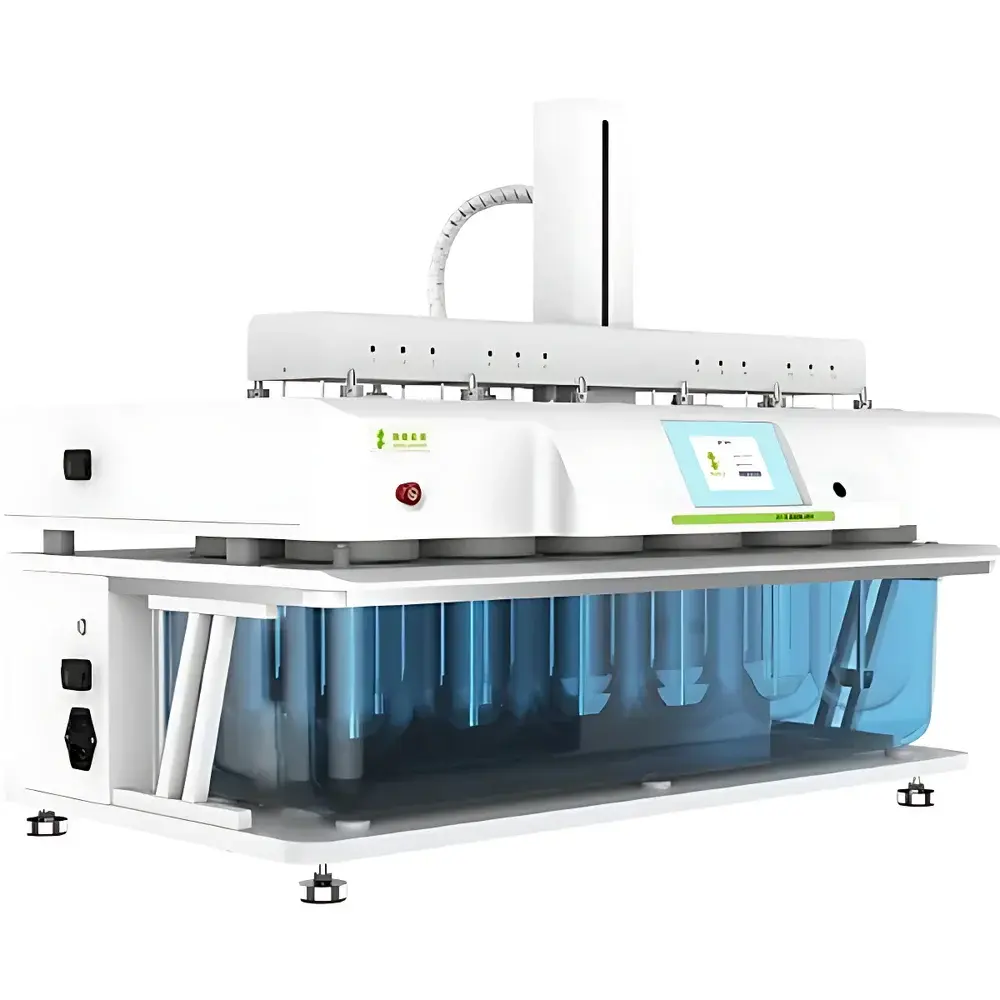
Haosoo DT12 Automated Dissolution Tester
| Brand | Haosoo |
|---|---|
| Origin | Shandong, China |
| Model | DT12 |
| Type | Offline Dissolution Tester |
| Configuration | 12-Vessel System with Dual Independent Zones (6+6) |
| Control Interface | 7-inch HD Color Touchscreen (Android OS) |
| Connectivity | USB, RS232, Wi-Fi |
| Compliance Features | Audit Trail, Multi-level User Permissions, Fingerprint Authentication |
| Safety | Emergency Stop Button, Obstruction Detection During Probe Descent, Dual Overheat Protection |
| Optional | Integrated High-Resolution Imaging Module |
| Temperature Control | Individual Vessel Real-time Monitoring with Calibration Function |
| Fluid Management | Built-in UV Sterilization in Recirculation Loop |
| Data Output | Onboard Thermal Printer, Export via USB/Network |
Overview
The Haosoo DT12 Automated Dissolution Tester is an offline, 12-vessel pharmaceutical dissolution testing system engineered for regulatory-compliant quality control and formulation development in R&D, QC, and stability laboratories. It operates on the principle of USP Apparatus 1 (basket) and Apparatus 2 (paddle), delivering precise hydrodynamic conditions under controlled temperature, rotation speed, and sampling timing. Designed to meet evolving global pharmacopeial requirements—including USP , EP 2.9.3, and JP 17—this instrument supports both synchronized and staggered dosing protocols across two independent operational zones (6+6 configuration), enabling parallel evaluation of distinct formulations or batch comparisons without cross-contamination risk. Its architecture integrates fluidic integrity, thermal uniformity, and data governance into a single platform compliant with GLP and GMP-aligned workflows.
Key Features
- Dual-zone 12-vessel configuration: Two physically isolated workspaces (6 vessels each) permit concurrent execution of separate dissolution methods with independent parameter sets—ideal for comparative bioequivalence studies or accelerated stability protocols.
- Automated dosing precision: Supports both simultaneous tablet/capsule introduction and programmable staggered dosing (e.g., delayed-release profiles), minimizing operator variability and ensuring reproducible start-time alignment per vessel.
- Per-vessel temperature monitoring and calibration: Each dissolution cup is equipped with a dedicated Pt100 sensor; real-time readings are displayed on-screen with traceable offset correction capability—critical for maintaining ±0.2 °C uniformity per USP requirements.
- Integrated UV-C sterilization module: Positioned within the recirculating water bath loop, this feature continuously suppresses microbial proliferation in the heating medium, reducing maintenance frequency and eliminating thermal drift caused by biofilm formation.
- Comprehensive safety architecture: Includes hardware-based emergency stop, obstruction-sensing descent logic for the vessel head assembly, redundant overtemperature cutoffs, and automatic liquid level verification prior to test initiation.
- Regulatory-grade data integrity: Implements full audit trail logging (user actions, parameter changes, method edits), role-based access control (administrator, analyst, reviewer), and biometric fingerprint authentication—all aligned with FDA 21 CFR Part 11 expectations for electronic records.
Sample Compatibility & Compliance
The DT12 accommodates standard USP-compliant dissolution vessels (1000 mL, 900 mL, or 500 mL), baskets, paddles, sinkers, and flow-through cells (with optional adapter kits). It supports solid oral dosage forms including immediate-release tablets, extended-release capsules, orally disintegrating tablets (ODTs), and multiparticulate systems. All mechanical components conform to ISO 9001-certified manufacturing practices. The system’s firmware and embedded software undergo periodic validation support documentation packages, facilitating IQ/OQ execution. Regulatory documentation—including design qualification summaries, traceability matrices, and cybersecurity risk assessments—is available upon request for audit readiness.
Software & Data Management
Running on a certified Android OS kernel, the DT12’s onboard software provides intuitive method creation, version-controlled storage (up to 500 methods), and one-touch printout via integrated thermal printer. Data export is supported via USB mass storage mode or network transfer (SFTP/HTTP POST) to LIMS or ELN platforms. Wi-Fi connectivity enables remote firmware updates, centralized method distribution, and secure cloud synchronization of test logs. Raw time-series dissolution data (time, % dissolved, temperature, rpm) is stored in CSV and XML formats with embedded metadata (operator ID, timestamp, method ID, instrument serial number), ensuring full traceability from acquisition to reporting.
Applications
- QC release testing of generic and innovator drug products against pharmacopeial specifications.
- Formulation optimization during preclinical and clinical development phases.
- Stability-indicating dissolution profiling under stressed conditions (e.g., pH-shift, surfactant variation).
- Comparative dissolution modeling for biowaivers (BCS Class I/III) per ICH Q5A(R2) and FDA guidance.
- Investigation of excipient–API interactions affecting release kinetics.
- Support for ANDA submissions requiring full dissolution dataset archiving and reanalysis capability.
FAQ
Does the DT12 comply with 21 CFR Part 11 requirements?
Yes—the system implements electronic signature enforcement, audit trail retention (minimum 18 months), and immutable record generation for all critical events.
Can the instrument be validated for GMP use?
Yes—Haosoo provides IQ/OQ protocol templates, factory calibration certificates, and URS-mapped verification reports for seamless integration into regulated environments.
Is third-party software integration supported?
Yes—via standardized RS232 and TCP/IP interfaces, the DT12 interoperates with common LIMS (e.g., LabVantage, Thermo SampleManager) and statistical analysis tools (e.g., JMP, Unscrambler).
What maintenance intervals are recommended for the UV sterilization module?
The UV-C lamp requires replacement every 9,000 operating hours; system diagnostics include lamp life tracking and predictive alerts.
How is temperature uniformity verified across all 12 vessels?
A calibrated NIST-traceable probe is used during installation qualification; routine performance checks follow ASTM E2500-13 guidelines using a multi-point thermistor array.
Related Products






