
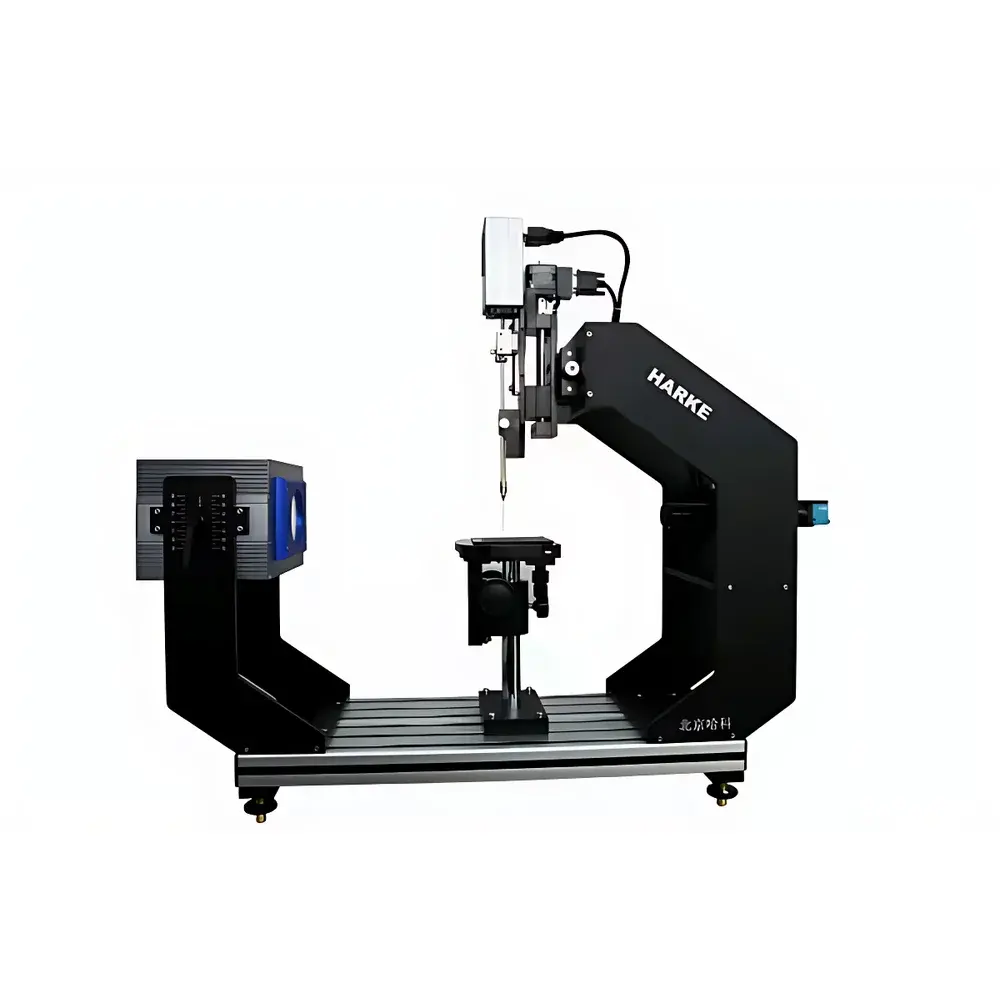
HARKE HARKE-OCPC Video-Based Optical Contact Angle Analyzer
| Brand | HARKE |
|---|---|
| Model | HARKE-OCPC |
| Origin | Beijing, China |
| Manufacturer Type | Direct Manufacturer |
| Instrument Category | Domestic |
| Instrument Type | Benchtop Laboratory System |
| Contact Angle Measurement Range | 0–180° |
| Contact Angle Accuracy | ±0.1° |
| Sample Stage Dimensions | 100 mm × 120 mm |
| Optical Magnification | 0.7×–4.5× |
| Surface/Interfacial Tension Range | 0–1000 mN/m |
| Surface/Interfacial Tension Resolution | 0.01 mN/m |
| Imaging System | USB 3.0 High-Speed Camera (30 fps standard |
| Software | SPCA 1.0 |
| Measurement Methods | Sessile Drop, Tilting Plate (Roll-Off Angle), Pendant Drop, Oscillating Drop, Circle/Ellipse/Height-Width Fitting, and 8+ algorithmic models |
| Stage Positioning Accuracy | ±0.1 mm |
| Syringe Translation Travel | 30 mm |
| Lens Vertical Travel | 30 mm |
| Power Supply | 220 V, 3 A, 50 Hz |
| Operating Temperature | Ambient |
| Weight | 30 kg |
| Footprint | 300 mm × 760 mm |
Overview
The HARKE HARKE-OCPC Video-Based Optical Contact Angle Analyzer is an engineered benchtop instrument designed for quantitative characterization of solid-liquid-gas interfacial interactions. It operates on the sessile drop method — a standardized optical technique in which a precisely dispensed liquid droplet is deposited onto a flat, homogeneous solid substrate, and its two-dimensional silhouette is captured via high-resolution imaging. The system applies advanced digital image processing algorithms to extract the droplet profile, then computes the contact angle θ at the three-phase boundary line using geometric fitting models (e.g., circle, ellipse, or Young-Laplace-based axisymmetric contour fitting). This principle enables direct, non-invasive measurement of static and dynamic contact angles, roll-off angles, surface free energy components (via Owens-Wendt, Wu, or van Oss-Chaudhury-Good models), and interfacial tension parameters. The instrument conforms to internationally recognized test frameworks including ASTM D7334 (surface energy of polymer films), ISO 19403 (contact angle measurement), and ISO 1409 (interfacial tension of polymer solutions), supporting GLP-compliant documentation workflows when integrated with audit-trail-enabled software configurations.
Key Features
- Benchtop modular architecture with rigid aluminum alloy frame and vibration-damped optical baseplate for stable micro-scale imaging
- Motorized precision syringe pump with ±0.1 mm linear positioning accuracy and programmable dispensing volume control (0.1–10 µL increments)
- Manually adjustable or software-controlled high-magnification zoom lens (0.7×–4.5×) with parfocal design and calibrated scale bar overlay
- USB 3.0 industrial CMOS camera delivering real-time 30 fps acquisition (optional high-speed modules: 100/300/1000 fps) for dynamic wetting kinetics analysis
- SPCA 1.0 analytical software featuring automated baseline detection, multi-method contact angle fitting (8+ algorithms), and real-time video replay with frame-accurate timestamping
- Integrated environmental enclosure compatibility (optional) for controlled humidity/temperature testing per ISO 291 and ASTM E171
- Export-ready data output in CSV, TXT, PDF, and XML formats; supports batch report generation with customizable templates aligned to internal QA/QC or regulatory submission requirements
Sample Compatibility & Compliance
The HARKE-OCPC accommodates rigid and flexible planar samples up to 100 mm × 120 mm in footprint and ≤25 mm in thickness, including polymers, metals, ceramics, coated substrates, thin films, and porous membranes. Its open-stage configuration permits rapid sample exchange and integration with external stimuli (e.g., temperature stages, gas purging manifolds, or electrochemical cells). All measurement protocols align with ISO 19403-2:2017 (static contact angle), ISO 19403-3:2017 (dynamic contact angle), and ASTM D5725 (surface wettability of paper and board). When configured with SPCA 1.0’s enhanced security module, the system supports 21 CFR Part 11-compliant electronic signatures, user-level access control, and immutable audit trails — fulfilling requirements for pharmaceutical QC labs operating under GMP/GLP environments.
Software & Data Management
SPCA 1.0 is a Windows-based application developed specifically for interfacial metrology. It provides synchronized hardware control (camera trigger, motorized stage, syringe actuation), real-time image enhancement (contrast normalization, noise suppression, edge sharpening), and physics-based droplet contour modeling. Users may select from eight validated fitting methods — including circle, ellipse, height-width, Young-Laplace iterative fitting, and polynomial spline approximation — each with uncertainty estimation. The software logs all acquisition parameters (exposure time, magnification, ambient temperature/humidity if sensor-integrated), raw images, processed contours, and calculated values in a structured SQLite database. Export functions include automated generation of summary reports compliant with ISO/IEC 17025 documentation standards, with metadata embedding for traceability.
Applications
- Surface energy quantification of packaging films, biomedical implants, and functional coatings
- Quality assurance of hydrophobic/hydrophilic surface treatments in semiconductor wafer fabrication
- Development and validation of anti-fouling, self-cleaning, or oleophobic materials
- Adsorption kinetics monitoring on activated carbon, MOFs, or ion-exchange resins
- Interfacial rheology assessment of surfactant-laden oil-water systems via oscillating pendant drop analysis
- Wettability screening of battery separator membranes and electrode coatings in energy storage R&D
- Regulatory testing of medical device surface biocompatibility per ISO 10993-6
FAQ
What contact angle measurement methods does the HARKE-OCPC support?
It supports sessile drop (static/dynamic), tilting plate (roll-off angle), pendant drop (surface/interfacial tension), oscillating drop (interfacial viscoelasticity), and captive bubble methods — all accessible via SPCA 1.0’s unified interface.
Is the system compatible with automated production-line integration?
Yes — optional TTL-trigger I/O ports and Modbus TCP communication enable synchronization with PLC-controlled conveyor systems for inline QC inspection of coated substrates or molded parts.
Can the instrument measure surface energy components (dispersive/polar)?
Yes — SPCA 1.0 includes built-in models (Owens-Wendt, Wu, van Oss-Chaudhury-Good) requiring input of at least two probe liquids with known surface tension components.
Does the software support FDA 21 CFR Part 11 compliance?
When deployed with the SPCA 1.0 Security Pack (separate license), it delivers electronic signature capability, role-based permissions, and full audit trail logging — meeting core Part 11 requirements for regulated laboratories.
What is the minimum detectable change in contact angle?
With optimized lighting and sub-pixel edge detection, the system achieves repeatability of ±0.1° under controlled lab conditions (ISO 19403-4:2017), with typical standard deviation <0.3° across n=10 repeated measurements on homogeneous surfaces.



