
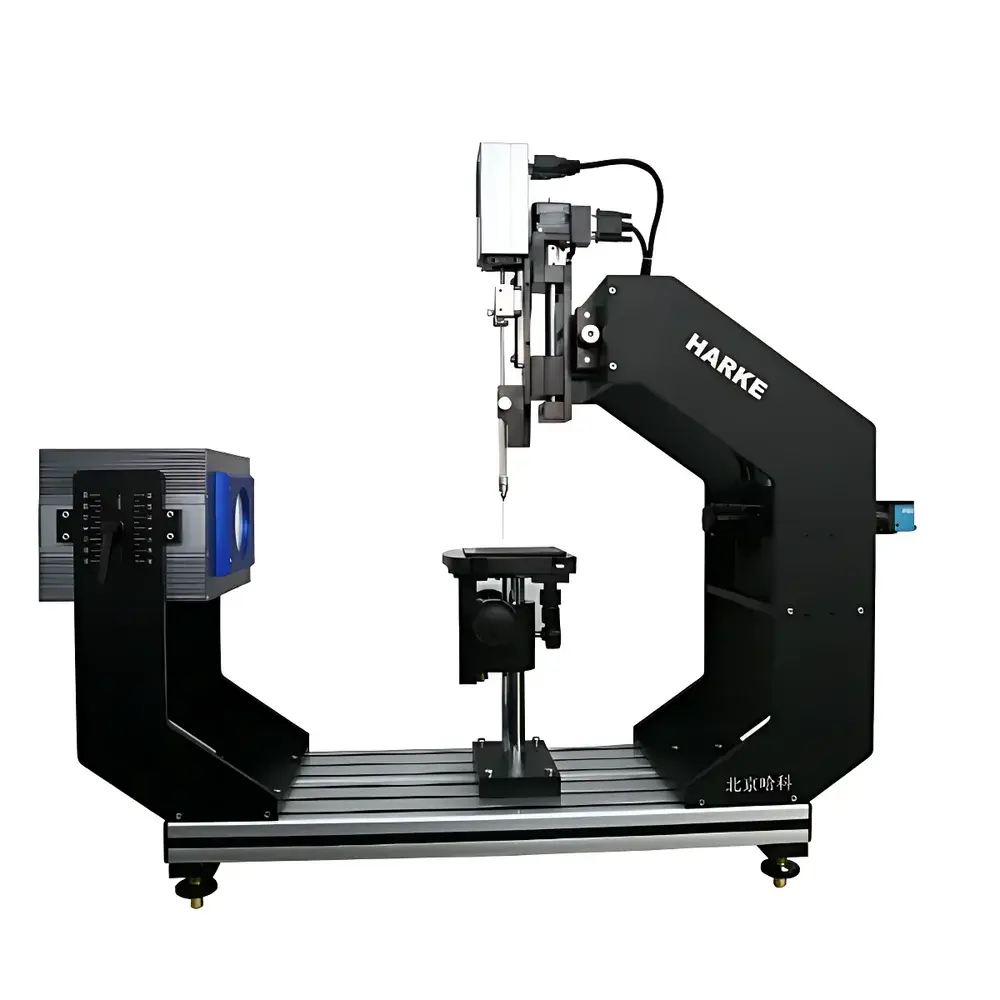
HARKE HARKE-SPCAX Video Optical Contact Angle Analyzer for Wafer Surface Characterization
| Brand | HARKE |
|---|---|
| Origin | Beijing, China |
| Manufacturer Type | Direct Manufacturer |
| Instrument Category | Domestic |
| Model | HARKE-SPCAX |
| Instrument Kind | Video Optical Contact Angle Analyzer |
| Instrument Type | Benchtop Laboratory System |
| Contact Angle Measurement Range | 0–180° |
| Contact Angle Measurement Accuracy | ±0.5° |
| Fixed Sample Stage Dimensions | 100 mm × 120 mm |
| Image Magnification | 0.7×–4.5× |
| Surface/Interfacial Tension Measurement Range | 0–1000 mN/m |
| Surface/Interfacial Tension Measurement Accuracy | ±0.01 mN/m |
| Contact Angle Resolution | 0.1° |
Overview
The HARKE HARKE-SPCAX Video Optical Contact Angle Analyzer is a precision benchtop instrument engineered for quantitative characterization of solid–liquid–gas interfacial behavior on planar and microstructured substrates—including silicon wafers, photomasks, thin-film coated glass, and semiconductor packaging materials. It operates on the principle of optical contour analysis: high-resolution side-view or top-view imaging captures the sessile drop profile at the three-phase contact line, and advanced edge-detection algorithms compute the contact angle (θ) via Young–Laplace fitting or tangent-based geometric methods. The system supports static, advancing/receding, dynamic, and immersion-mode measurements—enabling rigorous assessment of surface wettability, heterogeneity, contamination, and functional coating uniformity under controlled environmental conditions. Designed specifically for cleanroom-compatible integration, its rigid aerospace-grade aluminum frame, vibration-damped optical path, and sealed LED illumination ensure long-term measurement stability and repeatability across production QA/QC and R&D workflows.
Key Features
- Benchtop modular architecture with CNC-machined aviation aluminum chassis for thermal and mechanical stability
- Motorized XYZ translation stage (±60 mm vertical, ±30 mm horizontal, ±3 mm fine-focus depth adjustment) enabling precise positioning over wafer-scale substrates
- Telecentric zoom lens (0.7×–4.5× continuous magnification) with parallax-free imaging—optimized for sub-millimeter droplet resolution on reflective or low-contrast surfaces
- High-speed industrial CMOS sensor (≥120 fps at full resolution) synchronized with programmable dispensing unit for time-resolved contact angle kinetics
- Adjustable monochromatic blue LED cold light source (peak λ = 450 nm, >25,000 h lifetime) minimizing thermal drift and sample heating during prolonged acquisition
- Automated syringe pump module with sub-µL dispensing precision for repeatable droplet volume control (0.1–10 µL range)
- Multi-angle viewing capability: tilt-adjustable lens mount supports oblique, orthogonal, and inverted configurations for complex geometry analysis
Sample Compatibility & Compliance
The HARKE-SPCAX accommodates standard 100 mm × 120 mm fixed-stage samples—compatible with 100 mm, 150 mm, and 200 mm semiconductor wafers when used with optional vacuum chucks or kinematic mounts. Its non-contact optical methodology ensures zero sample damage, making it suitable for post-lithography, post-etch, and post-CMP surface evaluation. The system complies with ASTM D7334–22 (Standard Practice for Surface Wettability Assessment), ISO 19403-2:2017 (Contact angle measurement by optical methods), and supports GLP/GMP-aligned data integrity through timestamped image capture, operator ID logging, and audit-trail-enabled configuration history. All firmware and calibration routines are traceable to NIST-certified reference standards for contact angle (e.g., PTFE, silicon wafer, borosilicate glass).
Software & Data Management
Equipped with HARKE AnalyzePro™ v4.2 software, the analyzer delivers fully automated image processing, real-time curve fitting, and multi-parameter export (CSV, XML, PDF). The software implements ISO-compliant baseline detection algorithms, supports dual-curve fitting for asymmetric drops, and integrates Young–Dupré equation solvers for surface free energy decomposition (Owens–Wendt, Wu, van Oss–Chaudhury–Good models). Raw images and metadata—including environmental temperature/humidity logs, dispensing parameters, and motor position coordinates—are stored in a relational SQLite database. Export modules comply with FDA 21 CFR Part 11 requirements for electronic records and signatures, including user authentication, electronic signature capture, and immutable audit trails for regulatory submissions.
Applications
- Quantitative evaluation of hydrophobic/hydrophilic patterning fidelity in photolithography and self-assembled monolayer (SAM) processes
- In-line monitoring of cleaning efficacy (e.g., RCA SC-1/SC-2 residue removal) via contact angle hysteresis reduction
- Surface energy mapping of ALD/CVD-deposited dielectrics (SiO₂, SiNₓ, HfO₂) to correlate with adhesion performance in bonding steps
- Dynamic contact angle analysis during spin-coating or inkjet deposition to model precursor film formation and dewetting onset
- Interfacial tension quantification of photoresist developers and etchants using pendant drop method—supporting formulation optimization
- Assessment of anti-reflective coating (ARC) and hard mask layer uniformity through spatially resolved contact angle gradients
- Validation of plasma treatment parameters (O₂, CF₄, NH₃) by tracking polar component evolution in surface energy decomposition
FAQ
What wafer sizes can be directly accommodated without custom fixtures?
Standard operation supports flat samples up to 100 mm × 120 mm; 150 mm and 200 mm wafers require optional vacuum chuck kits with centering alignment pins.
Does the system support automated batch measurement across multiple wafer positions?
Yes—via programmable stage scripting in AnalyzePro™, users define coordinate grids and execute unattended multi-point acquisition with auto-focus and auto-lighting compensation.
Can surface free energy components be exported in machine-readable format for statistical process control (SPC)?
All calculated parameters—including dispersive, polar, and acid–base surface energy terms—are exportable as time-stamped CSV files compatible with JMP, Minitab, and Python pandas workflows.
Is the optical path compatible with nitrogen-purged or glovebox environments?
The base instrument features sealed optical housing and external cable ports; optional inert-gas purge adapters and glovebox feedthrough mounts are available upon request.
How is calibration verified between operational shifts?
Built-in calibration mode uses certified reference slides (contact angles: 10°, 65°, 110°, 145°) with automated validation reporting and pass/fail flagging per ISO 19403-4.



