
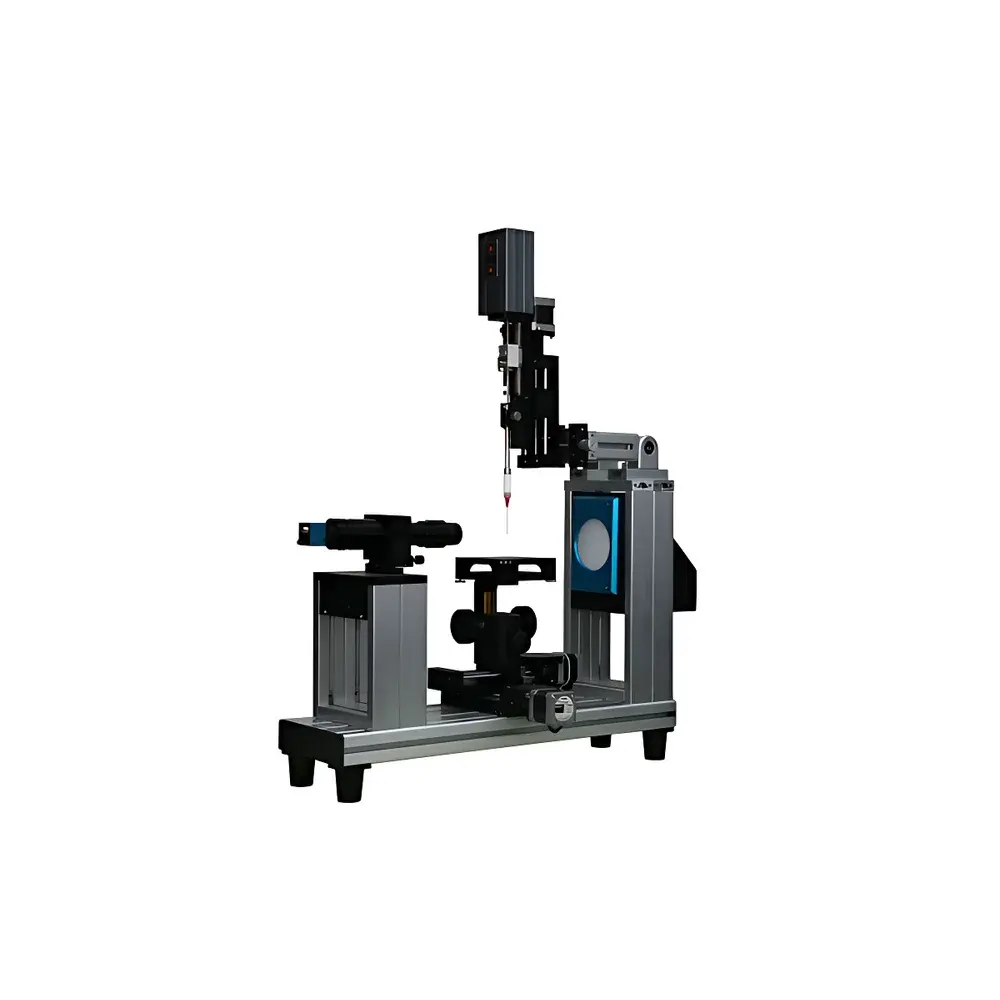
HARKE HK-20 Video-Based Optical Contact Angle Analyzer
| Brand | HARKE |
|---|---|
| Origin | Beijing, China |
| Manufacturer Type | Direct Manufacturer |
| Instrument Category | Domestic |
| Model | HK-20 |
| Instrument Type | Benchtop Laboratory System |
| Contact Angle Measurement Range | 0–180° |
| Contact Angle Measurement Accuracy | ±0.1° |
| Fixed Sample Stage Dimensions | 100 × 100 mm |
| Optical Magnification | 0.5×–0.7× (stepped zoom lens) |
| Surface/Interfacial Tension Measurement Range | 0–1000 mN/m |
| Surface/Interfacial Tension Measurement Resolution | 0.01 mN/m |
| Imaging Frame Rate | Up to 1000 fps (optional) |
| Software | HKCA20 v4.x |
| Measurement Methods | Sessile Drop, Captive Bubble, Immersion, Tilting Plate, Expansion–Contraction, Rolling-off, Elliptical Fitting, Circular Fitting, and Advanced Dynamic Analysis Modules |
Overview
The HARKE HK-20 is a high-precision, benchtop video-based optical contact angle analyzer engineered for quantitative characterization of solid–liquid interfacial behavior. It operates on the principle of digital image acquisition and geometric contour analysis of sessile or captive liquid drops, enabling non-invasive, real-time measurement of contact angle, surface free energy, and interfacial tension. Designed for rigorous laboratory environments, the HK-20 implements advanced optical metrology—including a stepped magnification lens (0.5×–0.7×), USB3.0 high-speed camera (standard 40 fps; optional up to 1000 fps), and sub-pixel edge detection algorithms—to ensure reproducible measurements across heterogeneous, anisotropic, or low-energy surfaces. Its architecture supports both static and dynamic interfacial analysis, including advancing/receding angles, roll-off angles, and time-resolved wetting kinetics—critical for evaluating hydrophobicity, coating uniformity, membrane wettability, and inkjet printability.
Key Features
- Benchtop modular design with rigid aluminum frame and vibration-damped optical baseplate for stable imaging under ambient lab conditions
- Motorized XYZ stage with ±0.1 mm positioning repeatability and 60 mm vertical syringe travel for precise droplet placement
- Automated drop dispensing system with programmable volume, speed, and dwell control to minimize perturbation during deposition
- Real-time image acquisition and on-the-fly analysis: automatic baseline recognition, dynamic contour fitting (circular, elliptical, polynomial, and Young–Laplace models), and synchronized parameter logging
- Multi-method measurement suite: sessile drop, captive bubble, immersion, tilting plate, expansion–contraction, and rolling-off protocols—all software-selectable and scriptable
- Integrated surface free energy calculation using Owens–Wendt, Wu, Fowkes, van Oss–Chaudhury–Good (vOCG), and Acid–Base models with user-defined reference liquids
- Compliant with ISO 19403-2:2017 (Contact angle measurement — Part 2: Static contact angle) and ASTM D7334-22 (Standard Practice for Surface Energy Analysis of Polymer Surfaces by Contact Angle Measurement)
Sample Compatibility & Compliance
The HK-20 accommodates diverse sample geometries and material classes without modification: flat substrates (glass, silicon wafers, metals), flexible films (PET, PE, PVDF), porous media (filter paper, nonwovens), fibers (single or bundled), powders (via compressed pellets or powder bed methods), and textured or patterned surfaces. Its 100 × 100 mm fixed stage supports standard petri dishes, microscope slides, and custom fixtures. All measurement workflows adhere to GLP-aligned data integrity principles: audit-trail-enabled software (HKCA20 v4.x) records operator ID, timestamp, instrument configuration, raw image files, and analysis parameters. The system supports 21 CFR Part 11-compliant electronic signatures and data export in CSV, PNG, TIFF, and XML formats for traceability in regulated QC/QA environments.
Software & Data Management
The HKCA20 software platform provides a unified interface for instrument control, image processing, statistical reporting, and method validation. It features batch processing for multi-sample sequences, customizable report templates (PDF/Excel), and embedded uncertainty estimation per IUPAC guidelines. Data management includes version-controlled method libraries, automated calibration logging (stage offset, lens distortion, pixel-to-mm conversion), and export-ready metadata compliant with FAIR principles (Findable, Accessible, Interoperable, Reusable). Optional modules enable time-series curve fitting (e.g., Washburn analysis for capillary rise), contact angle hysteresis quantification, and surface heterogeneity mapping via localized drop analysis.
Applications
The HK-20 serves as a core analytical tool across R&D and quality control domains: evaluation of anti-fouling coatings in biomedical devices; optimization of hydrophilic/hydrophobic balance in packaging films (ISO 8296, ASTM D2578); characterization of electrode wettability in battery electrolyte development; surface energy profiling of polymer composites prior to adhesive bonding; assessment of fiber wettability in textile finishing; and validation of cleaning efficacy on semiconductor wafers. It is routinely deployed in academic laboratories studying colloidal stability, Pickering emulsions, and surfactant adsorption kinetics—where interfacial thermodynamics directly govern macroscopic performance.
FAQ
What measurement methods does the HK-20 support?
Sessile drop, captive bubble, immersion, tilting plate, expansion–contraction, rolling-off, and dynamic contact angle (advancing/receding/sliding angles) — all selectable within the HKCA20 software.
Can the system measure surface free energy?
Yes — using multiple theoretical models (Owens–Wendt, Wu, Fowkes, vOCG, Acid–Base) with user-loaded reference liquid databases and automatic dispersion/polar component decomposition.
Is the software compliant with regulatory requirements for pharmaceutical or medical device testing?
HKCA20 v4.x supports 21 CFR Part 11-compliant audit trails, electronic signatures, and secure user access levels — validated for use in GMP/GLP environments per internal IQ/OQ documentation.
What is the maximum frame rate available for dynamic contact angle studies?
Standard configuration: 40 fps via USB3.0; optional high-speed modules deliver 100 fps, 300 fps, or up to 1000 fps with region-of-interest cropping for ultrafast wetting events.
Does the instrument support interfacial tension measurement?
Yes — via pendant drop analysis (Young–Laplace fitting) for liquid–liquid systems, covering 0–1000 mN/m with 0.01 mN/m resolution and temperature-stabilized sample environment options.



