
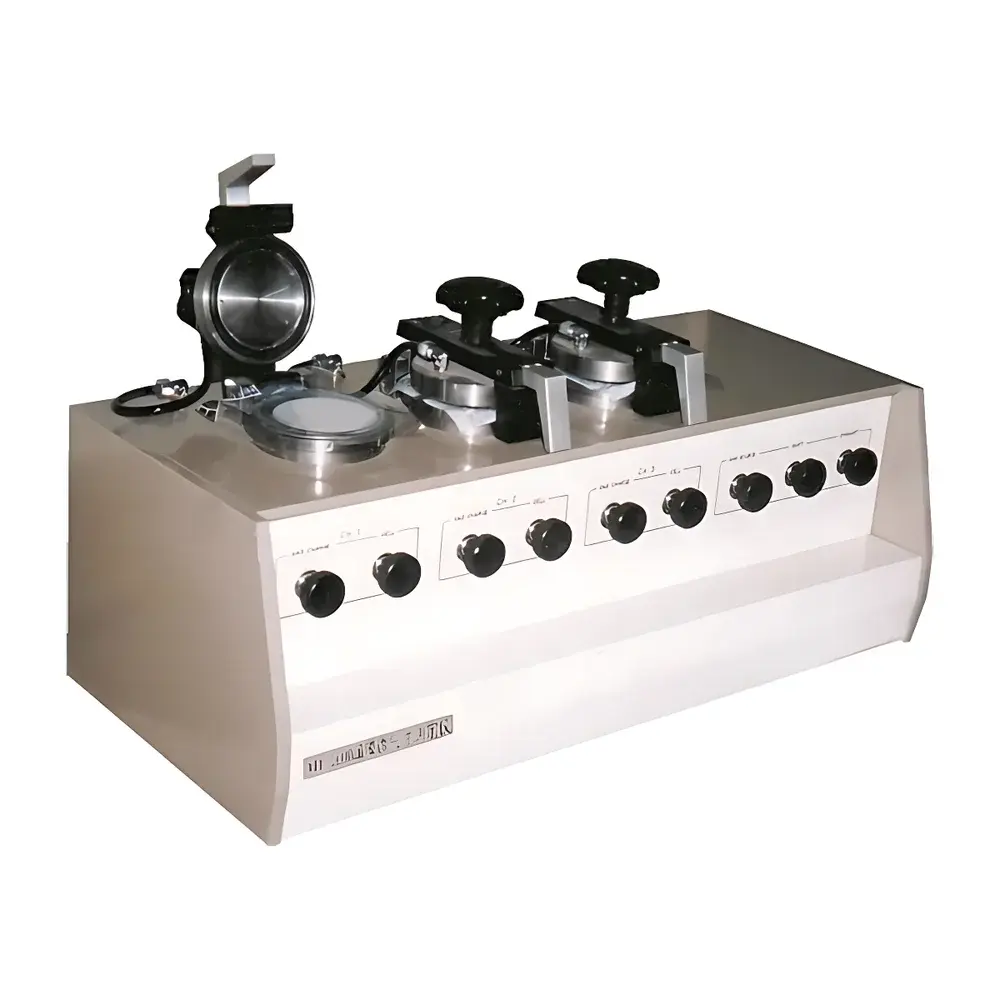
HARKE HK-701M Vacuum-Pressure Differential Gas Permeability Analyzer
| Brand | HARKE |
|---|---|
| Origin | Beijing, China |
| Manufacturer Type | OEM Manufacturer |
| Model | HK-701M |
| Measurement Principle | Vacuum-Pressure Differential Method |
| Test Gases | O₂, CO₂, N₂, Air, He, H₂, CH₄, C₃H₈, C₄H₁₀, NH₃ |
| Test Range | 0.01–150,000 cm³/m²·24h·0.1MPa |
| Resolution | 0.001 cm³/m²·24h·0.1MPa |
| Sample Capacity | 1–3 independent chambers |
| Vacuum Resolution | 0.1 Pa |
| Temperature Control Range | 5–95 °C |
| Temperature Accuracy | ±0.1 °C |
| Humidity Control Range (optional) | 0%RH, 2–98.5%RH, 100%RH |
| Humidity Accuracy | ±1%RH |
| Max Sample Thickness | ≤5 mm |
| Sample Area | 48 cm² |
| Sample Dimensions | ≥150 mm × 94 mm or circular |
| Test Pressure Range | −0.1 to +0.1 MPa |
| Gas Supply Pressure | 0.3–1.0 MPa |
| Gas Inlet Port | Ø8 mm |
| Dimensions (L×W×H) | 730 × 510 × 350 mm |
| Weight | 63 kg |
| Compliance | GB/T 1038–2000, ISO 15105-1, ISO 2556, ASTM D1434, JIS K 7126-1, YBB 00082003 |
Overview
The HARKE HK-701M is a high-precision vacuum-pressure differential gas permeability analyzer engineered for quantitative determination of gas transmission rates—including oxygen transmission rate (OTR), carbon dioxide transmission rate (CO₂TR), nitrogen transmission rate (NTR), and air permeability—across flexible and rigid packaging materials under controlled temperature and humidity conditions. It operates on the fundamental principle of pressure differential measurement in a vacuum-based test chamber: one side of the specimen is exposed to a defined test gas at atmospheric or regulated pressure, while the other side is maintained under high vacuum. The transient pressure rise on the vacuum side is measured via high-stability absolute pressure transducers, enabling direct calculation of gas permeation flux based on ideal gas law and Fick’s first law of diffusion. This method delivers traceable, reproducible results compliant with internationally recognized standards for barrier property evaluation in regulated industries.
Key Features
- Triple independent test chambers with fully decoupled thermal control—each equipped with dedicated Pt100 RTD sensors and PID-regulated water bath circulation for ±0.1 °C temperature stability across 5–95 °C.
- Ultra-high-resolution vacuum sensing (0.1 Pa resolution) using calibrated capacitance manometers, ensuring accurate quantification of low-flux permeation in ultra-high-barrier films (e.g., AlOx-coated PET, SiOx-laminates, metallized foils).
- Modular gas delivery architecture with original-imported solenoid valves, stainless-steel tubing, and precision pressure regulators—designed to minimize dead volume and eliminate adsorption artifacts during He, H₂, or NH₃ testing.
- Embedded Linux-based controller with remote firmware update capability, real-time system diagnostics, and dual-mode operation (local touchscreen + PC-hosted software interface).
- Comprehensive parameter logging: synchronized time-series acquisition of vacuum pressure, chamber temperature, relative humidity (with optional humidity generator), and differential pressure—exportable as CSV or binary archives with nanosecond timestamping.
- FDA 21 CFR Part 11–ready software architecture featuring 5-tier user role management (Administrator, QA Manager, Lab Technician, Reviewer, Auditor), electronic signatures, and immutable audit trails for all method changes, calibration events, and result approvals.
Sample Compatibility & Compliance
The HK-701M accommodates a broad spectrum of planar specimens up to 5 mm thick and 48 cm² effective area—including multilayer coextrusions (e.g., EVOH/PET/PE), cold-form blister foils, pharmaceutical PVC/PVDC lidding, battery separator membranes (e.g., PE/PP microporous films), aerospace-grade polyimide laminates, and enzymatically degradable PHA/PLA blends. Its mechanical clamping system ensures uniform sealing without edge creep or radial stress distortion. All test protocols align with regulatory requirements for packaging validation: GB/T 1038–2000 (China), ISO 15105-1 (gas transmission through plastic film and sheeting), ISO 2556 (determination of gas transmission rate under atmospheric pressure), ASTM D1434 (standard test method for determining gas permeability characteristics), JIS K 7126-1 (Japanese Industrial Standard), and YBB 00082003 (Chinese Pharmacopoeia packaging guidance). Data integrity meets GLP/GMP documentation expectations for QC release testing and stability program support.
Software & Data Management
HARKE PermeaSoft™ v5.2 provides full lifecycle data governance—from method creation and instrument calibration (vacuum zero, standard membrane verification per ISO 15105-2) to statistical analysis and regulatory reporting. The software supports multi-curve overlay (pressure vs. time, temperature vs. OTR, RH vs. diffusion coefficient), non-linear regression fitting for Arrhenius activation energy estimation, and automated derivation of permeability (P), diffusivity (D), and solubility (S) coefficients via the P = D × S relationship. Raw datasets include embedded metadata (operator ID, environmental log, sensor serial numbers, firmware revision). Optional integration with DSM Laboratory Data Management System (sold separately) enables centralized monitoring across multiple HK-701M units, SPC charting, deviation investigation workflows, and automated report distribution to LIMS or ERP platforms.
Applications
- Pharmaceutical packaging: Quantifying OTR of blister cavities, sachets, and vial stoppers to ensure shelf-life prediction per ICH Q5C guidelines.
- Food packaging R&D: Benchmarking barrier performance of biopolymer films under accelerated aging conditions (e.g., 40 °C/75%RH).
- Battery materials: Measuring helium permeation through lithium-ion battery separators to assess pore structure integrity and thermal shutdown safety margins.
- Medical device packaging: Validating microbial barrier efficacy of Tyvek®/PET pouches per ISO 11607-1.
- Aerospace composites: Evaluating outgassing profiles of polymeric matrix resins under vacuum exposure for satellite component qualification (ECSS-Q-ST-70-02C).
- Sustainable packaging: Correlating CO₂TR of compostable films with degradation kinetics under controlled humidity cycles.
FAQ
What gases can be tested on the HK-701M?
Standard configurations support O₂, N₂, CO₂, air, He, H₂, CH₄, C₃H₈, C₄H₁₀, and NH₃. Custom gas modules are available upon request for specialty applications requiring trace-level detection or reactive gas handling.
Is humidity control included in the base system?
No. Relative humidity control (2–98.5%RH, ±1%RH accuracy) requires the optional humidity generation module, which integrates vapor-saturated carrier gas blending with inline dew-point monitoring.
Can the instrument perform simultaneous multi-gas testing?
No. Each test run is gas-specific due to sensor selectivity and calibration traceability requirements. However, sequential automated testing across three chambers allows rapid throughput for comparative studies.
How is calibration traceability ensured?
Vacuum sensors are factory-calibrated against NIST-traceable barometric standards; gas flow paths are verified using certified reference membranes (e.g., PMMA or cellulose acetate standards per ISO 15105-2). Full calibration records—including uncertainty budgets—are stored within the software audit trail.
Does the system support 21 CFR Part 11 compliance out-of-the-box?
Yes. With enabled user roles, electronic signature prompts, and disabled local data deletion privileges, the HK-701M meets core technical requirements for Part 11 compliance. Site-specific validation documentation (IQ/OQ/PQ) is provided upon installation.





