
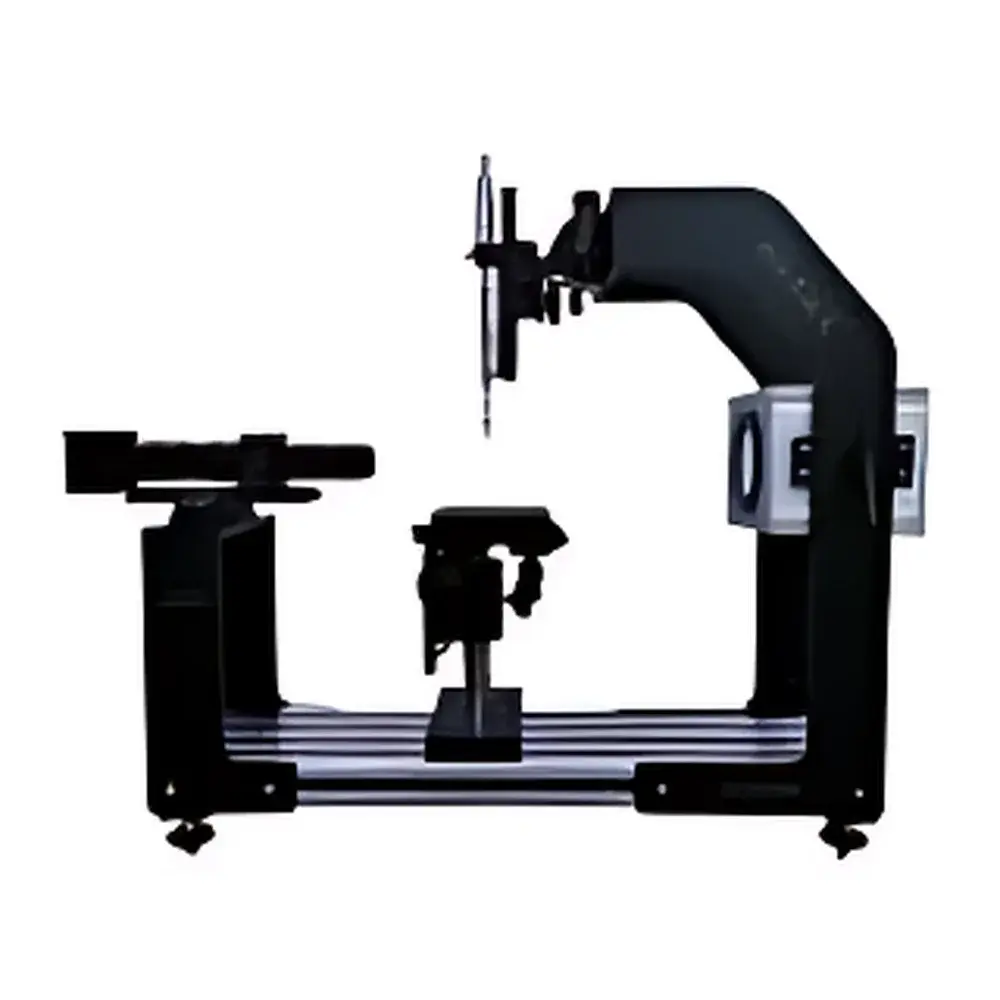
HARKE HK-SPCA-1 Advanced Dynamic Contact Angle Analyzer
| Brand | HARKE |
|---|---|
| Model | HK-SPCA-1 |
| Origin | Beijing, China |
| Manufacturer Type | Direct Manufacturer |
| Instrument Category | Domestic |
| Instrument Type | Benchtop Laboratory System |
| Contact Angle Measurement Range | 0–180° |
| Contact Angle Measurement Accuracy | ±0.1° |
| Contact Angle Display Resolution | 0.01° |
| Sample Stage Dimensions | 400 mm × 400 mm |
| Optical Zoom Magnification | 0.7×–4.5× |
| Surface/Interfacial Tension Measurement Range | 0–1000 mN/m |
| Surface/Interfacial Tension Accuracy | ±0.01 mN/m |
| Imaging System | USB 2.0 High-Speed Camera (30 fps standard |
| Lens Travel | 120 mm |
| Dimensions (W×D×H) | 260 mm × 700 mm × — mm |
| Weight | ~30 kg |
| Power Supply | 220 V / 3 A / 50 Hz |
| Operating Temperature | Ambient |
| Surface Energy Calculation Method | Equation of State (EOS) |
| Fitting Algorithms | Circle, Ellipse, Young-Laplace, Sessile Drop, Captive Bubble, Tilting Plate |
| Tension Method | Pendant Drop |
| Software Version | HARKE-SPCA 1.0 |
Overview
The HARKE HK-SPCA-1 Advanced Dynamic Contact Angle Analyzer is a precision benchtop instrument engineered for quantitative characterization of solid surface wettability and liquid interfacial behavior using high-resolution optical imaging and advanced drop shape analysis. It operates on the fundamental principle of sessile drop methodology—capturing high-fidelity images of a liquid droplet dispensed onto a solid substrate under controlled environmental conditions, then applying rigorous mathematical models—including the Young–Laplace equation—to extract contact angle (θ), surface free energy, and interfacial tension values. Designed specifically for research-grade surface science applications, the system supports both static and dynamic measurements (advancing/receding angles, roll-off analysis, time-resolved wetting kinetics), enabling robust evaluation of hydrophobicity, oleophobicity, and functional coating performance—particularly critical in glass cover plate quality assurance for display manufacturing, photovoltaic encapsulation, and anti-fingerprint coating development.
Key Features
- Benchtop modular architecture with rigid aluminum frame and vibration-damped optical baseplate for stable micro-scale imaging
- Motorized Z-axis lens positioning (120 mm travel range) with fine-step resolution for rapid focal plane optimization across diverse sample topographies
- High-definition ZF-180 parfocal zoom lens (0.7×–4.5× magnification) ensuring consistent field-of-view calibration without refocusing during magnification changes
- USB 2.0 high-speed camera (standard 30 fps; optional upgrades to 100/300/1000 fps) for capturing transient wetting events such as droplet spreading, retraction, or sliding dynamics
- Large 400 mm × 400 mm motorized XY sample stage accommodating oversized glass substrates (e.g., Gen 8.5+ display panels) with programmable positioning repeatability < ±2 µm
- Integrated pendant drop module for independent interfacial tension measurement (0–1000 mN/m) compliant with ASTM D971 and ISO 1409 standards
- Multi-algorithm fitting engine supporting Circle, Ellipse, Young–Laplace, and Polynomial-based contour extraction—enabling accurate θ calculation even on rough, heterogeneous, or low-contrast surfaces
Sample Compatibility & Compliance
The HK-SPCA-1 accommodates rigid and semi-rigid flat samples up to 25 mm thickness—including tempered glass cover plates, ITO-coated substrates, polymer films, ceramic tiles, and metallized surfaces—without requiring vacuum clamping or adhesive fixation. Its open-stage design permits direct integration with environmental chambers (optional) for humidity- and temperature-controlled testing (10–85% RH, 15–60°C). All measurement protocols adhere to internationally recognized metrological frameworks: contact angle data traceability aligns with ISO 27448 (photocatalytic self-cleaning glass) and ASTM D7334 (surface wettability of coatings); surface energy calculations follow the Owens–Wendt–Rabel–Kaelble (OWRK) and Wu harmonic mean methods per ISO 19403-2/-3. The system supports full audit trail logging required for GLP-compliant laboratories and satisfies core elements of FDA 21 CFR Part 11 when deployed with validated software configuration and electronic signature modules.
Software & Data Management
HARKE-SPCA 1.0 software provides a deterministic, scriptable interface for automated measurement sequences, batch processing, and statistical reporting. It features real-time image acquisition synchronization with stage motion and environmental sensor inputs (optional hygrometer/thermometer). Raw TIFF image sequences are stored with embedded metadata (timestamp, lens position, illumination intensity, calibration ID). Contact angle values are calculated using dual-mode validation: primary fit (Young–Laplace) supplemented by secondary geometric fit (ellipse/circle) to flag potential edge detection anomalies. Export formats include CSV (with uncertainty propagation), PDF reports (customizable templates), and HDF5 for machine learning pipeline ingestion. Data integrity safeguards include write-once storage mode, user role-based access control, and versioned analysis parameter sets—ensuring reproducibility across operators and regulatory inspections.
Applications
- Quality control of anti-reflective, anti-fingerprint, and oleophobic coatings on smartphone/tablet glass cover plates
- Development and validation of hydrophobic sol-gel layers for architectural glazing and solar panel front sheets
- Surface energy mapping of printed circuit board (PCB) solder masks and conformal coatings
- Wettability screening of biomedical device substrates (e.g., silicone elastomers, PEEK, Ti-6Al-4V) prior to plasma treatment
- Dynamic contact angle profiling of inkjet-printed functional inks on flexible OLED substrates
- Interfacial tension quantification of surfactant formulations used in semiconductor wafer cleaning chemistries
- Educational demonstration of Young’s equation, Cassie–Baxter vs. Wenzel state transitions, and hysteresis mechanisms
FAQ
What is the difference between static and dynamic contact angle measurements?
Static contact angle refers to the equilibrium angle formed by a sessile droplet after stabilization (~30–60 s), while dynamic measurements capture advancing (θA) and receding (θR) angles during controlled droplet volume increase/decrease—or via substrate tilting—to quantify contact angle hysteresis (Δθ = θA − θR), a key indicator of surface heterogeneity and mobility.
Can the HK-SPCA-1 measure contact angles on curved or textured glass surfaces?
Yes—its high-magnification optical path, multi-algorithm fitting engine, and motorized focus control enable reliable θ extraction on moderately curved (R ≥ 50 mm) and micro-textured (Ra ≤ 5 µm) glass substrates, provided local surface normals remain within the lens depth-of-field.
Is surface energy calculation included in the standard software package?
Yes—HARKE-SPCA 1.0 includes built-in EOS (Equation of State), OWRK, and Wu methods with preloaded liquid probe databases (water, diiodomethane, ethylene glycol, formamide) and supports user-defined probe liquids for custom surface chemistry analysis.
Does the system support GMP/GLP documentation requirements?
When configured with password-protected user roles, electronic signatures, and audit-trail-enabled operation mode, the HK-SPCA-1 meets foundational data integrity criteria for GLP environments; full 21 CFR Part 11 compliance requires site-specific validation documentation and IT infrastructure alignment.
What maintenance is required for long-term optical calibration stability?
Annual recalibration of lens magnification factor and camera pixel-to-length conversion is recommended using NIST-traceable stage micrometers; routine cleaning of lens elements with spectroscopic-grade solvents and lint-free wipes ensures sustained image fidelity.



