
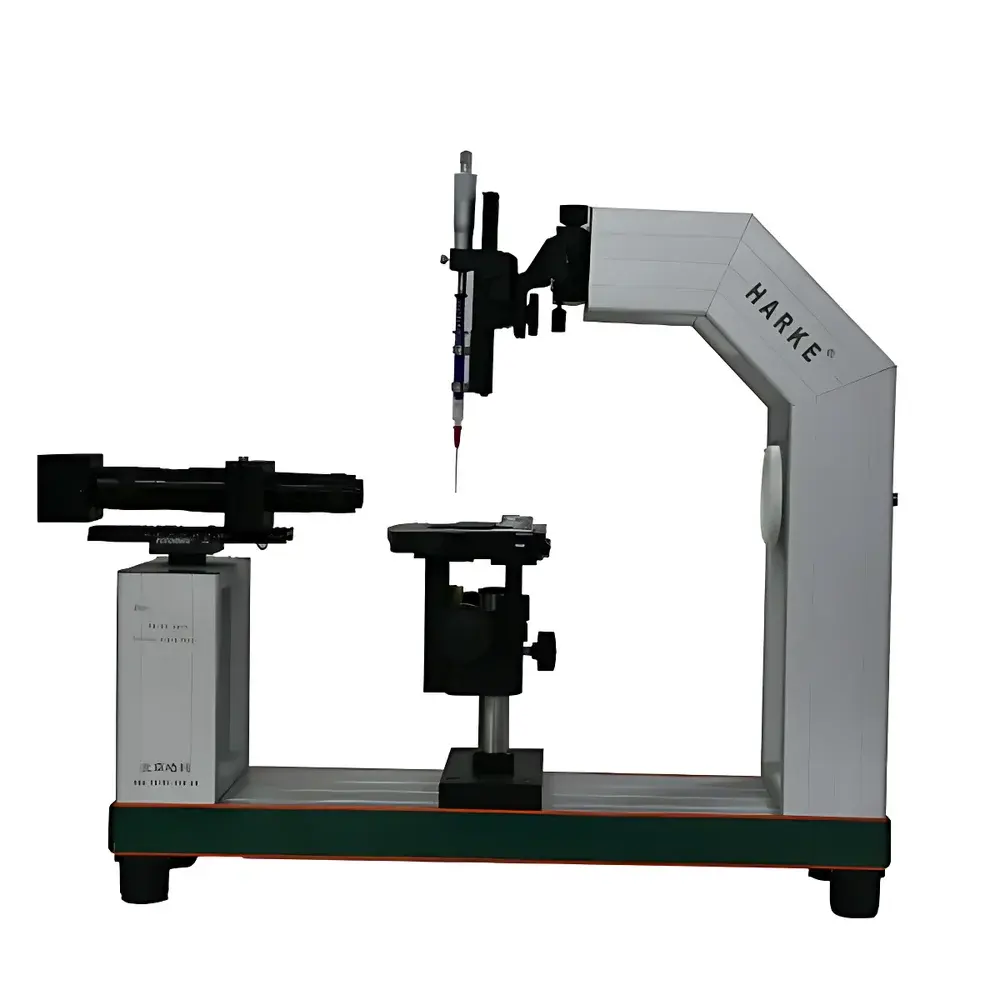
HARKE SPCA Video-Based Optical Contact Angle Analyzer
| Brand | HARKE |
|---|---|
| Model | SPCA |
| Type | Benchtop Video Optical Contact Angle Analyzer |
| Origin | Beijing, China |
| Manufacturer | HARKE (Domestic Producer) |
| Measurement Range | 0–180° |
| Accuracy | ±0.1° |
| Droplet Formation Methods | Sessile Drop, Captive Bubble |
| Analysis Algorithms | Automatic Circle Fitting, Ellipse Fitting, Full-Profile Tangent, Local-Profile Tangent, Height/Width Method, Young–Laplace Fitting, Curve Ruler Method |
| Surface Adaptability | Convex/Concave Surfaces, Tilted Substrates, Curvature Correction |
| Dynamic Contact Angle Capability | Yes |
| Image Processing Modes | Manual & Fully Automated |
| Syringe Dispensing Volume | 0–100 µL (Computer-Controlled), 1 mL (Manual) |
| Dispensing Precision | ±0.1 µL |
| Surface Energy Models | Zisman Plot, Fowkes, Owens–Wendt–Rabel–Kaelble (OWRK) |
| Microscope | 0.75×–4.5× Continuous Zoom, Parfocal Design (HARKE Custom) |
| Camera | High-Resolution CMOS Digital Imaging System |
| Video Capture | Real-Time Recording, Frame-by-Frame Playback, Timed Snapshot Capture, Single-Frame Export from Video |
| Stage Dimensions | 100 mm × 120 mm |
| Stage Travel | Vertical 50 mm, Horizontal (X/Y) 70 mm × 40 mm |
| Stage Extension | 30 mm (Vertical Fine Adjustment) |
| Fixed Mount Translation | 150 mm (Z-axis) |
| Syringe Holder Travel | 100 mm × 100 mm (Vertical/Horizontal) |
| Microscope Translation | 100 mm (Z-axis) |
| Max Sample Size | 100 mm (W) × 80 mm (D) × Unrestricted Height |
| Overall Dimensions | 240 mm (W) × 640 mm (D) × 630 mm (H) |
Overview
The HARKE SPCA is a benchtop video-based optical contact angle analyzer engineered for high-precision interfacial characterization of solid–liquid systems. It operates on the principle of digital image analysis of sessile or captive droplets captured in real time using a parfocal zoom microscope and high-speed CMOS imaging system. By quantifying the tangent angle formed between the liquid–vapor interface and the solid surface at the three-phase contact line, the instrument delivers quantitative metrics essential for surface energy estimation, wettability assessment, and coating performance validation. Designed for laboratory environments requiring reproducible, traceable measurements under ambient or controlled conditions, the SPCA supports static, advancing/receding, and dynamic contact angle protocols—enabling rigorous evaluation of time-dependent wetting behavior across heterogeneous, curved, or inclined substrates.
Key Features
- High-resolution optical path with HARKE-custom 0.75×–4.5× continuous zoom microscope—maintaining focus throughout magnification changes for consistent pixel-scale calibration.
- Automated, software-driven syringe pump with ±0.1 µL volumetric precision over 0–100 µL range; manual 1 mL syringe option available for rapid prototyping or viscous fluid handling.
- Multi-algorithm contact angle analysis suite: automatic circle, ellipse, full-profile tangent, local-profile tangent, height/width, Young–Laplace fitting, and curve-ruler methods—each selectable based on droplet symmetry, substrate topography, and measurement objective.
- Comprehensive geometric adaptability: built-in correction routines for convex/concave surfaces, programmable tilt-stage integration for advancing/receding angle acquisition, and curvature compensation for non-planar samples.
- Real-time video capture at configurable frame rates, with synchronized timestamping, frame-triggered snapshot export, and lossless single-frame extraction from recorded sequences for post-acquisition reanalysis.
- Full motorized stage control (X/Y/Z + rotation-capable optional upgrade) enabling precise sample positioning, multi-site mapping, and automated batch measurement workflows.
Sample Compatibility & Compliance
The SPCA accommodates standard and custom substrates up to 100 mm wide and 80 mm deep, with vertical clearance unrestricted by fixed enclosures. Its modular stage architecture permits direct mounting of temperature-controlled stages, environmental chambers (humidity/gas), or electrochemical cells—enabling in situ contact angle studies under non-ambient conditions. All measurement algorithms and calibration procedures align with ASTM D7334 (“Standard Practice for Surface Wettability Assessment Using Contact Angle Measurements”) and ISO 19403-2 (“Plastics — Determination of Surface Free Energy — Part 2: Contact Angle Measurement”). Data audit trails, user access logs, and parameter-locking features support GLP/GMP-aligned operation where required.
Software & Data Management
The proprietary HARKE SPCA Control Suite runs on Windows OS and provides full instrument orchestration—including hardware synchronization, real-time droplet tracking, and automated report generation in PDF/CSV formats. Software modules implement surface energy calculation via Zisman, Fowkes, and OWRK models, and compute thermodynamic parameters including adhesion work (Wa) and spreading coefficient (S). All raw images, metadata, and processing history are stored in a structured SQLite database with versioned backups. Optional 21 CFR Part 11 compliance package includes electronic signatures, role-based permissions, and immutable audit logs for regulated QC/QA laboratories.
Applications
- Quality control of hydrophobic/hydrophilic coatings in medical device manufacturing (e.g., catheter surface modification).
- Characterization of porous membranes and filtration media for water treatment and battery separator development.
- Surface treatment validation in automotive paint, aerospace composite priming, and printed electronics substrate functionalization.
- Pharmaceutical tablet film-coating uniformity assessment and dissolution behavior correlation.
- Academic research in colloid science, soft matter physics, and biomimetic surface design (e.g., lotus-effect surfaces).
- Adhesive formulation optimization through interfacial energy mapping across polymer blends and filler systems.
FAQ
What droplet formation methods does the SPCA support?
Sessile drop and captive bubble configurations are natively supported, with interchangeable needle assemblies and pressure-controlled dispensing modules for both air- and liquid-submerged measurements.
Can the SPCA measure contact angles on curved or tilted surfaces?
Yes—curvature correction algorithms and programmable stage tilt (with optional motorized goniometer) enable accurate contact angle determination on convex, concave, and inclined substrates.
Is surface energy calculation included in the base software?
Yes—the standard software package includes Zisman plot, Fowkes, and OWRK surface energy modeling with interactive component selection and error propagation analysis.
Does the system comply with regulatory data integrity requirements?
With the optional 21 CFR Part 11 add-on module, the SPCA meets FDA requirements for electronic records and signatures, including audit trail generation, user authentication, and data immutability.
What is the minimum resolvable contact angle increment?
The system achieves ±0.1° measurement accuracy under optimal lighting and contrast conditions, validated against NIST-traceable reference standards.



