
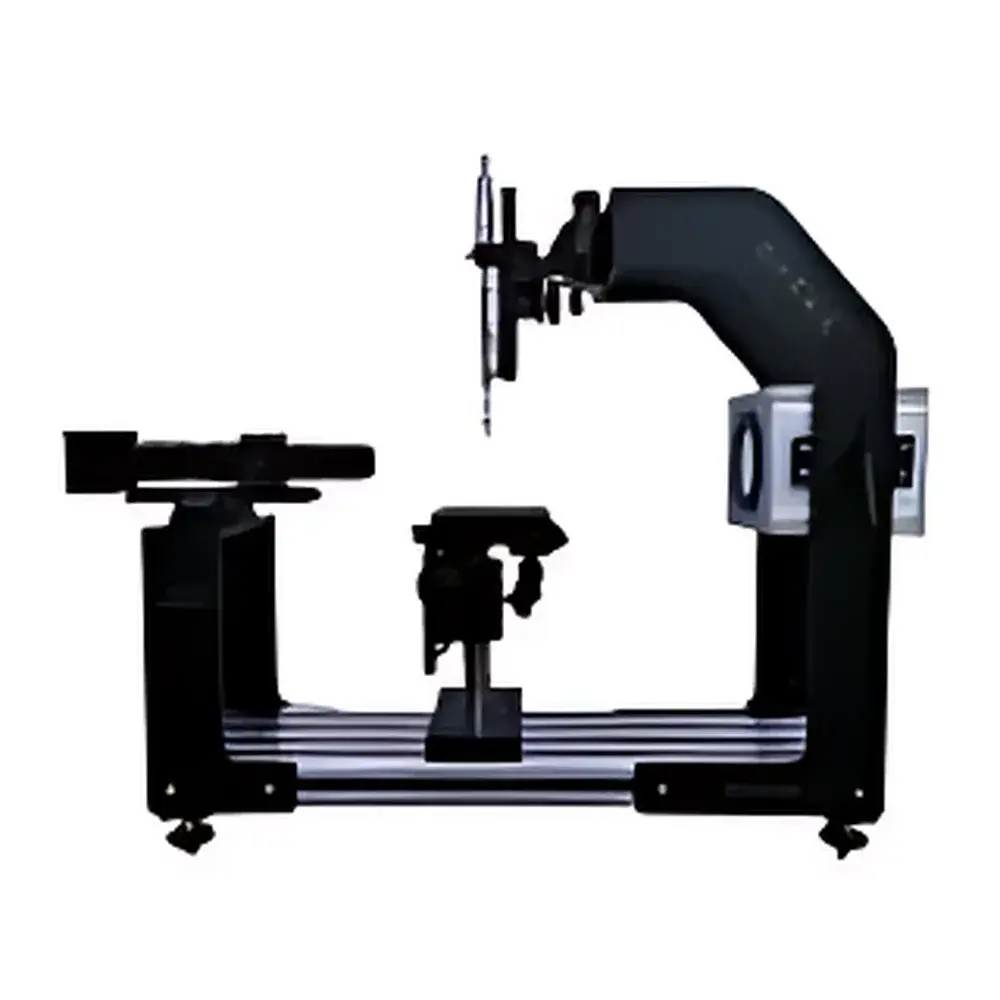
HARKE HK-SPCA Optical Contact Angle Analyzer
| Brand | HARKE |
|---|---|
| Model | HK-SPCA |
| Origin | Beijing, China |
| Manufacturer Type | Direct Manufacturer |
| Instrument Type | Benchtop Laboratory System |
| Contact Angle Measurement Range | 0–180° |
| Contact Angle Measurement Accuracy | ±0.1° |
| Contact Angle Display Resolution | 0.01° |
| Sample Stage Dimensions | 400 mm × 400 mm |
| Optical Zoom Magnification | 0.7×–4.5× |
| Surface/Interfacial Tension Measurement Range | 0–1000 mN/m |
| Surface/Interfacial Tension Measurement Accuracy | ±0.01 mN/m |
| Imaging System | ZF-180 High-Resolution Stepping Zoom Lens + USB 2.0 Camera (30 fps standard |
| Software | HARKE-SPCA v1.0 |
| Surface Energy Analysis Method | Equation of State (EOS), Circle Fit, Ellipse Fit, Sessile Drop Small-Drop Method |
| Tension Analysis Method | Pendant Drop |
| Power Supply | 220 V / 3 A / 50 Hz |
| Weight | ~30 kg |
| Footprint | 260 mm × 700 mm |
| Lens Vertical Travel | 120 mm |
Overview
The HARKE HK-SPCA Optical Contact Angle Analyzer is a precision benchtop instrument engineered for quantitative characterization of solid–liquid interfacial phenomena using high-resolution digital image analysis. It operates on the principle of sessile drop, pendant drop, and tilting-stage dynamic measurement methodologies—enabling rigorous determination of contact angle, surface free energy, interfacial tension, wettability hysteresis, and adhesion work. Designed for laboratory environments requiring traceable, repeatable, and ISO-compliant surface metrology, the HK-SPCA integrates a motorized high-fidelity optical path with real-time video capture and algorithm-driven contour fitting. Its modular architecture supports both static and dynamic measurements—including advancing/receding angles, roll-off (sliding) angles, time-resolved wetting kinetics, and submerged (under-liquid) contact angle analysis—making it suitable for R&D, QC, and GLP-aligned surface science workflows.
Key Features
- Benchtop design with robust aluminum alloy frame and vibration-damped optical baseplate for stable imaging under ambient lab conditions
- Motorized ZF-180 stepping zoom lens system (0.7×–4.5× magnification) enabling precise focus control and consistent pixel-to-length calibration across measurement sessions
- High-speed USB 2.0 camera (standard 30 fps; optional 100/300/1000 fps modules) for capturing rapid wetting dynamics, droplet oscillation, or capillary rise events
- Large 400 mm × 400 mm XYZ-adjustable sample stage with fine-thread micrometers (±1 µm repeatability) accommodating oversized substrates, flexible films, or multi-sample trays
- Software-controlled automated dispensing interface (optional add-on) compatible with syringe pumps for reproducible droplet volume delivery (1–10 µL typical)
- Multi-algorithm fitting engine supporting circle, ellipse, Young–Laplace, and conic section models—each selectable per frame or applied globally for batch processing
- Integrated environmental enclosure option (temperature/humidity controlled) for ISO 27448-compliant surface energy testing under defined ambient conditions
Sample Compatibility & Compliance
The HK-SPCA accommodates flat, curved, porous, fibrous, powdered, and anisotropic surfaces—including ultra-hydrophobic (θ > 150°), superhydrophilic (θ < 5°), and heterogeneous coatings. Sample mounting is tool-free via vacuum chuck or magnetic clamping (accessories sold separately). The system complies with ASTM D7334 (Standard Practice for Surface Wettability of Coatings), ISO 19403-2 (Contact angle measurement—Part 2: Static contact angle), and ISO 19403-4 (Dynamic contact angle), and supports audit-ready data export aligned with FDA 21 CFR Part 11 requirements when used with HARKE-SPCA v1.0’s electronic signature and audit trail module. All calibration routines follow NIST-traceable reference standards (e.g., diethylene glycol, water, ethylene glycol) and include documented uncertainty budgets per ISO/IEC 17025 guidelines.
Software & Data Management
HARKE-SPCA v1.0 is a Windows-based application built on .NET Framework with native support for multilingual UI (English, German, Japanese, Chinese). It provides full experimental protocol definition—including auto-triggered image capture, timed sequence acquisition, and conditional loop execution (e.g., “acquire frame every 0.5 s until θ stabilizes”). Raw TIFF sequences are stored with embedded metadata (timestamp, lens position, lighting intensity, syringe volume). Quantitative outputs include CSV/Excel-exportable tables for contact angle vs. time, surface energy component breakdowns (Lifshitz–van der Waals, Lewis acid–base), interfacial tension profiles, and adhesion work integrals. Data integrity is enforced via SHA-256 hash logging, user-level permissions, and version-controlled method templates—fully compatible with LIMS integration via RESTful API.
Applications
The HK-SPCA serves as a primary metrology platform in materials science, microelectronics, biomedical device development, and industrial coating validation. Typical use cases include: evaluating plasma-treated polymer surfaces for adhesive bonding readiness; quantifying hydrophobic recovery in fluorinated thin films post-annealing; assessing cleaning efficacy on semiconductor wafers via contact angle uniformity mapping; characterizing inkjet printability on functionalized textiles; validating anti-fouling performance of marine coatings through dynamic receding angle decay analysis; and determining surface energy polarity ratios for pharmaceutical tablet film coatings per USP . Its pendant drop capability further enables formulation scientists to determine surfactant CMC values and interfacial rheology parameters relevant to emulsion stability studies.
FAQ
What is the minimum measurable contact angle resolution, and how is it validated?
The system displays contact angle to 0.01° resolution and achieves ±0.1° measurement accuracy per ASTM D7334 Annex A1, verified using certified spherical calibration artifacts and reference liquids with known surface tension.
Can the HK-SPCA perform surface energy calculations without third-party software?
Yes—HARKE-SPCA v1.0 includes built-in EOS, OWRK, Wu, and van Oss–Chaudhury–Good models with interactive component decomposition and confidence interval estimation.
Is tilt-stage dynamic contact angle measurement supported natively?
Yes—the optional motorized tilt module (0–90°, ±0.1° step resolution) integrates seamlessly with software for automated advancing/receding angle sweeps and sliding angle detection.
Does the system support GMP/GLP-compliant reporting?
When configured with the Audit Trail & Electronic Signature Add-on, all measurements generate 21 CFR Part 11–compliant PDF reports with embedded digital signatures, revision history, and raw image archives.
What accessories are required for powder contact angle measurement?
A compression die set (for pellet formation) and a dedicated hydrophobic/hydrophilic reference liquid kit are recommended; both are available as catalog options under HARKE-ACC-PCA series.



