
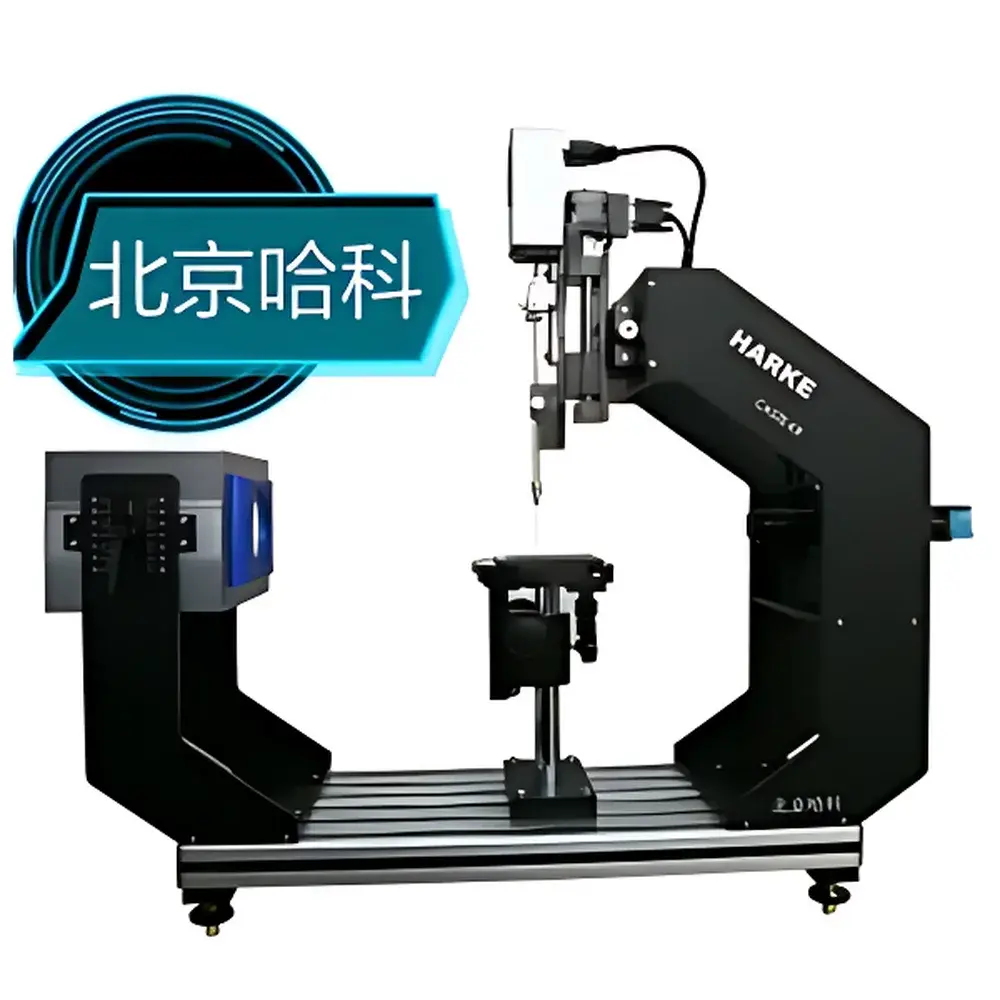
HARKE HK-SPCAX1 Underwater Oil Contact Angle Measurement System
| Brand | HARKE |
|---|---|
| Model | HK-SPCAX1 |
| Origin | Beijing, China |
| Manufacturer Type | Direct Manufacturer |
| Instrument Category | Domestic |
| Instrument Type | Benchtop Video-Based Optical Contact Angle Analyzer |
| Contact Angle Measurement Range | 0–180° |
| Contact Angle Accuracy | ±0.1° |
| Contact Angle Resolution | ±0.01° |
| Sample Stage Dimensions | 100 mm × 120 mm |
| Optical Zoom Ratio | 0.7×–5× (Stepped Zoom Lens) |
| Surface/Interfacial Tension Range | 0–1000 mN/m |
| Surface/Interfacial Tension Resolution | 0.01 mN/m |
| Imaging System | USB 3.0 High-Speed Camera (Standard: 30 fps |
| Optional | 100/300/1000+ fps) |
| Frame Rate Control | Software-Triggered Synchronization |
| Lens Vertical Travel | 30 mm |
| Syringe Dispenser Vertical Travel | 30 mm |
| Positioning Accuracy (Motorized Options) | ±0.1 mm |
| Software | SPCA 1.0 (Windows-based, GLP-compliant audit trail optional) |
| Power Supply | 220 V AC, 3 A, 50 Hz |
| Ambient Operating Temperature | 15–30 °C |
| Measurement Methods | Circle Fitting, Ellipse Fitting, Height-Width Method, Sessile Drop, Pendant Drop, Captive Bubble, Tilting Plate, and Dynamic Advancing/Receding via Expansion-Contraction or Slide-Off |
| Optional Modules | Interfacial Tension (Pendant Drop), Dynamic Contact Angle (Advancing/Receding), Sliding Angle, Solid Surface Free Energy Calculation (Owens-Wendt, Wu, van Oss-Chaudhury-Good) |
Overview
The HARKE HK-SPCAX1 Underwater Oil Contact Angle Measurement System is a precision-engineered benchtop optical goniometer designed for quantitative characterization of solid–liquid–liquid interfacial behavior—specifically, oil–water–solid systems under submerged conditions. Unlike conventional air-based contact angle analyzers, the HK-SPCAX1 integrates a fully submersible sample chamber and high-stability optical path architecture to enable direct measurement of oil droplet contact angles on solid substrates immersed in aqueous media. This capability is critical for evaluating wettability reversal in enhanced oil recovery (EOR), marine antifouling coating performance, underwater adhesion mechanisms, and biomimetic surface design where interfacial thermodynamics govern functionality. The system operates on the principle of real-time digital image capture of sessile or captive oil droplets at the solid–water–oil triple-phase boundary, followed by pixel-level contour extraction and geometric fitting using multiple validated algorithms—including circle, ellipse, and height-width methods—to compute contact angles with traceable uncertainty.
Key Features
- Benchtop modular design with rigid aluminum frame and vibration-damped optical baseplate for stable long-duration imaging
- Submersible sample stage compatible with custom fluid cells (standard configuration supports water-immersed oil droplet formation)
- Stepped zoom optical system (0.7×–5×) with parfocal lens turret enabling consistent focus across magnification changes without refocusing
- USB 3.0 high-speed camera (30 fps standard; upgradable to 1000+ fps for rapid dynamic processes such as oil droplet coalescence or detachment)
- Motorized or manual XYZ positioning stages with ±0.1 mm repeatability for precise droplet placement and multi-point spatial mapping
- Integrated syringe pump module with programmable dispensing control for automated drop formation and volume ramping
- SPCA 1.0 software platform supporting ISO 19403-compliant contact angle analysis, ASTM D7490-22 data reporting templates, and optional 21 CFR Part 11 audit trail modules
Sample Compatibility & Compliance
The HK-SPCAX1 accommodates flat, rigid, or flexible substrates up to 100 mm × 120 mm, including hydrophobic/hydrophilic polymers, metal oxides, functionalized silicon wafers, and bio-inspired textured surfaces. Substrate thickness is unrestricted provided mechanical stability during immersion is maintained. The system supports both static and dynamic measurements under controlled environmental conditions (ambient temperature: 15–30 °C). All contact angle and interfacial tension calculations comply with ISO 19403-2:2017 (contact angle determination) and ISO 19403-4:2017 (interfacial tension via pendant drop method). For regulated environments, optional software validation packages support GLP/GMP documentation workflows, including electronic signatures, user access control, and raw image metadata logging.
Software & Data Management
SPCA 1.0 is a Windows-native application built on a modular architecture for extensibility and traceability. Core functions include real-time droplet contour detection, batch processing of time-lapse sequences, automatic baseline correction, and multi-method comparative analysis. Data export is supported in CSV, TXT, and PDF formats—with embedded metadata (timestamp, operator ID, calibration status, lens magnification, ambient humidity). Audit trail functionality (optional add-on) records all parameter modifications, image deletions, and result exports with tamper-proof timestamps, satisfying FDA 21 CFR Part 11 requirements for regulated laboratories. Raw video files are stored in lossless AVI format with embedded hardware timestamps for forensic replay.
Applications
- Quantification of underwater oleophobicity in filtration membranes and anti-oil-fouling coatings
- Wettability assessment of reservoir rock analogs saturated with brine and crude oil phases
- Dynamic contact angle hysteresis analysis during oil droplet expansion/contraction cycles
- Sliding angle determination for self-cleaning underwater surfaces
- Solid surface free energy calculation using combined advancing/receding angles and interfacial tension inputs
- Interfacial tension measurement between immiscible liquids (e.g., decane–water) via pendant drop analysis
- Method development for ASTM D7490-22 and ISO 19403-2 validation studies
FAQ
Can the HK-SPCAX1 measure contact angles of oil droplets directly beneath a water surface?
Yes—the instrument includes a dedicated submersion cell configuration and refractive index compensation in its optical path to minimize distortion and ensure accurate edge detection of oil–water–solid interfaces.
Is pendant drop interfacial tension measurement included as standard functionality?
Pendant drop analysis is enabled by default in SPCA 1.0 software; however, optimal accuracy requires optional high-frame-rate camera upgrade (≥100 fps) for droplet shape stabilization.
Does the system support automated dynamic contact angle cycling (e.g., advancing/receding loops)?
Yes—via programmable syringe volume modulation and synchronized image capture; full cycle definition (number of cycles, dwell time, volume step size) is configurable in SPCA 1.0.
What calibration standards are recommended for traceable contact angle verification?
NIST-traceable contact angle reference slides (e.g., KRUSS DSA-CAL series) are recommended for periodic verification; calibration certificates must be renewed annually per ISO/IEC 17025 guidelines.
Can third-party software (e.g., MATLAB, Python) interface with the HK-SPCAX1 for custom analysis pipelines?
Yes—SPCA 1.0 provides documented COM/ActiveX API and CSV-based intermediate file exchange for integration into external computational environments.



