
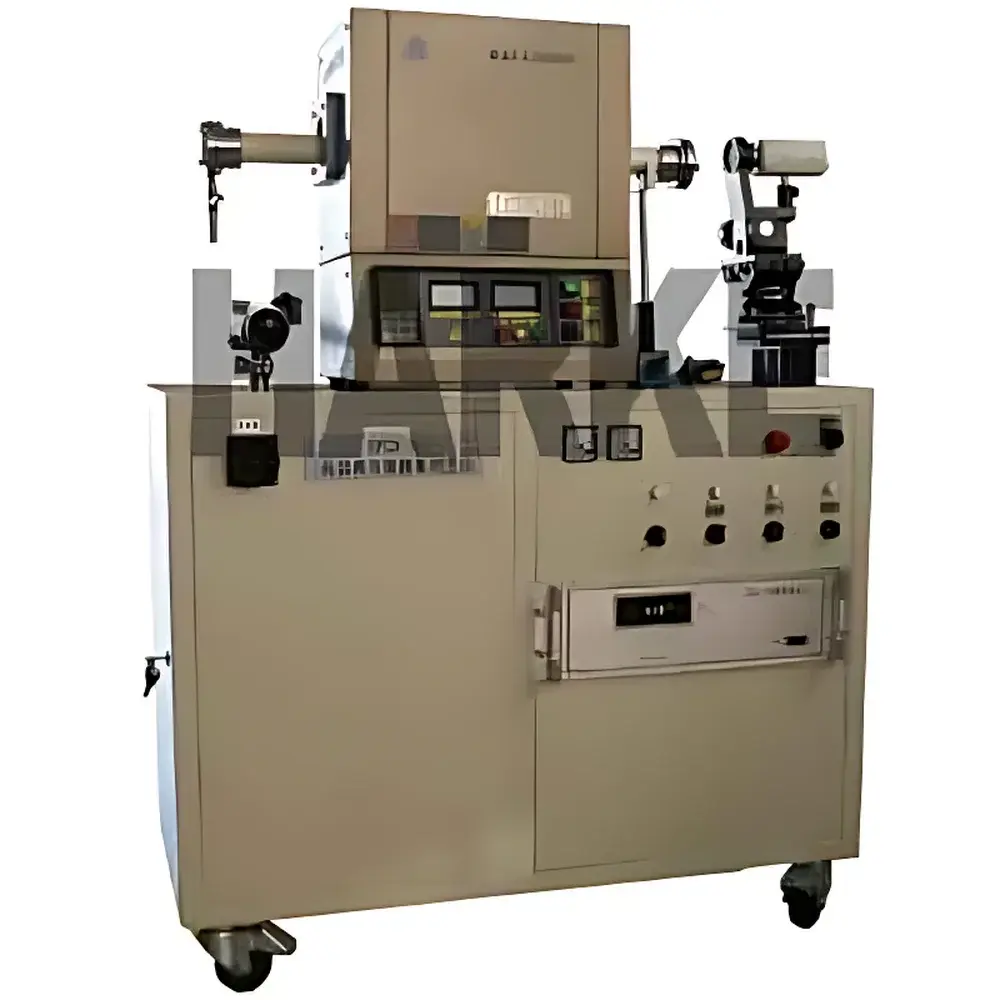
HARKE SPCA-GZ1 High-Temperature Vacuum Contact Angle Analyzer
| Brand | HARKE |
|---|---|
| Origin | Beijing, China |
| Manufacturer Type | Direct Manufacturer |
| Instrument Category | Domestic |
| Model | SPCA-GZ1 |
| Instrument Type | Benchtop Laboratory System |
| Contact Angle Measurement Range | 0–180° |
| Contact Angle Accuracy | ±0.1° |
| Sample Stage Dimensions | 1200 × 250 × 300 mm |
| Optical Magnification | 0.7×–4.7× |
| Surface/Interfacial Tension Range | 0–1000 mN/m |
| Surface/Interfacial Tension Accuracy | ±0.01 mN/m |
| Temperature Range | Ambient to 1300 °C (up to 1600 °C with optional configuration) |
| Vacuum Level | ≤1×10⁻⁴ atm (4×10⁻⁴ atm at ambient |
| Heating Zone Length | 300 mm |
| Isothermal Zone Length | >150 mm |
| Max. Heating Power | >1.5 kW |
| Furnace Internal Diameter | Ø40 mm |
| Control Precision | ±1 °C |
| Compatible Atmospheres | Inert gas (Ar, N₂), reduced-oxygen environment |
| Imaging System | High-resolution CCD camera with monochromatic LED illumination and continuous zoom objective |
| Software | Dedicated contact angle analysis suite with automated sessile drop, tilting plate (roll-off), and immersion method protocols |
| Compliance | Designed for GLP-compliant workflows |
Overview
The HARKE SPCA-GZ1 High-Temperature Vacuum Contact Angle Analyzer is an engineered platform for quantitative interfacial characterization under rigorously controlled thermal and atmospheric conditions. It operates on the principle of optical silhouette imaging—capturing high-contrast profiles of liquid droplets or menisci on solid substrates—and applying geometric curve-fitting algorithms (e.g., Young-Laplace fitting, circle/ellipse tangent methods) to determine static, advancing, and receding contact angles with sub-degree resolution. Unlike ambient-only systems, the SPCA-GZ1 integrates a high-vacuum furnace chamber (≤1×10⁻⁴ atm base pressure), programmable temperature control up to 1300 °C (extendable to 1600 °C), and inert-gas purging capability—enabling reproducible measurements of wettability, surface energy, and interfacial tension in environments where oxidation, decomposition, or vapor-phase interference would otherwise compromise data integrity. Its design targets materials science laboratories engaged in high-temperature ceramic sintering, molten metal–substrate interactions, refractory coating development, and advanced battery electrode wetting studies.
Key Features
- Integrated high-vacuum system featuring a space-grade oil diffusion pump (patented technology developed with CAS Institute of Mechanics), stainless-steel construction, and a DL-9 programmable vacuum gauge (Peking University design) for real-time pressure monitoring across 10⁻⁴–10² Pa range.
- High-stability resistive heating furnace with axial symmetry, 300 mm active zone, >150 mm isothermal region, and ±1 °C temperature uniformity—validated per ASTM E220 calibration standards.
- Benchtop mechanical architecture with casters and locking brakes, enabling repositioning within shared lab spaces without recalibration.
- Dual-mode optical path: adjustable magnification (0.7×–4.7×) via continuous-zoom telecentric lens paired with monochromatic LED backlighting to minimize chromatic aberration and enhance droplet edge detection.
- Multi-method measurement support: sessile drop, dynamic tilting (roll-off angle), and immersion (captive bubble) techniques—all executed under synchronized thermal/vacuum control and captured via frame-triggered CCD acquisition.
- Modular gas handling interface supporting N₂ or Ar purge, leak-tight stainless-steel fittings, and pressure-regulated inlet/outlet valves compliant with ISO 8573-1 Class 2 purity specifications.
Sample Compatibility & Compliance
The SPCA-GZ1 accommodates flat or low-curvature solid samples up to 120 mm × 25 mm × 30 mm in footprint, including ceramics, metals, graphite, CMCs, and coated foils (e.g., aluminum hydrophilicity verification). Substrate heating is direct and uniform; no external hot-stage coupling is required. The furnace chamber’s Ø40 mm bore and quartz observation windows permit unobstructed optical access during operation. All vacuum components meet NASA-STD-6002 cleanliness requirements for ultra-high-vacuum instrumentation. The system is engineered for compliance with ISO 19403 (contact angle measurement), ASTM D7334 (surface energy of solid substrates), and USP (wettability assessment of pharmaceutical excipients). Full electronic records—including raw images, metadata (time, T, P, humidity), and processed results—are timestamped and exportable in CSV/PNG/TIFF formats to support 21 CFR Part 11–aligned quality systems.
Software & Data Management
The proprietary HARKE Contact Angle Analysis Suite (v4.2+) provides deterministic image preprocessing (adaptive thresholding, noise suppression), multi-point baseline correction, and dual-curve Young-Laplace fitting. Users define custom analysis protocols—including automatic sequence triggering upon temperature stabilization—and generate reports with statistical summaries (mean, SD, CV%) across multiple droplets. Audit trail functionality logs all parameter changes, user logins, and result exports with immutable timestamps. Data files are stored in hierarchical folders with SHA-256 checksums; optional integration with LIMS via RESTful API enables traceable sample-to-result workflows. Software validation documentation (IQ/OQ/PQ templates) is provided for GMP/GLP deployment.
Applications
- Quantifying dynamic wettability hysteresis of molten solder alloys on Cu/Ni metallizations during reflow profiling.
- Evaluating oxide layer formation effects on Ti-6Al-4V wettability in Ar-purged vacuum brazing cycles.
- Measuring advancing/receding angles of LiPF₆–EC/DMC electrolyte on sintered LiCoO₂ cathodes at 80–120 °C under <10⁻³ atm O₂.
- Assessing hydrophilicity decay kinetics of Al foil anodes during thermal aging under controlled H₂O partial pressure.
- Characterizing carbon fiber–resin precursor interfacial adhesion via captive bubble analysis at 200 °C in N₂.
- Validating surface functionalization efficacy on SiC substrates prior to high-temperature CVD coating.
FAQ
What maximum operating temperature is certified for continuous use?
Continuous operation is rated to 1000 °C; intermittent exposure up to 1300 °C is supported with extended cool-down cycles. Optional furnace upgrades enable 1600 °C peak capability.
Can the system measure contact angles on curved or porous substrates?
Flat, polished surfaces yield optimal accuracy. For low-curvature samples (<5° deviation), manual baseline adjustment is available; porous media require pre-wetting protocols and captive bubble methodology.
Is remote operation and monitoring supported?
Yes—Ethernet-connected control allows full GUI mirroring, real-time video streaming, and scheduled shutdown via secure SSH or VNC. No cloud dependency.
How is vacuum integrity verified during thermal cycling?
The DL-9 vacuum gauge performs auto-zero compensation before each run; integrated leak-check routines (pressure-rise test) validate chamber integrity per ISO 20483 Annex B.
Does the software support ISO 19403–compliant uncertainty calculation?
Yes—Type A (statistical) and Type B (systematic) uncertainty contributors (e.g., pixel resolution, lens distortion, temperature gradient) are propagated per GUM (JCGM 100:2008) guidelines and reported in final output tables.



