
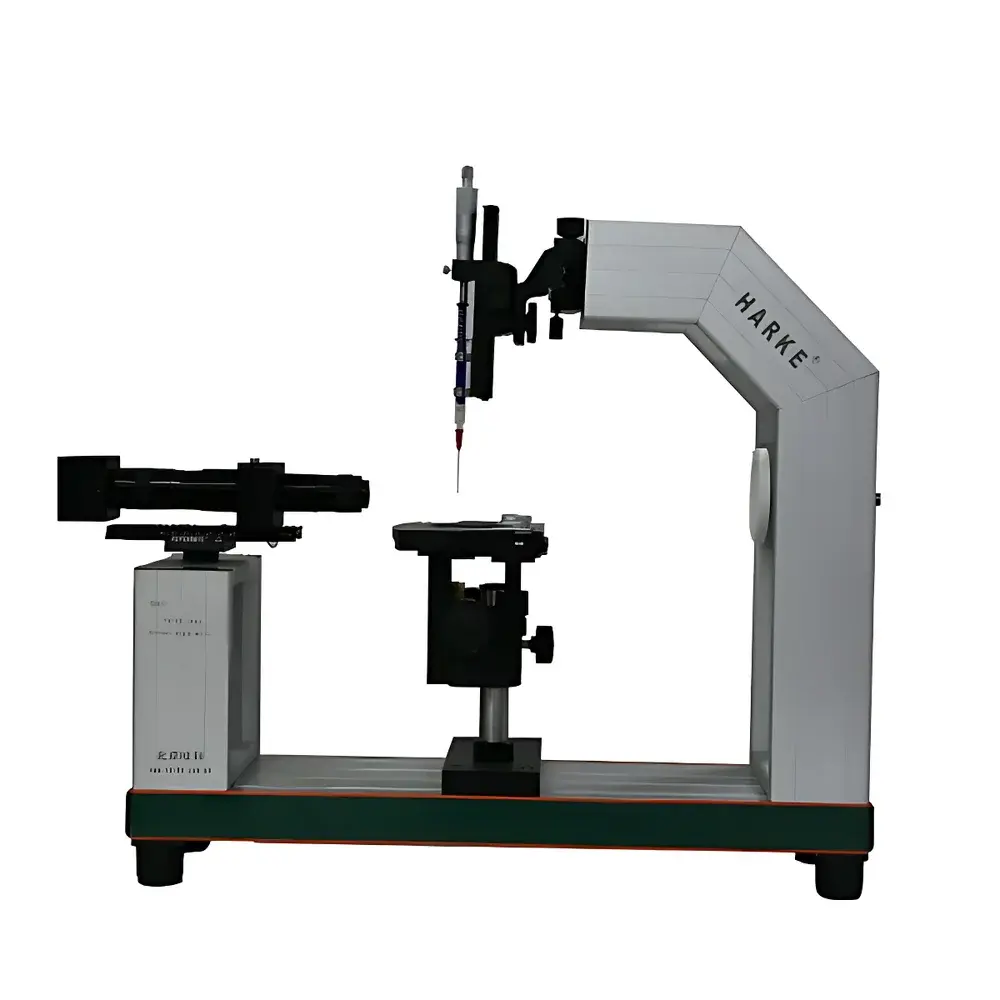
HARKE SPCA-X1 Video-Based Optical Contact Angle Analyzer
| Brand | HARKE |
|---|---|
| Model | SPCA-X1 |
| Type | Benchtop Video Optical Contact Angle Analyzer |
| Contact Angle Range | 0–180° |
| Contact Angle Accuracy | ±0.1° |
| Contact Angle Resolution | ±0.01° |
| Surface/Interfacial Tension Range | 0–1000 mN/m |
| Surface/Interfacial Tension Accuracy | ±0.01 mN/m |
| Sample Stage Dimensions | 100 mm × 120 mm |
| Optical Zoom | 0.7×–5× Fixed-Position Zoom Lens |
| Imaging System | USB 3.0 High-Speed Camera (30 fps standard |
| Frame Rate Options | 30 / 100 / 300 / 1000 fps |
| Lens Vertical Travel | 30 mm |
| Instrument Footprint | 300 mm × 760 mm |
| Weight | 30 kg |
| Software | SPCA 1.0 |
| Power Supply | 220 V, 3 A, 50 Hz |
| Operating Temperature | Ambient |
| Measurement Methods | Circle Fitting, Ellipse Fitting, Height-Width Method, Sessile Drop, Captive Bubble, Tilting Plate, Dynamic Expansion/Contraction, Slide-off Method |
| Optional Modules | Surface Energy Calculation (Owens-Wendt, Wu, van Oss), Advancing/Receding Angles, Roll-off Angle, Interfacial Tension (Pendant Drop), Dynamic Contact Angle Analysis |
Overview
The HARKE SPCA-X1 Video-Based Optical Contact Angle Analyzer is a precision benchtop instrument engineered for quantitative characterization of solid–liquid and liquid–liquid interfacial behavior. It operates on the principle of sessile drop analysis using high-resolution optical imaging and automated image processing algorithms to determine contact angle, surface free energy, and interfacial tension. The system employs a calibrated optical path with a motorized zoom lens (0.7×–5×) and a USB 3.0 CMOS camera capable of real-time capture at up to 1000 frames per second—enabling robust analysis of dynamic wetting phenomena including advancing/receding angles, roll-off behavior, and time-dependent droplet spreading. Designed for laboratory environments requiring traceable, repeatable measurements under ambient conditions, the SPCA-X1 conforms to core methodologies described in ASTM D7334 (surface energy of polymer films), ISO 19403 (contact angle measurement), and ISO 1409 (interfacial tension via pendant drop). Its rigid mechanical architecture—including a 30 mm vertical lens travel range and ±0.1 mm precision XYZ sample positioning—ensures long-term stability and minimal thermal drift during extended acquisition sequences.
Key Features
- Benchtop modular design with compact footprint (300 mm × 760 mm) and 30 kg mass for vibration-damped operation on standard lab benches
- Motorized fixed-position zoom optics (0.7×–5×) delivering consistent magnification without parallax shift across measurement sessions
- High-speed imaging platform: baseline 30 fps USB 3.0 camera with field-upgradable options up to 1000 fps for transient interfacial kinetics
- Automated droplet dispensing control with 30 mm vertical syringe travel and programmable deposition timing
- SPCA 1.0 software suite supporting eight standardized fitting algorithms (circle, ellipse, height-width, Young-Laplace, etc.) and GLP-compliant audit trail logging
- Integrated stage with 100 mm × 120 mm horizontal travel range and micrometer-level manual XY adjustment
- Comprehensive method library compliant with ASTM D7490, ISO 27448, and USP analytical instrument qualification guidelines
Sample Compatibility & Compliance
The SPCA-X1 accommodates flat, rigid, or flexible substrates up to 10 mm thickness—including ceramic insulators, polymer coatings, metal foils, glass slides, and functionalized membranes. Its open-stage configuration supports custom fixtures for non-planar samples (e.g., cylindrical insulator sheds) when used with optional tilt-stage accessories. All measurement protocols adhere to internationally recognized standards for surface characterization: contact angle repeatability meets ISO 19403-2 (RSD ≤ 0.5% for homogeneous surfaces), while interfacial tension results align with ISO 1409:2016 (pendant drop method). The system’s software architecture supports 21 CFR Part 11 compliance through electronic signature enforcement, user role-based access control, and immutable data archiving—making it suitable for regulated QC/QA workflows in power transmission, aerospace composites, and biomedical device manufacturing.
Software & Data Management
SPCA 1.0 is a Windows-native application built on a deterministic image-processing engine that separates edge detection from geometric fitting to minimize operator bias. It provides real-time contour extraction, automatic baseline correction, and multi-point contact angle mapping across heterogeneous surfaces. Raw images, processed profiles, and metadata (timestamp, environmental conditions, operator ID) are stored in vendor-neutral HDF5 format. Export options include CSV (for statistical process control), PNG/TIFF (publication-grade figures), and XML (LIMS integration). Audit trails record all parameter changes, measurement events, and software updates—fully traceable for internal audits or regulatory inspections. Optional modules enable surface energy decomposition (Owens-Wendt, Wu, van Oss-Chaudhury), hysteresis quantification (advancing–receding difference), and dynamic contact angle modeling (Cassie–Baxter vs. Wenzel state transitions).
Applications
- Electrical insulation diagnostics: hydrophobicity assessment of silicone rubber and EPDM composite insulators per IEC 62073 and DL/T 810–2012
- Coating development: optimization of anti-icing, anti-fouling, and self-cleaning surfaces for high-voltage infrastructure
- Pharmaceutical solid dosage forms: wettability screening of tablet excipients and film-coated APIs
- Microfluidic device validation: verification of channel wall surface modification uniformity
- Adhesion science: correlation of surface energy components with bond strength in structural adhesives
- Quality control of printed electronics: ink-substrate interaction analysis for conductive trace formation
FAQ
What contact angle methods does the SPCA-X1 support?
Circle fitting, ellipse fitting, height-width method, Young-Laplace fitting, captive bubble, tilting plate, dynamic expansion/contraction, and slide-off (roll-off) analysis.
Is the system compatible with GMP/GLP documentation requirements?
Yes—SPCA 1.0 includes electronic signatures, user permission tiers, and tamper-evident audit logs aligned with FDA 21 CFR Part 11 and ISO/IEC 17025.
Can the instrument measure interfacial tension between two immiscible liquids?
Yes, using the pendant drop method with optional dual-syringe dispensing and density calibration tools.
What is the minimum resolvable contact angle increment?
The system displays contact angles to ±0.01° resolution and achieves ±0.1° measurement accuracy under controlled ambient conditions.
Does the software support batch processing of multiple images?
Yes—automated batch analysis mode processes queued images using identical fitting parameters and exports consolidated statistical reports.



