
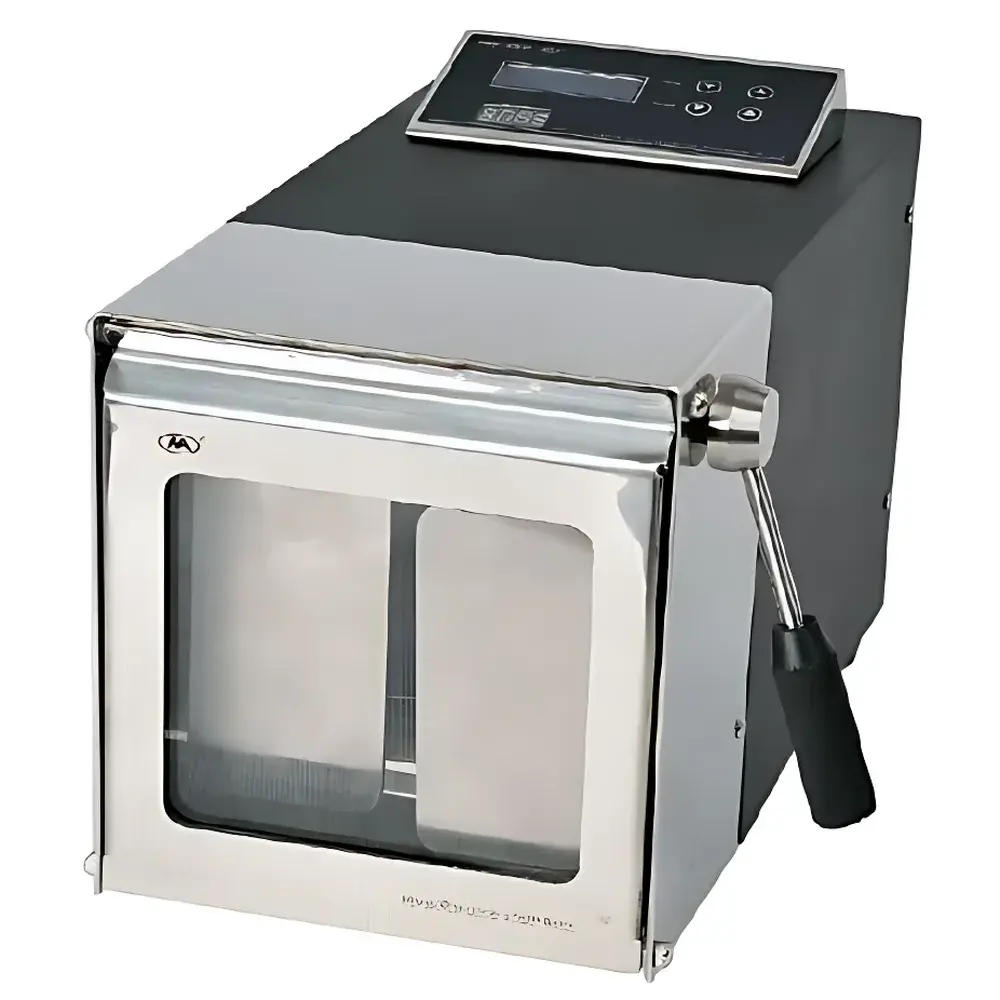
HBM-400A Sterile Pulsed-Action Homogenizer
| Origin | Shanghai, China |
|---|---|
| Manufacturer Type | Authorized Distributor |
| Product Origin | Domestic (China) |
| Model | HBM-400A |
| Price | USD 2,350 (FOB Shanghai) |
| Instrument Type | Pulsed-Action (Stomacher-Type) Homogenizer |
| Dimensions (W×D×H) | 450 × 270 × 290 mm |
| Sample Volume Range | 30–400 mL |
| Control Interface | Digital Display |
| Homogenization Time Settings | 10, 30, 60, 90, 120, 180, 600 s + Continuous Mode (8 programmable steps) |
| Pulse Frequency | 6–9 pulses/sec (customizable range: 3–12 pulses/sec) |
| Weight | 16.5 kg |
| Power Consumption | 200 W |
| Input Voltage/Frequency | 220 V AC / 50 Hz |
| Sterile Bag Dimensions | 30 × 17 cm |
| Safety Features | Hall-effect door interlock, leak-proof waste tray, fully opening front door, transparent polycarbonate viewing window |
| Optional Accessories | Micro-volume pulsing plate kit |
Overview
The HBM-400A Sterile Pulsed-Action Homogenizer is a laboratory-grade stomacher-type homogenizer engineered for reproducible, contamination-controlled sample preparation in microbiological, food safety, and environmental testing workflows. It operates on the principle of controlled mechanical disruption: two parallel stainless-steel paddles alternately compress and release sterile filter bags containing sample and diluent, generating consistent shear and impact forces that liberate microorganisms—both surface-adhered and intracellular—from solid or semi-solid matrices without thermal degradation or cross-contamination. Unlike rotor-stator or ultrasonic systems, this pulsed-action design ensures minimal foaming, low heat generation, and full containment within single-use ISO-certified sterile bags (e.g., ISO 7218-compliant), making it ideal for aerobic/anaerobic microbial enumeration, pathogen enrichment, and residue extraction prior to HPLC, GC-MS, or ELISA analysis.
Key Features
- Digitally controlled pulse timing with eight discrete preset durations (10–600 s) plus continuous mode for method flexibility and SOP compliance;
- Adjustable pulse frequency (6–9 Hz standard; optional 3–12 Hz range) to optimize recovery efficiency across diverse sample types—including leafy greens, meat tissue, soil suspensions, and seafood;
- Integrated digital gap indicator showing real-time clearance between pulsing plates, enabling precise calibration for variable bag fill volumes (30–400 mL);
- Full-front access with wide-opening door and shatter-resistant polycarbonate viewport for unobstructed process monitoring and rapid bag loading/unloading;
- Hall-effect safety interlock system automatically halts pulsing upon door opening, preventing operator injury and ensuring GLP-aligned operational integrity;
- Modular pulsing plate design supports optional micro-volume kits (e.g., for ≤50 mL samples), extending method applicability to high-value clinical or forensic specimens;
- Leak containment system featuring integrated waste tray beneath the chamber, capturing incidental bag breaches and maintaining cabinet hygiene;
- Non-contact architecture: no internal wetted parts—only disposable sterile bags contact the sample, eliminating carryover risk and reducing cleaning validation burden.
Sample Compatibility & Compliance
The HBM-400A accommodates a broad spectrum of food, environmental, and agricultural matrices—including raw produce, dairy products, poultry carcasses, activated sludge, and plant tissues—when processed in certified sterile filter bags (e.g., 30 × 17 cm polyethylene/polyamide laminates with 100 µm pore-rated filters). Its performance aligns with internationally recognized standards for sample homogenization: ISO 6887-1:2017 (microbiological examination of food and animal feeding stuffs), AOAC Official Method 990.12 (stomacher-based recovery of Salmonella), and USP <1117> (microbiological control of pharmaceutical environments). The instrument’s closed-bag operation satisfies biosafety Level 1 (BSL-1) containment requirements and supports audit-ready documentation when paired with compliant LIMS-integrated software (see Software & Data Management).
Software & Data Management
While the HBM-400A operates via embedded digital controls (no PC dependency), its time/frequency parameters are fully programmable and retain settings across power cycles. For regulated environments, optional RS-232 or USB-to-serial interface enables integration with laboratory information management systems (LIMS) or electronic lab notebooks (ELN). When used under FDA 21 CFR Part 11–compliant platforms, audit trails—including operator ID, start/stop timestamps, selected duration/frequency, and door-open events—can be logged and exported as CSV or PDF. All firmware updates adhere to IEC 62304 Class B medical device software lifecycle requirements, ensuring traceability and version control during GMP/GLP audits.
Applications
- Microbial enumeration (total viable count, coliforms, E. coli, Listeria, Campylobacter) per ISO 4833-1, ISO 16649-2, and APHA Standard Methods;
- Pre-analytical homogenization for pesticide residue analysis (e.g., multi-residue GC-MS screening per EN 15662);
- Environmental monitoring of water, biofilm, and wastewater solids in accordance with EPA Method 1603 and ISO 9308-1;
- Academic research requiring high-recovery homogenization of delicate biological tissues (e.g., gut microbiota studies, plant metabolomics);
- Quality control in dairy, meat processing, and ready-to-eat food manufacturing facilities operating under HACCP or SQF protocols.
FAQ
What sterile bag specifications are required for optimal performance?
Standard 30 × 17 cm filter bags with 100 µm nominal pore size and polyethylene/polyamide construction are validated for use. Bags must comply with ISO 7218:2018 Annex A for microbiological homogenization.
Can the HBM-400A be validated for ISO/IEC 17025 accredited laboratories?
Yes—its digital parameter logging, repeatable pulse mechanics, and compatibility with certified reference materials support full method validation per ISO/IEC 17025:2017 Clause 7.2.2.
Is routine calibration required?
No scheduled calibration is mandated; however, periodic verification of pulse frequency (via external tachometer) and timer accuracy (±0.5 s tolerance) is recommended annually or after 500 operating hours.
Does the unit meet electrical safety standards for export to the EU or USA?
It conforms to IEC 61010-1:2010 for laboratory equipment and carries CE marking. UL/cUL listing is available upon request for North American installations.
How is cleaning and maintenance performed?
Exterior surfaces are wiped with 70% ethanol; interior chamber is wiped with mild detergent and dried. No lubrication or internal servicing is required—only bag disposal and waste tray emptying constitute routine maintenance.



