
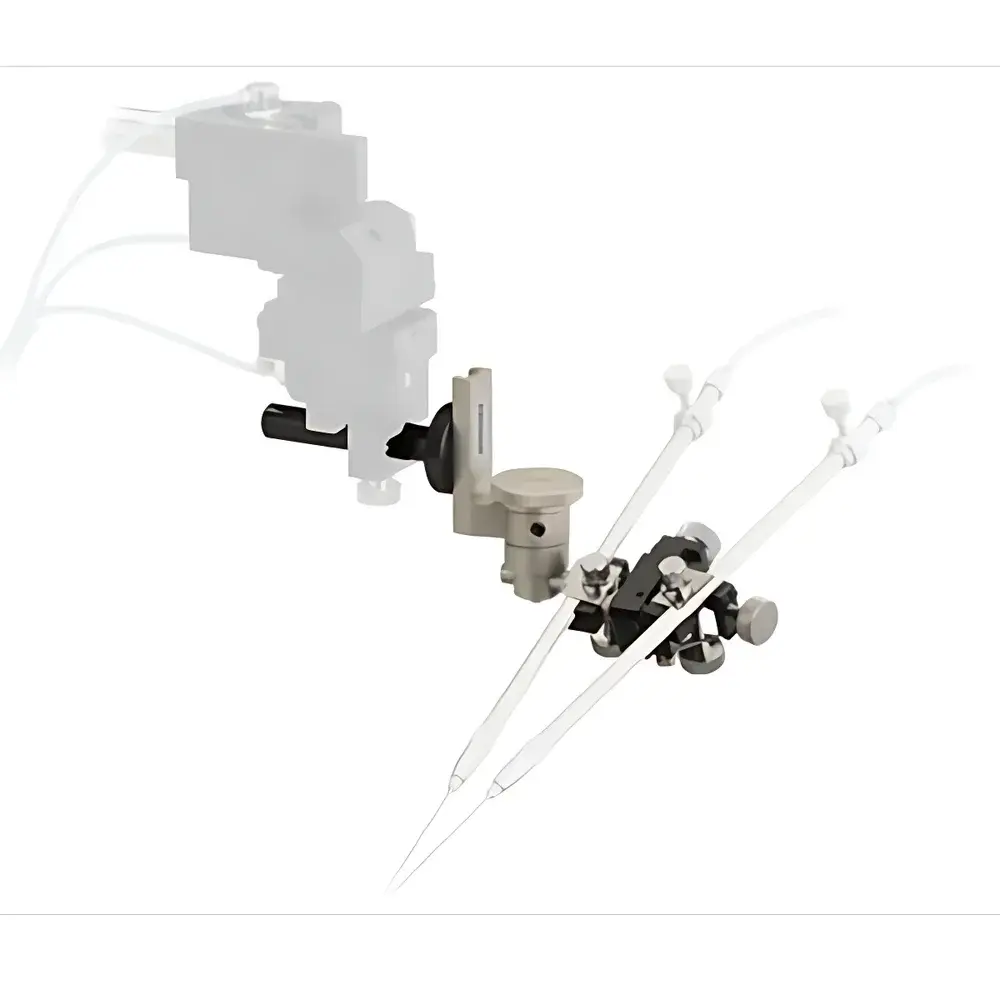
HD-21 Dual Pipette Holder by Narishige
| Brand | Narishige |
|---|---|
| Origin | Japan |
| Model | HD-21 |
| Dimensions (W×D×H) | 127 × 38 × 52 mm |
| Weight | 105 g |
| Material | Corrosion-resistant anodized aluminum alloy |
| Compatibility | Designed for simultaneous mounting of two standard single-channel pipettes onto a three-axis hydraulic micromanipulator (e.g., MO-10, MN-151 series) |
| Alternate Use | Direct replacement for UT-10 universal joint |
| Included Tool | Hex key (2.0 mm) |
Overview
The HD-21 Dual Pipette Holder is an engineered mechanical interface component developed by Narishige—a Japanese manufacturer with over five decades of precision instrumentation heritage in life science and electrophysiology research. Unlike general-purpose lab stands, the HD-21 serves a specific functional role within micro-manipulation workflows: it enables rigid, co-aligned dual-pipette mounting on Narishige’s three-axis hydraulic micromanipulators (e.g., MO-10, MN-151, or NT-81). Its design adheres to the principles of mechanical stability, minimal thermal drift, and repeatable positioning—critical requirements when performing patch-clamp recording, intracellular injection, or dual-probe microinjection protocols. The holder operates on passive mechanical coupling—no electronics, no software dependency—and relies on precisely machined dovetail interfaces and set-screw clamping to maintain sub-millimeter positional fidelity during fine axial adjustments.
Key Features
- Simultaneous dual-pipette fixation: Accommodates two standard 10–200 µL single-channel pipettes with cylindrical shafts (diameter range: 6.8–7.2 mm), enabling coordinated manipulation without cross-interference.
- Direct integration with Narishige hydraulic manipulators: Mounts via standardized M4 threaded holes compatible with MO-series base plates; eliminates need for intermediate adapters or custom brackets.
- Corrosion-resistant construction: CNC-machined from aerospace-grade 6061-T6 aluminum, finished with hard-anodized coating (Type III, 25 µm thickness) for long-term resistance to ethanol, saline, and mild acidic/basic solutions commonly used in electrophysiology buffers.
- Tool-inclusive assembly: Supplied with a 2.0 mm hex key for torque-controlled tightening of all retention screws—ensuring consistent clamping force and preventing pipette tube deformation or slippage.
- Compact footprint and low mass: At 127 × 38 × 52 mm and only 105 g, the HD-21 minimizes inertial load on micromanipulator arms while preserving full range-of-motion in X/Y/Z axes.
- UT-10 replacement functionality: Offers superior rigidity and reduced play compared to the UT-10 universal joint, particularly under lateral loading conditions typical during electrode penetration or tissue probing.
Sample Compatibility & Compliance
The HD-21 is intended for use with glass or plastic pipettes meeting ISO 8655-2 dimensional tolerances for shaft diameter and concentricity. It does not incorporate active sensing or fluidic pathways, and therefore falls outside regulatory scopes requiring medical device classification (e.g., FDA 510(k), CE IVD). However, its material composition complies with ISO 10993-5 (cytotoxicity) and RoHS Directive 2011/65/EU for hazardous substance restriction. In GLP- and GMP-regulated environments, the HD-21 may be included in instrument qualification documentation as a Class II auxiliary component—subject to routine visual inspection and mechanical integrity verification per SOP-QC-07 (holder clamping torque verification every 200 operational hours).
Software & Data Management
The HD-21 is a purely mechanical component and requires no firmware, drivers, or software integration. It does not generate, store, or transmit data. As such, it imposes zero computational overhead and introduces no cybersecurity or audit-trail considerations. When deployed in systems governed by FDA 21 CFR Part 11, the HD-21 is classified as a “non-configurable hardware element” and excluded from electronic record/electronic signature (ER/ES) requirements. Its usage is documented solely through procedural logs (e.g., “HD-21 installed on MO-10 Unit #A721, verified torque: 0.35 N·m”) within laboratory notebooks or LIMS entries.
Applications
- Dual-electrode voltage clamp (DEVC) experiments requiring precise inter-electrode distance control.
- Paired whole-cell recordings in brain slice preparations, where independent XYZ adjustment of pre- and postsynaptic pipettes is essential.
- Microinjection of morpholinos or CRISPR-Cas9 ribonucleoprotein complexes into zebrafish or Xenopus embryos using synchronized bilateral approach.
- Combined extracellular recording and juxtacellular labeling, where one pipette delivers neurobiotin while the other monitors spiking activity.
- Calibration validation of micromanipulator linearity: The HD-21’s fixed center-to-center spacing (32.0 ± 0.1 mm) serves as a physical reference for stage movement accuracy assessment.
FAQ
Can the HD-21 accommodate motorized or electronic pipettes?
No—the HD-21 is dimensionally optimized for manual, air-displacement pipettes with smooth cylindrical barrels. Motorized pipettes often feature asymmetric housings, integrated displays, or non-circular cross-sections that prevent secure clamping.
Is thermal expansion compensated in the HD-21 design?
While no active compensation is implemented, the use of 6061-T6 aluminum (CTE ≈ 23.6 × 10⁻⁶ /°C) ensures predictable, linear dimensional change across typical lab temperature ranges (18–25°C); users performing sub-micron positional work should allow 15-minute thermal equilibration post-installation.
Does Narishige provide calibration certificates for the HD-21?
No—calibration is not applicable to passive mechanical holders. Dimensional conformity to drawing spec HD-21-REV3 is verified during final QA via CMM (coordinate measuring machine) and documented in batch-specific CoC (Certificate of Conformance).
Can the HD-21 be sterilized using autoclaving?
No—autoclaving (121°C, 15 psi) exceeds the thermal limit of the anodized layer and may compromise screw thread integrity. Wipe disinfection with 70% ethanol or 0.5% sodium hypochlorite is recommended.



