
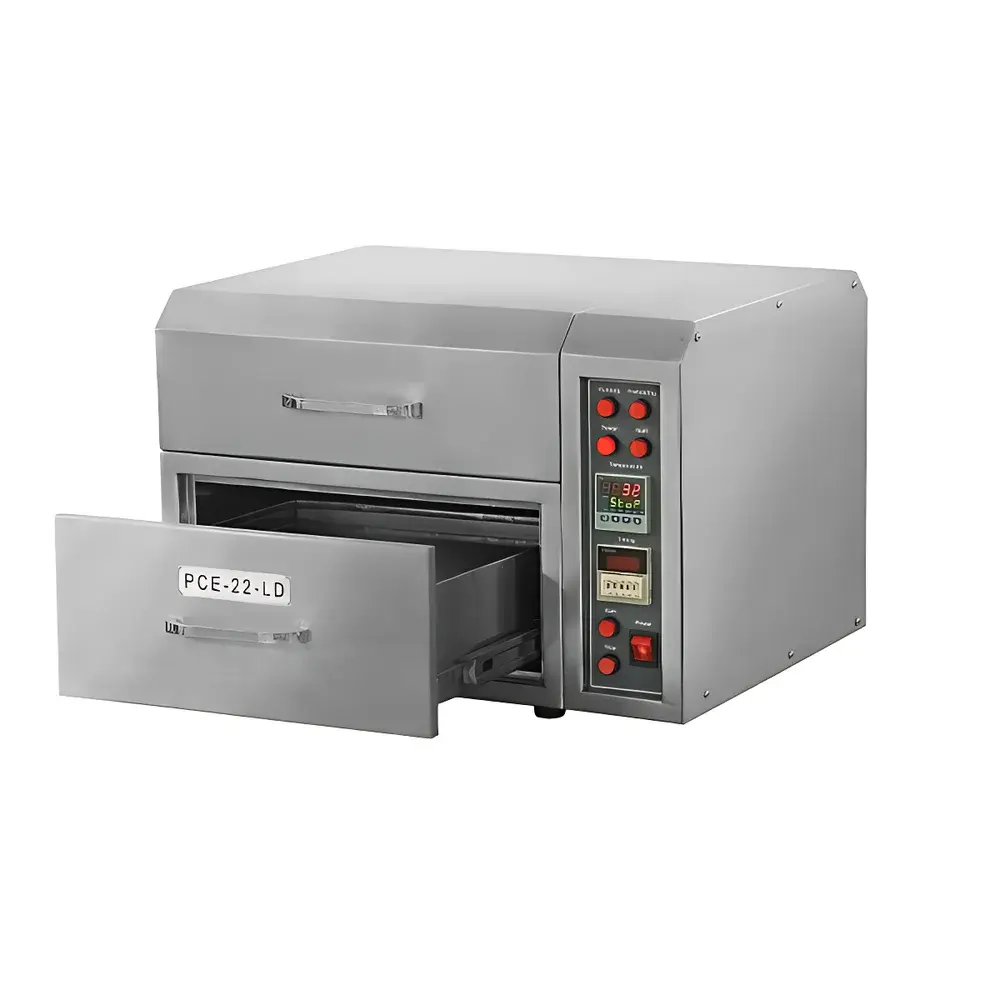
Heated UV-Ozone Cleaner PCE-22 by Hefei Kejing
| Brand | Hefei Kejing |
|---|---|
| Model | PCE-22 |
| Type | Heated UV-Ozone Surface Cleaning System |
| Chamber Dimensions | 310 mm × 320 mm (L × W) |
| UV Lamp Output | 254 nm and 185 nm |
| UV Power | 55 W |
| Max Heating Temperature | 150 °C |
| Temperature Control Accuracy | ±1 °C |
| Programmable Ramp/Soak Stages | 20 segments |
| Timer Range | 0.01 s – 99.9 h |
| Exhaust Port Diameter | 80 mm |
| Net Weight | 28 kg |
| Power Supply | AC 208–240 V, 50/60 Hz, Single Phase |
| UV Lamp Lifetime | 2500 h |
| Construction | Stainless Steel Enclosure with Drawer-Type Sample Stage |
| Adjustable UV-to-Sample Distance | 20–40 mm |
Overview
The Hefei Kejing PCE-22 Heated UV-Ozone Cleaner is a precision-engineered surface treatment system designed for atomic-level, solvent-free cleaning of substrates in semiconductor fabrication, microelectronics research, nanomaterial synthesis, and advanced microscopy preparation. Unlike wet chemical or plasma-based methods, this instrument utilizes synergistic photochemical oxidation driven by dual-wavelength ultraviolet irradiation (185 nm and 254 nm) in ambient air, combined with programmable thermal activation up to 150 °C. The 185 nm photons photodissociate molecular oxygen (O₂) to generate atomic oxygen and subsequently ozone (O₃), while 254 nm photons directly cleave C–C, C–H, and C–O bonds in organic contaminants—enabling rapid decomposition of hydrocarbons, photoresists, lubricants, and adventitious carbon layers. Integrated resistive heating enhances reaction kinetics, particularly for thermally stable residues, without inducing substrate stress or interfacial diffusion. The system operates as a closed yet actively vented chamber, ensuring operator safety and environmental compliance through external ozone abatement via the rear-mounted 80 mm exhaust port.
Key Features
- Stainless steel chamber with drawer-style sample stage for reproducible loading/unloading and optimal UV exposure uniformity across a 200 mm × 200 mm irradiation zone
- Dual-band low-pressure mercury UV lamp (55 W) emitting at precisely 185 nm and 254 nm—calibrated for maximum photochemical efficiency and traceable spectral output
- Programmable temperature control with ±1 °C accuracy and up to 20 independent ramp/soak segments, enabling precise thermal profiling for process optimization
- Time resolution down to 0.01 seconds and total runtime up to 99.9 hours, supporting both rapid surface activation and extended oxidative treatment protocols
- Adjustable vertical spacing (20–40 mm) between UV source and sample stage to balance photon flux density and thermal gradient across diverse substrate geometries and thicknesses
- Integrated ozone ventilation module with dedicated exhaust interface—designed for connection to building exhaust ducting or catalytic ozone destruct units per OSHA and NIOSH exposure guidelines
Sample Compatibility & Compliance
The PCE-22 accommodates rigid planar substrates up to 310 mm × 320 mm, including silicon wafers, germanium, GaAs, sapphire, fused silica, quartz, ITO-coated glass, and oxidized metal surfaces. Its dry, non-abrasive cleaning mechanism preserves nanoscale topography and avoids ion implantation or surface charging—critical for TEM grid preparation, AFM tip conditioning, and MEMS device release. The system conforms to fundamental safety requirements outlined in IEC 61010-1 (Electrical Safety for Laboratory Equipment) and supports laboratory adherence to ISO 14644-1 (cleanroom particulate control) and ASTM F2617 (standard guide for UV-ozone surface cleaning of silicon wafers). While not inherently GLP/GMP-certified, its programmable parameters, repeatable thermal profiles, and timestamped operation logs facilitate audit-ready documentation when integrated into validated workflows.
Software & Data Management
The PCE-22 employs an embedded microcontroller-based interface with tactile membrane keypad and LCD display—optimized for reliability and electromagnetic compatibility in shared lab environments. All operational parameters (UV exposure time, temperature setpoint, ramp rates, soak durations) are stored in non-volatile memory and retain configuration after power cycling. Though it does not feature Ethernet or USB connectivity, the unit supports manual data recording compatible with laboratory information management systems (LIMS) via standardized parameter logging. For regulated environments requiring electronic records, users may implement external time-stamped video monitoring or integrate the timer relay output (optional accessory) with PLC-based supervisory control systems compliant with FDA 21 CFR Part 11 when paired with appropriate audit-trail software.
Applications
- Removal of sub-monolayer organic contamination from SEM/TEM specimen stubs, grids, and electron-transparent windows
- Photoresist stripping and sidewall residue reduction prior to thin-film deposition (e.g., ALD, PVD, CVD)
- Surface hydrophilization of PDMS, PET, and polyimide for microfluidic bonding and biofunctionalization
- Pre-deposition cleaning of optical coatings substrates to minimize defect density and improve film adhesion
- UV-assisted catalytic oxidation of volatile organic compounds (VOCs) adsorbed on sensor platforms and gas-sensing films
- In situ activation of catalyst supports (e.g., TiO₂, ZnO) and functionalization of graphene oxide surfaces
FAQ
Does the PCE-22 generate ozone internally, and how is operator safety ensured?
Yes—the 185 nm UV radiation dissociates ambient O₂ to produce ozone inside the chamber. Safety is maintained via mandatory external exhaust: the 80 mm rear port must be connected to a fume hood or ozone-destruct system meeting OSHA PEL (0.1 ppm, 8-hr TWA) and NIOSH REL (0.1 ppm, 10-hr TWA) limits.
Can the UV lamp be replaced in-house, and what is its calibration traceability?
The lamp is field-replaceable using OEM part number KJ-UV-LAMP-254185. While intensity decay is not monitored in real time, spectral output remains stable within ±5% over its rated 2500-hour lifetime; users may verify irradiance with NIST-traceable UV radiometers (e.g., ILT950UV) during periodic maintenance.
Is the heated stage compatible with vacuum or inert-gas purged operation?
No—the system is engineered for ambient-air operation only. Introducing inert gases or vacuum would suppress ozone generation and disrupt the photochemical cleaning mechanism; alternative configurations require custom engineering and are outside standard warranty coverage.
What is the minimum detectable contaminant layer thickness this system can remove?
Under optimized conditions (150 °C, 30-min exposure), the PCE-22 achieves removal of organic monolayers ≤0.3 nm thick—as verified by XPS C1s peak suppression and water contact angle reduction from >90° to <10° on SiO₂/Si.
How does thermal activation enhance cleaning efficacy compared to room-temperature UV-ozone alone?
Elevated temperature increases surface mobility of adsorbed radicals (e.g., •OH, O•), accelerates desorption of volatile oxidation byproducts (CO₂, H₂O), and lowers activation energy for scission of recalcitrant C–C bonds—yielding up to 4× faster carbon removal rate on cured photoresist films.



