
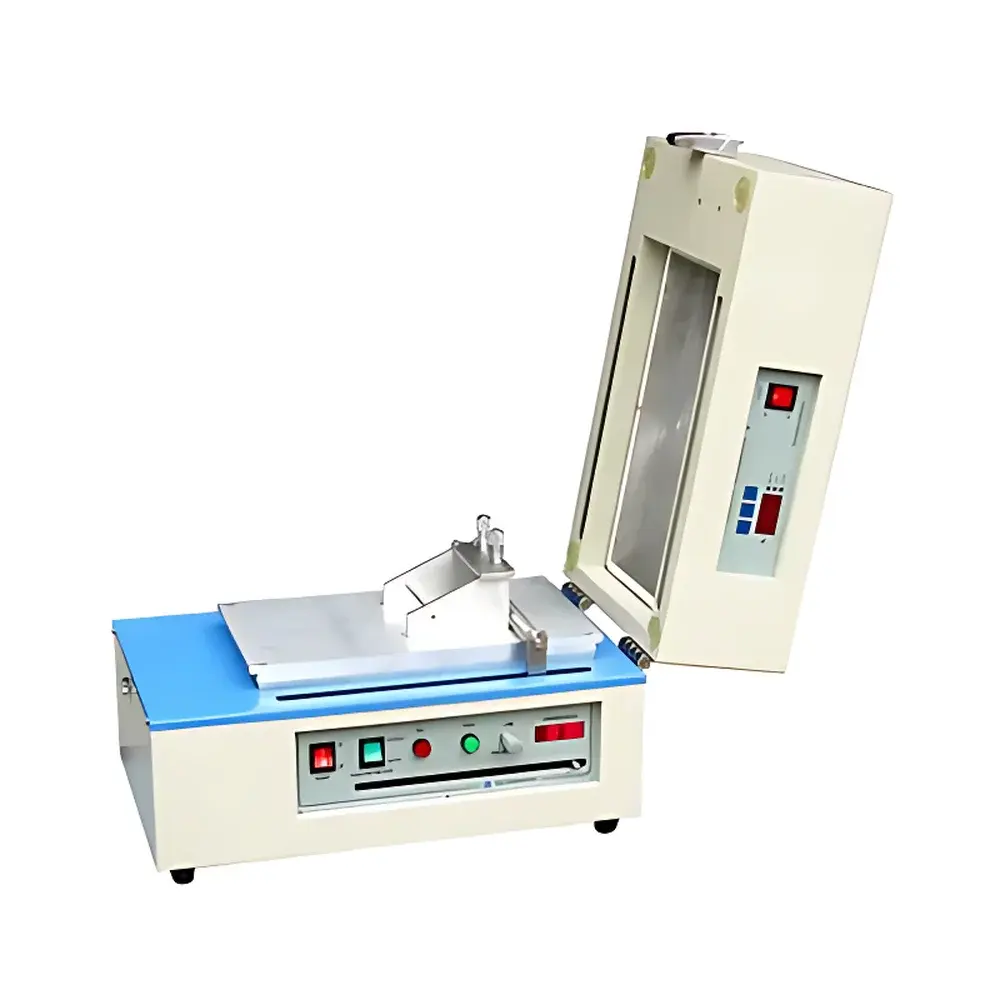
Hefei Kejing MSK-AFA-III Automated Doctor Blade Coater with Integrated Hot-Air Drying Chamber
| Brand | Hefei Kejing |
|---|---|
| Origin | Anhui, China |
| Model | MSK-AFA-III |
| Instrument Type | Benchtop Box-Type Coating & Drying System |
| Max Temperature | 200°C |
| Temperature Control Accuracy | ±1°C |
| Max Heating Power | 1500 W |
| Max Ramp Rate | 10°C/min |
| Push Rod Travel | 10–250 mm (adjustable) |
| Push Rod Speed | 0–100 mm/sec (adjustable, ±10 mm/sec repeatability) |
| Vacuum Platen Dimensions | 365 mm × 200 mm (Aluminum) |
| Coater Blade Width | 100 mm (adjustable gap: 0.01–3.5 mm) |
| Overall Dimensions | 550 mm × 330 mm × 320 mm (L×W×H) |
| Certification | CE |
Overview
The Hefei Kejing MSK-AFA-III is a compact, benchtop automated doctor blade coater engineered for reproducible thin-film deposition and in-situ thermal drying—specifically optimized for solid-state electrolyte layers, lithium-ion battery cathode/anode slurries, functional polymer films, and ceramic precursor coatings. Unlike conventional manual or semi-automated coaters, the MSK-AFA-III integrates two synchronized functional modules: a precision linear motion system for controlled blade traversal and an independently regulated hot-air drying chamber mounted on the hinged upper lid. The system operates on the principle of meniscus-controlled wet-film formation under vacuum-assisted substrate immobilization, followed by convective thermal curing within a thermally stable, insulated cavity. This dual-stage architecture eliminates post-coating handling, minimizes solvent-induced defects (e.g., coffee-ring effects, edge beading), and enables direct correlation between coating parameters (gap height, speed, vacuum level) and dried film morphology—critical for R&D scalability and process transfer to pilot-scale slot-die or roll-to-roll systems.
Key Features
- Vacuum-adhered aluminum platen (365 × 200 mm) ensures flat, wrinkle-free substrate fixation during coating—compatible with glass, silicon wafers, metal foils, and flexible polymer substrates up to 0.5 mm thickness.
- Motorized push rod with digitally adjustable speed (0–100 mm/sec, ±10 mm/sec repeatability) and programmable stroke (10–250 mm) delivers consistent shear rate across the entire coated area.
- Adjustable doctor blade (100 mm width, gap range: 0.01–3.5 mm) fabricated from hardened stainless steel; optional 55 mm micrometer-adjustable blade available for sub-10 µm wet-film control.
- Integrated top-mounted drying chamber with PID-controlled resistive heating elements, achieving uniform temperature distribution (±1°C accuracy at setpoint) and ramp rates up to 10°C/min up to 200°C.
- CE-certified electrical architecture compliant with IEC 61010-1 for laboratory equipment safety; all heating circuits include overtemperature cut-off and thermal fusing.
- Modular design supports seamless integration of optional accessories: vacuum deaeration mixer (120 L/min capacity) for slurry homogenization and viscosity-controlled dispensing, and inline viscometer coupling for real-time rheological feedback during coating trials.
Sample Compatibility & Compliance
The MSK-AFA-III accommodates substrates ranging from rigid 4″ wafers to flexible PET/PI films (max. 300 mm × 200 mm). Its vacuum platen tolerates surface roughness ≤ 1.6 µm Ra and supports static load up to 5 kg. All wet-contact components (blade, platen, feed trough) are chemically inert to common battery slurry solvents (NMP, DMF, aqueous PAA dispersions) and compatible with ISO 8502-3 surface cleanliness protocols. The instrument meets CE marking requirements per Directive 2014/35/EU (Low Voltage Directive) and 2014/30/EU (EMC Directive). While not GMP-certified out-of-the-box, its temperature logging capability (via external USB data logger) and repeatable mechanical actuation support GLP-aligned documentation for QC/QA workflows in battery material development labs.
Software & Data Management
The MSK-AFA-III operates via front-panel digital interface with dedicated parameter presets (speed, stroke, dwell time, temperature ramp profile). No proprietary software is required; however, optional RS-232 or USB-to-serial connectivity enables integration with LabVIEW™ or Python-based automation scripts for batch parameter logging. Temperature profiles are traceable via built-in thermocouple (Type K) with 0.1°C resolution and ±0.5°C calibration uncertainty (as verified per ASTM E220). All operational events—including vacuum activation, blade start/stop, and heating cycle initiation—are timestamped and can be exported as CSV for audit trail generation in accordance with FDA 21 CFR Part 11 principles when paired with validated third-party data acquisition software.
Applications
- Preparation of solid polymer electrolyte membranes (e.g., PEO-LiTFSI) with controlled thickness gradients for impedance spectroscopy validation.
- Rapid prototyping of NMC, LFP, or Si-C composite electrodes—enabling systematic study of binder distribution, porosity evolution, and calendering response.
- Deposition of perovskite precursor layers (e.g., MAPbI₃ in DMF/DMSO) with in-situ annealing to suppress pinhole formation.
- Functional coating of antireflective, conductive (ITO, PEDOT:PSS), or barrier (Al₂O₃ sol-gel) layers on optical and flexible electronics substrates.
- Method development for ASTM D823 (Standard Practice for Producing Films of Uniform Thickness) and ISO 2808 (Paints and Varnishes—Determination of Film Thickness).
FAQ
What substrate materials are compatible with the vacuum platen?
Glass slides, silicon wafers, aluminum/copper foil (≥10 µm thickness), stainless steel strips, and polyimide or PET films—with surface energy ≥38 mN/m and flatness deviation <50 µm over 200 mm.
Can the drying chamber operate independently of the coating module?
Yes—the upper lid heating system functions as a standalone hotplate mode when the push rod is parked and the blade retracted, enabling post-deposition thermal treatment of manually coated samples.
Is the temperature profile programmable (e.g., hold steps, multi-segment ramps)?
No—the standard unit supports single-setpoint operation only; multi-step thermal profiles require external PID controller interfacing via analog voltage input (0–10 V) on the optional I/O expansion port.
What maintenance is required for long-term vacuum integrity?
The integrated vacuum seal uses fluorosilicone gasketing rated for >10,000 cycles; users should inspect gasket compression and clean platen surface with isopropanol after each slurry-based run to prevent residue buildup.
Does the system comply with UL or CSA safety standards?
It carries CE certification per EU directives but does not hold UL 61010-1 or CSA C22.2 No. 61010-1 listing; laboratories requiring North American regulatory alignment must engage a certified test lab for field evaluation prior to installation.



