
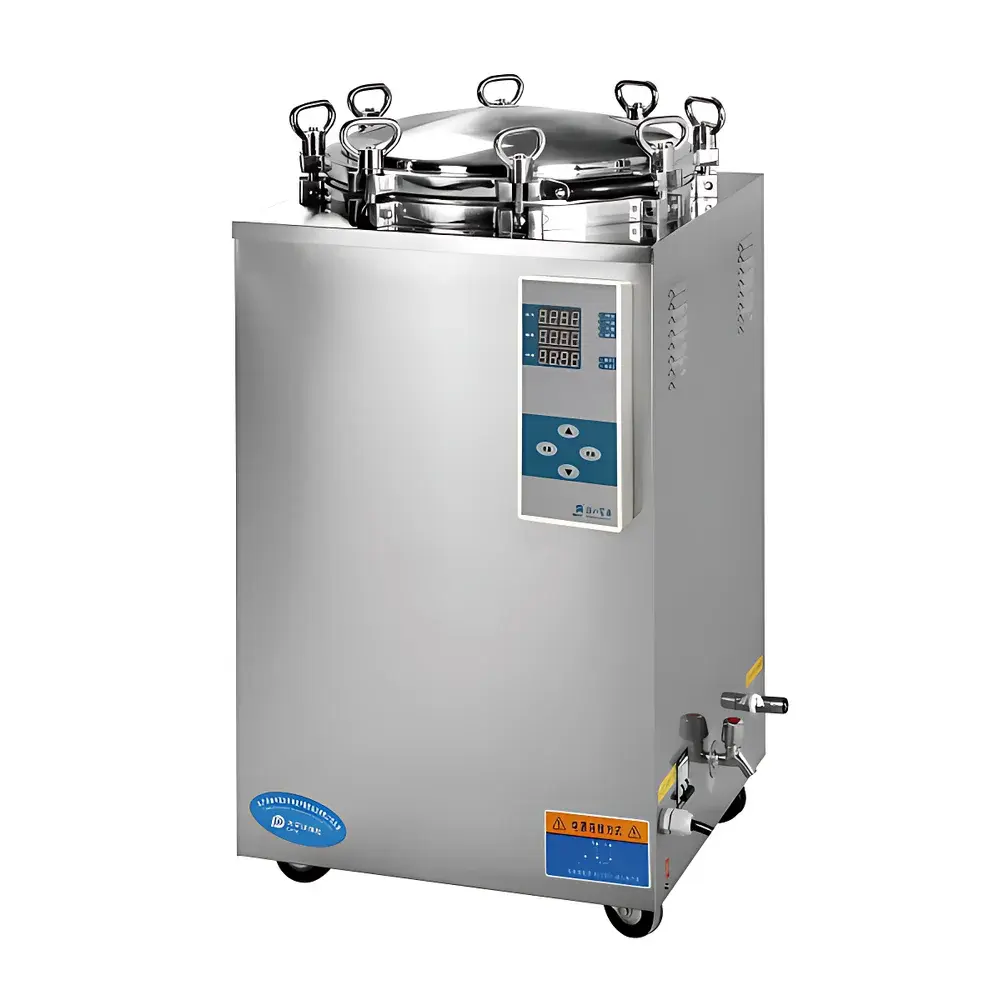
Heineu LS-120LD Vertical Steam Autoclave
| Brand | Heineu (Jihepu) |
|---|---|
| Origin | Shandong, China |
| Model | LS-120LD |
| Sterilization Chamber Volume | 120 L |
| Maximum Operating Temperature | 134 °C |
| Maximum Operating Pressure | 0.22 MPa |
| External Dimensions | 600 × 640 × 1140 mm |
| Heating Power | 6 kW |
| Supply Voltage | AC 220 V, 50 Hz |
| Temperature Uniformity | ≤ ±1 °C |
| Timer Range | 0–99 min |
| Temperature Control Range (Sterilization) | 105–134 °C |
| Temperature Control Range (Boiling Mode) | 50–101 °C |
| Safety Features | Dry-run overheat protection, pressure relief valve, current overload cutoff, earth leakage protection |
| Net Weight | 100 kg |
| Gross Weight | 125 kg |
Overview
The Heineu LS-120LD Vertical Steam Autoclave is a fully automatic, microprocessor-controlled laboratory sterilization system engineered for precision, safety, and regulatory compliance in demanding biomedical and research environments. Based on saturated steam under controlled pressure—governed by the fundamental principle that microbial inactivation follows predictable Arrhenius kinetics—the LS-120LD delivers validated thermal lethality (F0) across its 120 L stainless-steel chamber. It operates within the internationally recognized sterilization envelope of 121 °C at 0.11 MPa (15 psi) and 134 °C at 0.22 MPa (32 psi), meeting minimum exposure requirements per ISO 17665-1:2017 and EN 285:2015 for porous load and wrapped item sterilization. Designed for unattended operation, it integrates real-time monitoring of chamber temperature, pressure, and elapsed cycle time, with automated phase transitions between pre-vacuum air removal, sterilization hold, exhaust, and drying—ensuring consistent bioburden reduction (≥10−6 SAL) without operator intervention.
Key Features
- Fully automated digital control system with LED display showing real-time temperature, pressure, remaining time, and active phase (pre-vacuum, heating, sterilizing, exhaust, drying)
- Dual-mode thermal control: sterilization range (105–134 °C) and boiling mode (50–101 °C) for non-sterile applications such as media preparation or instrument cleaning
- Integrated automatic air removal system using gravity displacement and dynamic venting to ensure complete steam penetration and eliminate cold spots
- High-efficiency immersed tubular heating elements (6 kW total) delivering rapid, uniform heat-up with ≤ ±1 °C chamber temperature uniformity per ISO 17665 Annex C
- Redundant safety architecture: spring-loaded safety valve (ASME-certified set point at 0.24 MPa), dry-run overheat sensor, dual-pole circuit breaker, and residual-current device (RCD) for earth leakage protection
- 304 stainless steel chamber and door gasket—electropolished interior surface for corrosion resistance, cleanability, and compliance with ISO 15883-1 hygiene standards
- Auto-cycle termination with audible alarm, passive pressure release, and automatic power cutoff upon program completion
Sample Compatibility & Compliance
The LS-120LD accommodates a broad spectrum of load types—including wrapped surgical kits, unwrapped instruments, glassware, liquid media (in vented containers), and porous textiles—within its 120 L chamber. Its gravity-displacement air removal mechanism is validated for Class N (non-porous) and Class S (mixed) loads per EN 13060:2014. While not certified for Class B vacuum-assisted cycles (e.g., hollow instruments), it fulfills essential requirements for routine lab sterilization where validation records are maintained per GLP and internal SOPs. The unit supports basic documentation via manual logbook entry; optional RS-232 or USB data export enables traceable cycle parameter logging compatible with FDA 21 CFR Part 11–aligned archive systems when paired with compliant third-party software.
Software & Data Management
The embedded controller provides non-volatile memory for up to 99 programmable cycles, each configurable for target temperature, dwell time, pre-vacuum duration, and exhaust rate. Cycle logs—including start time, peak temperature, minimum/maximum pressure, and fault codes—are retained for ≥1,000 cycles. Though the base model lacks built-in Ethernet or cloud connectivity, its serial interface permits integration with laboratory information management systems (LIMS) or electronic batch record (EBR) platforms via standard Modbus RTU protocol. All firmware updates are performed offline via USB key, ensuring data integrity and avoiding network-based vulnerabilities. Audit trail functionality is implemented at the hardware level for critical events (e.g., door open during cycle, safety valve activation), satisfying foundational GMP documentation expectations.
Applications
This autoclave serves core sterilization workflows across academic, clinical, and industrial laboratories. Typical use cases include: terminal sterilization of reusable surgical tools and dental handpieces; depyrogenation of glass vials and pipettes prior to aseptic processing; preparation of agar plates and broth media for microbiological culture; decontamination of biohazardous waste (BSC-generated sharps, solid cultures); and heat-labile material conditioning where precise thermal ramping minimizes thermal shock. Its 134 °C capability enables shorter cycle times for flash sterilization of unwrapped items—subject to institutional policy and local infection control guidelines. The boiling mode extends utility to labware rinsing, water bath pre-conditioning, and low-risk equipment sanitization.
FAQ
What is the maximum validated load capacity for wrapped instruments at 134 °C?
The chamber volume is 120 L, but effective load capacity depends on packaging density and steam permeability. For wrapped sets, we recommend ≤70% chamber fill volume to ensure adequate steam circulation and air removal.
Does the LS-120LD comply with ISO 13485 or FDA 510(k) requirements?
It is manufactured to meet general electrical safety (IEC 61010-1) and pressure equipment directives (PED 2014/68/EU via CE marking). However, it is not individually registered as a medical device under FDA or notified body certification—users must perform site-specific validation per ISO 17665.
Can liquid media be sterilized without boil-over?
Yes—when using the dedicated liquid cycle (with slower exhaust and extended dwell), the controller modulates pressure release to prevent container rupture. Users must employ vented closures and limit fill volume to ≤75% of container capacity.
Is routine maintenance required beyond daily draining and weekly gasket inspection?
Yes. Quarterly verification of safety valve set point, annual calibration of temperature and pressure sensors against NIST-traceable references, and biannual chamber leak testing (per EN 285 Annex D) are strongly recommended to sustain performance and audit readiness.
What is the expected service life under continuous lab use?
With adherence to manufacturer-recommended maintenance intervals and proper water quality (deionized or softened water only), the unit demonstrates >10 years of operational reliability—supported by replaceable components including heaters, solenoid valves, and control boards.



