
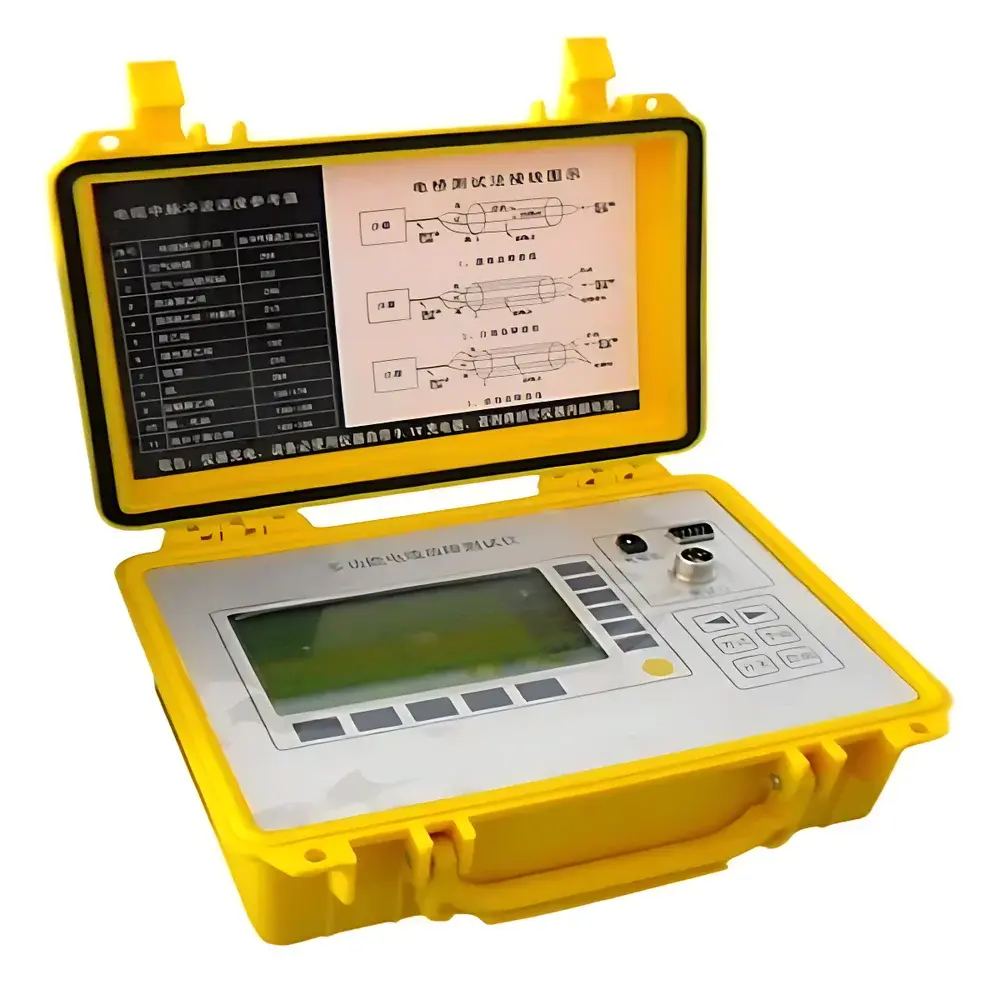
HengaoDe HAD-iT-8390 Cable Fault Locator with Pulse Reflection Testing Method
| Brand | HengaoDe |
|---|---|
| Origin | Beijing, China |
| Manufacturer Type | Authorized Distributor |
| Country of Origin | China |
| Model | HAD-iT-8390 |
| Pricing | Upon Request |
Overview
The HengaoDe HAD-iT-8390 Cable Fault Locator is an integrated diagnostic instrument engineered for precise localization of electrical faults in metallic telecommunications cables—including lead-sheathed telephone cables, all-plastic cables, and subscriber drop wires. It operates primarily on the time-domain reflectometry (TDR) principle—specifically pulse reflection testing—where a fast-rise electrical pulse is injected into the cable, and reflections generated at impedance discontinuities (e.g., open circuits, short circuits, insulation degradation, or poor terminations) are captured and analyzed to determine fault distance. Complemented by intelligent bridge testing for low-resistance and high-resistance fault characterization, the HAD-iT-8390 delivers a dual-method approach aligned with industry-standard practices defined in ITU-T G.826, IEC 60255-24, and ANSI/TIA-568.3-D for copper cable certification and maintenance. Its design targets field technicians performing rapid fault isolation during emergency restoration, routine line audits, and post-installation commissioning verification under real-world environmental constraints.
Key Features
- Dual-mode operation: Pulse reflection testing (TDR) for distance-to-fault estimation and intelligent bridge testing for resistance-based fault classification (e.g., leakage, partial shorts, high-impedance grounds).
- Automated test sequence execution: One-button initiation triggers adaptive pulse width selection (80 ns to 10 µs), automatic gain control, and impedance balancing—eliminating manual calibration drift and operator dependency.
- Integrated metrology functions: Built-in megohmmeter (0–100 MΩ insulation resistance) and loop ohmmeter (0–2 kΩ continuity check), compliant with IEEE 43 and IEC 60204-1 safety verification protocols.
- Non-volatile waveform storage: Up to 10 trace waveforms retained across power cycles—enabling comparative analysis without external printing or data logging hardware.
- Environmental robustness: Encased in a Pelican™ IP67-rated polyethylene housing (MIL-STD-810G certified for shock, vibration, and immersion), rated for continuous operation from –10 °C to +50 °C and 95% RH non-condensing.
- Human-factor optimized interface: Backlit monochrome LCD with full Chinese-language menu navigation; rechargeable Li-ion battery with smart charging circuitry (no supervision required); NIST-traceable calibration reference points embedded in firmware.
Sample Compatibility & Compliance
The HAD-iT-8390 supports copper conductor cables with nominal diameters ranging from 0.3 mm to 0.99 mm (AWG 26–18), including but not limited to PVC-jacketed twisted pair, PE-insulated distribution cables, and armored underground feeder lines. It is validated for use with both balanced and unbalanced transmission lines up to 8 km in length. The instrument conforms to electromagnetic compatibility requirements per EN 61326-1 (industrial environment), safety standards per IEC 61010-1 CAT III 300 V, and carries CE marking for EU market access. For regulated infrastructure applications (e.g., telecom carrier networks), test records generated via optional RS-485 output may be archived with timestamped metadata to satisfy GLP audit trails when integrated with validated data acquisition software.
Software & Data Management
While the HAD-iT-8390 operates as a standalone field instrument, its RS-485 serial interface (Modbus RTU protocol) enables integration with PC-based asset management platforms. When paired with optional RS232-to-USB adapters and vendor-provided configuration utilities, users can export waveform traces in CSV format, annotate fault locations with GPS-tagged metadata, and generate PDF-formatted test reports compliant with ISO/IEC 17025 documentation requirements. Firmware updates are delivered via secure USB memory stick—ensuring version control integrity without internet connectivity. No cloud dependency or proprietary runtime environments are required.
Applications
- Emergency fault location in PSTN and legacy broadband access networks following lightning strikes or excavation damage.
- Pre-commissioning validation of new cable plant installations per Telcordia GR-902-CORE specifications.
- Periodic health assessment of aging copper infrastructure in rural and urban exchange areas.
- Verification of splice integrity and termination quality during fiber-co-location projects where copper auxiliary power or alarm circuits remain active.
- Educational use in telecommunications engineering laboratories for hands-on TDR theory instruction and signal propagation analysis.
FAQ
What is the minimum resolvable fault distance in short cable runs?
For cable lengths under 2 km, the pulse reflection method achieves ±1 m resolution (typical), verified using calibrated open-circuit stubs per IEC 61190-1-1 Annex B.
Can the device measure faults in shielded or armored cables?
Yes—provided the metallic shield is bonded at both ends and does not form a closed current loop; ground return path integrity must be confirmed prior to testing.
Is firmware calibration traceable to national standards?
Internal calibration references are maintained against NIST-traceable pulse generators and impedance standards; full calibration certificates are issued upon request with annual recalibration service.
Does the instrument support third-party data aggregation systems?
Yes—Modbus RTU implementation allows interoperability with SCADA, CMMS, and network operations center (NOC) dashboards using standard industrial communication gateways.
What maintenance is required for long-term accuracy?
No routine mechanical adjustment is needed; periodic verification (annually or after 500+ test cycles) against known-length cable samples is recommended per manufacturer’s maintenance schedule.






