
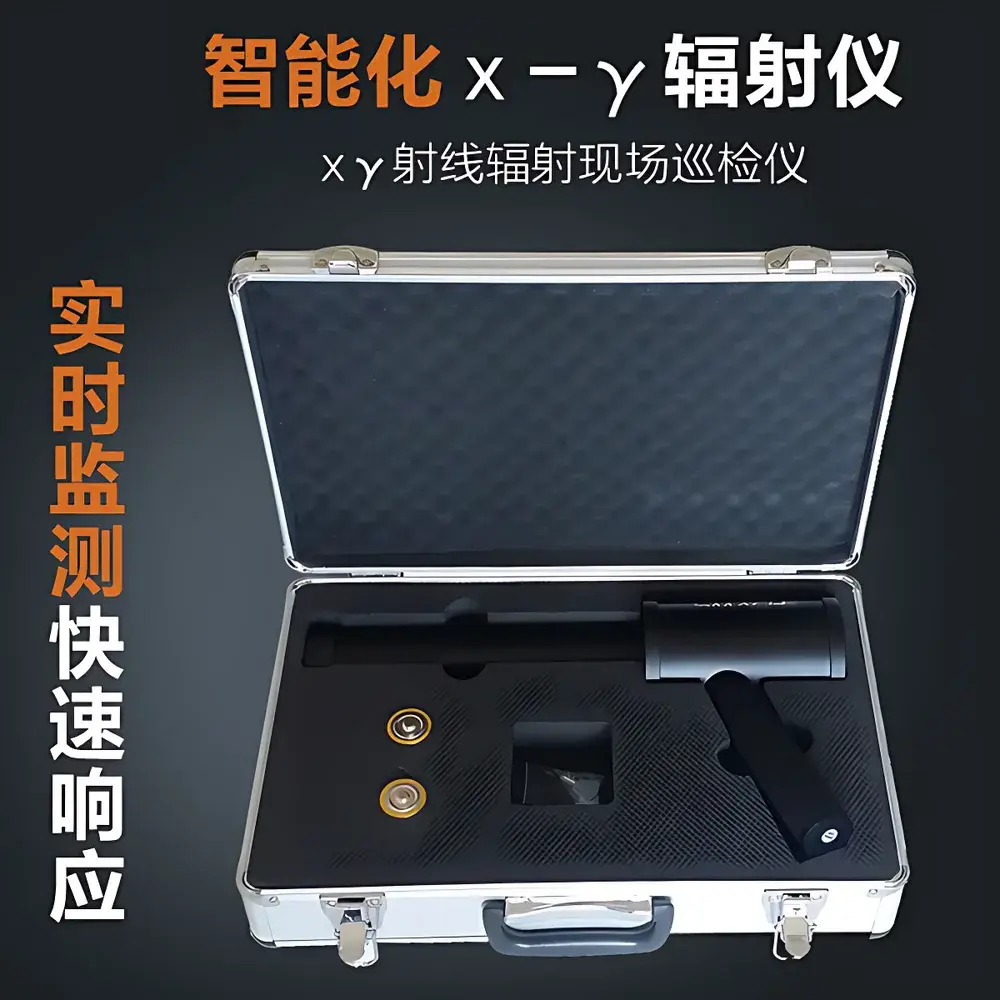
SMACH RD300 Portable X-γ Radiation Survey Meter
| Brand | SMACH |
|---|---|
| Model | RD300 |
| Type | Portable Dose Rate Meter |
| Detector | Ø30×25 mm NaI(Tl) Scintillation Crystal |
| Radiation Types | X-ray & Gamma-ray |
| Dose Rate Range | 0.01–600.00 µSv/h |
| Accumulated Dose Range | 0.00 µSv–999.9 Sv |
| Sensitivity | ≥350 cps per µSv/h |
| Energy Response | 48 keV–3 MeV |
| Accuracy | ≤±5% at 200.00 µSv/h |
| Measurement Time | 5–120 s (user-configurable) |
| Display | Backlit Color LCD with Adjustable Brightness |
| Units | µSv/h, µGy/h, µSv, CPS |
| Operating Temperature | −10°C to +50°C |
| Power | Rechargeable Li-ion battery + 2×D-cell backup |
| Weight | 1.55 kg (with battery) |
| Dimensions | 420 × 180 × 88 mm |
| Housing | Anodized Aluminum Alloy |
| Compliance | Meets IEC 60846-1:2014 and GB/T 10257–2022 requirements for portable radiation survey instruments |
Overview
The SMACH RD300 Portable X-γ Radiation Survey Meter is a high-sensitivity, field-deployable instrument engineered for accurate real-time measurement of ambient dose equivalent rate (H*(10)) and accumulated dose in environments exposed to ionizing X-ray and gamma radiation. Based on thallium-doped sodium iodide (NaI(Tl)) scintillation detection technology, the RD300 leverages the high light yield and favorable energy response characteristics of NaI crystals to deliver reliable performance across a broad photon energy range—from 48 keV (e.g., Am-241) up to 3 MeV (e.g., Co-60). Its detector geometry (Ø30 × 25 mm) is optimized for sensitivity and angular response uniformity under varied irradiation geometries. The instrument operates on the principle of pulse-height analysis of scintillation photons converted via photomultiplier tube (PMT) or silicon photomultiplier (SiPM) readout—calibrated to traceable standards per ISO/IEC 17025-accredited laboratories. Designed for compliance with international radiation protection frameworks—including ICRP recommendations and IAEA Safety Standards—the RD300 serves as a primary tool for routine area monitoring, source verification, and emergency response in regulated and non-regulated settings.
Key Features
- High-sensitivity NaI(Tl) scintillation detector with ≥350 cps per µSv/h nominal sensitivity and flat energy response from 48 keV to 3 MeV
- Dual-mode operation: real-time continuous measurement and user-defined timed acquisition (5–120 seconds)
- Simultaneous display of ambient dose equivalent rate (µSv/h), absorbed dose rate (µGy/h), accumulated dose (µSv/Sv), and count rate (CPS)
- Configurable dual-threshold alarms for both dose rate and accumulated dose, with audible, visual, and vibration alerts
- Auto-calibration function supporting periodic in-field verification against reference sources without external software
- Backlit color LCD with adjustable brightness for operation under low-light or direct sunlight conditions
- Bilingual interface (English & Chinese) compliant with multilingual operational requirements in international field deployments
- Rugged anodized aluminum housing rated for IP54 ingress protection, suitable for outdoor and industrial environments
- Dual-power architecture: integrated rechargeable Li-ion battery (≥24 h typical runtime) plus optional 2×D-cell mechanical backup
- On-device data logging with timestamped alarm records, accessible via USB interface and exportable in CSV format
Sample Compatibility & Compliance
The RD300 is validated for use with common gamma-emitting radionuclides including 137Cs (662 keV), 60Co (1.17 & 1.33 MeV), 241Am (59.5 keV), and 192Ir (300–612 keV), as well as diagnostic and therapeutic X-ray spectra (e.g., 60–150 kVp). It conforms to IEC 60846-1:2014 (Radiation protection instrumentation — Ambient and/or directional dose equivalent (rate) meters and/or monitors for beta, X and gamma radiation), and satisfies technical criteria outlined in GB/T 10257–2022 (Chinese national standard for portable radiation survey meters). While not certified for use in safety-critical nuclear facility control rooms, it meets GLP-aligned documentation requirements for environmental monitoring programs and supports audit-ready record retention for regulatory submissions under EPA, NRC, or national radiation protection authorities.
Software & Data Management
Data retrieval is performed via standard USB 2.0 interface using vendor-provided PC application compatible with Windows 10/11. The software enables configuration of alarm thresholds, measurement duration, unit preferences, and date/time synchronization. All logged events—including dose rate excursions, threshold breaches, battery warnings, and detector fault codes—are time-stamped and stored with device serial number and firmware version. Exported datasets include metadata required for ISO/IEC 17025-compliant reporting (e.g., uncertainty contributions, calibration certificate traceability ID). No cloud connectivity or remote telemetry is implemented; all data remains under local operator control to comply with ITAR and national data sovereignty regulations applicable to radiation instrumentation.
Applications
- Routine environmental surveillance around nuclear medicine departments, radiotherapy bunkers, and PET cyclotron facilities
- Field assessment of contaminated sites during radiological emergency response (e.g., orphan source recovery, transport incident mitigation)
- Regulatory compliance checks in industrial radiography (NDT), scrap metal recycling, and border radiation portal monitoring
- Occupational exposure monitoring for personnel working with sealed sources or X-ray generating equipment
- Educational use in university health physics laboratories for hands-on dosimetry training and shielding validation experiments
- Long-term trend analysis of background radiation levels in geological surveys and mining operations
FAQ
What radiation types does the RD300 detect?
The RD300 is optimized for X-ray and gamma-ray photons. It is not sensitive to alpha, beta, or neutron radiation.
Is the instrument suitable for personal dosimetry?
No—it is a survey meter intended for area monitoring. Personal dosimeters (e.g., TLD or OSL badges) must be used for individual dose assessment per ICRP and regulatory requirements.
Does the RD300 require annual recalibration?
Yes. Annual calibration against traceable 137Cs and 60Co sources is recommended per ISO/IEC 17025 and manufacturer guidelines to maintain stated accuracy of ≤±5% at 200 µSv/h.
Can the device be used in high-humidity or rain-exposed environments?
Its IP54 rating provides protection against dust ingress and water splashes from any direction, but prolonged immersion or heavy rainfall exposure is not supported.
How is energy dependence corrected across the 48 keV–3 MeV range?
The firmware applies a factory-derived energy compensation algorithm based on measured detector response curves, verified using calibrated multi-energy reference sources per IEC 60846-1 Annex B.







