
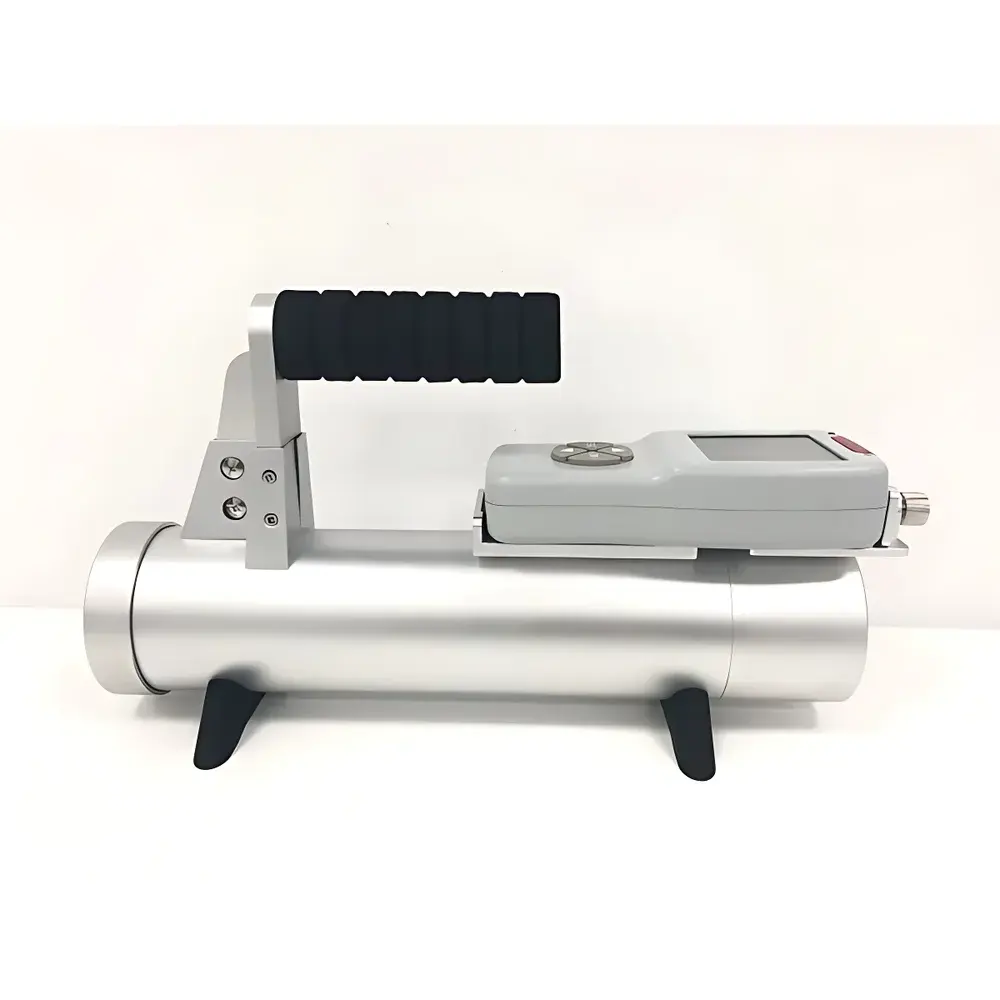
SMACH RD500 Environmental X-γ Dose Rate Meter
| Brand | SMACH |
|---|---|
| Model | RD500 |
| Detector Type | NaI(Tl) Scintillation + Energy-Compensated GM Tube |
| Measurement Range | 1 nSv/h – 100 µSv/h (NaI mode) |
| Sensitivity | ≥1200 cps/µSv/h (for ¹³⁷Cs, NaI) |
| Energy Response | 48 keV – 3 MeV (±20% relative to ¹³⁷Cs) |
| Display Units | µGy/h, µSv/h, cps |
| Operating Temperature | −20 °C to +50 °C |
| Weight | 2.65 kg |
| Power | Rechargeable Li-ion Battery (72 h continuous operation) |
| Connectivity | Wired (Micro-USB) and Wireless (2.4 GHz RF), Ethernet port, USB data export |
| Compliance | Designed for environmental radiation monitoring per IEC 60846-1:2014, ISO 4037-3, and national standards for environmental dose rate instrumentation |
Overview
The SMACH RD500 Environmental X-γ Dose Rate Meter is a dual-detector, field-deployable radiation survey instrument engineered for precise, real-time measurement of ambient photon dose rate in environmental and occupational settings. It operates on two complementary detection principles: scintillation-based energy-integrated dose assessment using a Φ38 × 38 mm thallium-doped sodium iodide [NaI(Tl)] crystal, and high-range gross counting via an energy-compensated Geiger-Müller (GM) tube. This hybrid architecture enables seamless transition between ultra-low-level background monitoring (down to 1 nSv/h) and emergency-range exposure assessment (up to 300 mSv/h), without manual range switching or detector substitution. The instrument conforms to the functional and metrological requirements specified in IEC 60846-1:2014 for environmental dose rate meters, including linearity, angular response, and energy dependence verification across the 48 keV–3 MeV photon spectrum (referenced to 137Cs). Its modular host-probe architecture supports operational flexibility—both units function autonomously, with synchronized time-stamped data acquisition enabled via wired (shielded Micro-USB) or low-latency 2.4 GHz wireless link.
Key Features
- Dual-sensor architecture: NaI(Tl) scintillator for high sensitivity (≥1200 cps/µSv/h @ 137Cs) and GM tube for extended dynamic range (0.01 µSv/h–300 mSv/h)
- Automatic background subtraction: Real-time baseline update at power-on and during idle periods to minimize drift-induced offset
- Onboard spectral analysis capability: Pulse-height histogramming with peak identification for radionuclide screening (e.g., 137Cs, 60Co, 40K)
- Self-calibrating sensor interface: Automatic gain stabilization and reference-source-triggered recalibration routine
- Peak capture & timestamping: Records maximum dose rate event with UTC-aligned timestamp; last-peak snapshot displayed on main screen
- Integrated dosimetry: Continuous real-time dose rate plotting alongside user-configurable alarm thresholds on shared time-axis graph
- Multi-mode alarm system: Programmable audio (85 dB), visual (LED strobe), and tactile (vibration) alerts; combinable per alarm class
- Comprehensive alarm taxonomy: Threshold exceedance, detector blockage, sensor failure, artificial nuclide signature detection, and low-battery warning
- Non-volatile storage: Internal flash memory retains >100,000 measurement records and full alarm history with power-loss resilience
- Embedded RTC: Independent real-time clock maintains accurate timestamps across power cycles (battery-backed)
- Adaptive UI: Dot-matrix LCD with auto-adjusting backlight (ambient light sensor controlled)
- Interoperable connectivity: Micro-USB (compatible with standard Android chargers), 10/100 Mbps Ethernet, and USB mass-storage mode for direct data extraction
Sample Compatibility & Compliance
The RD500 is validated for environmental photon fields encountered in regulatory compliance monitoring, including natural background, medical radiotherapy leakage, industrial radiography scatter, and nuclear facility perimeter surveillance. Its NaI(Tl) detector provides optimal efficiency for low-energy photons (<200 keV), while the energy-compensated GM tube ensures flat response up to 3 MeV—meeting the spectral uniformity criteria of ISO 4037-3 Annex B for environmental dosimeters. The instrument’s mechanical design complies with IP54 ingress protection (dust and splash resistant), and its operating temperature range (−20 °C to +50 °C) satisfies field deployment requirements under ISO/IEC 17025-accredited environmental monitoring programs. All firmware and data handling routines support audit-trail generation per GLP/GMP-aligned workflows, with immutable metadata (operator ID, GPS coordinates if externally sourced, calibration certificate ID) embedded in exported CSV/JSON datasets.
Software & Data Management
Data acquisition, visualization, and reporting are managed through the optional SMACH RadLink Desktop Suite (Windows/macOS), which imports time-series measurements, spectral histograms, and alarm logs via USB or Ethernet. The software enforces traceable data integrity: each imported session is cryptographically hashed, and all parameter changes (e.g., alarm thresholds, display units) are logged with operator ID and timestamp. Export formats include CSV (ISO 8601 timestamps, SI units), PDF summary reports (with configurable header/footer per organizational template), and XML for integration into LIMS platforms. Firmware updates are delivered as signed binary packages verified via ECDSA signature prior to installation—ensuring chain-of-custody continuity required by ISO/IEC 17025 Clause 5.9.2.
Applications
- Environmental baseline surveys conducted by national radiation protection authorities
- In situ dose rate mapping around radiotherapy bunkers and PET cyclotron facilities
- Post-irradiation safety verification for industrial gamma radiography sites
- Perimeter monitoring and emergency response at nuclear power plants and fuel cycle facilities
- Customs and border control radiation screening at ports and airports
- First-responder readiness for radiological dispersal device (RDD) incidents
- Long-term ecological monitoring in regions affected by historical nuclear events
FAQ
What radiation types does the RD500 measure?
The RD500 is optimized for X-ray and gamma-ray photons only. It does not detect alpha, beta, or neutron radiation.
Is the instrument suitable for personal dosimetry?
No—it is classified as an environmental survey meter per IEC 60846-1, not a personal dosimeter (IEC 61526). It measures ambient dose equivalent H*(10), not Hp(10).
How is energy compensation achieved in the GM detector?
Through proprietary multi-layer metal filtering (Cu + Sn + Pb) combined with pulse-shape discrimination circuitry to flatten the intrinsic over-response below 200 keV.
Can spectral data be exported for offline analysis?
Yes—full 1024-channel pulse-height spectra are stored in IEEE 32-bit float format and exportable via USB or Ethernet.
Does the RD500 support remote monitoring?
Yes—when connected via Ethernet, it serves real-time dose rate and status data via Modbus TCP or HTTP REST API endpoints.
Related Products







