
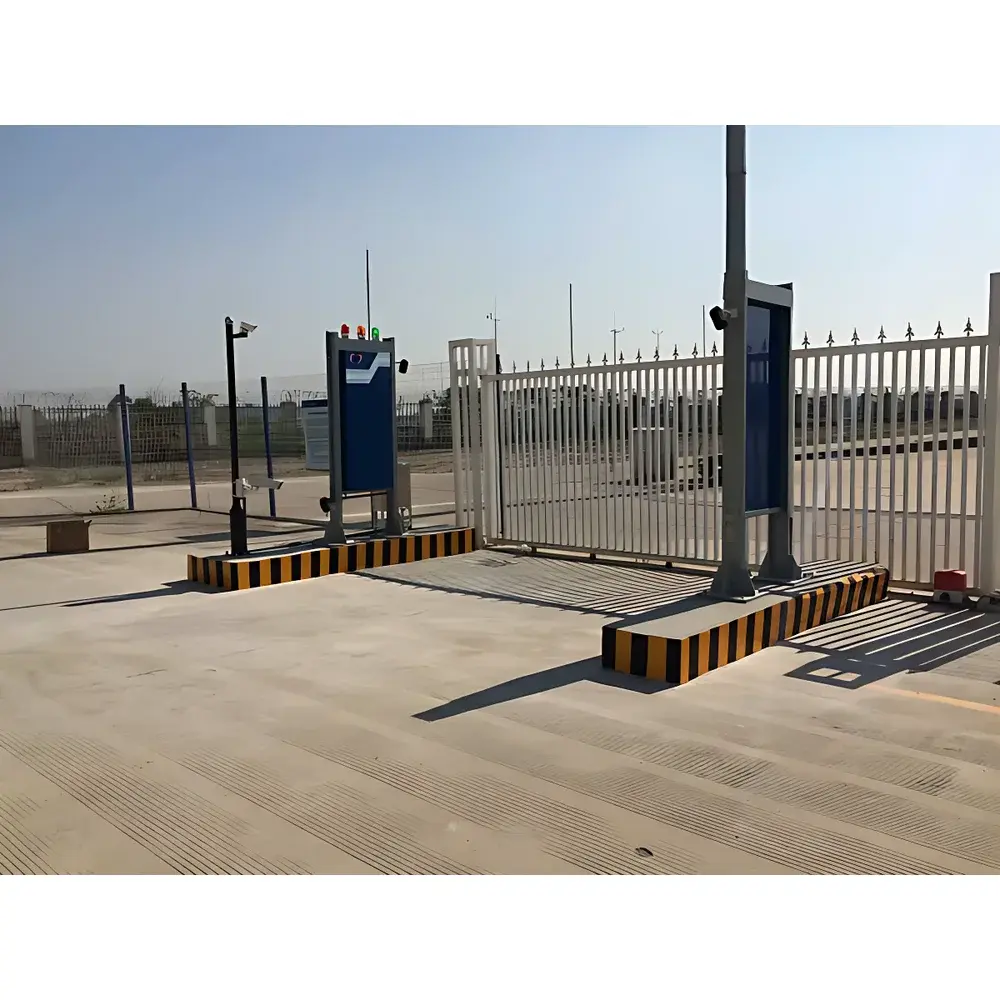
SMACH RC Series Portal-Based Radioactive Material Detection System
| Brand | SMACH |
|---|---|
| Origin | Fujian, China |
| Manufacturer Type | Authorized Distributor |
| Product Category | Domestic |
| Model | RC Series |
| Instrument Type | Gamma Spectrometer |
| Detector Material | Imported Plastic Scintillator |
| Energy Range | 20 keV – 3 MeV |
| Detection Sensitivity | Up to 4 × 60,000 cps/µSv/h (at background 0.2 µSv/h, Δ0.1 µSv/h in 1 s) |
| Detection Probability | ≥99.99% |
| False Alarm Rate | ≤0.01% |
| Standard Vehicle Speed | 8 km/h |
| Max Vehicle Speed | 20 km/h |
| Monitoring Height Range | 0.1–4.5 m (RC4025), 0.1–3.5 m (RC2025), 0.1–1.0 m (RC2010) |
| Width Coverage | 6 m (dual-side), 1 m (pedestrian) |
| Operating Temperature | −30 °C to +60 °C |
| IP Rating | IP65 |
| Power Supply | 220 V AC / 50 Hz |
| Data Storage | 1 TB HDD (≥400,000 records, ≥10 years retention) |
| Communication Interfaces | RS232 / RS485 / Ethernet / TCP/IP / GPRS (optional) |
| Compliance | GB/T 24246–2009, IAEA Nuclear Security Series No. 1 |
Overview
The SMACH RC Series Portal-Based Radioactive Material Detection System is a high-reliability, gamma-ray spectrometry-enabled radiation monitoring platform engineered for continuous, non-intrusive screening of vehicles, cargo containers, railcars, pedestrians, and baggage at fixed checkpoints. Utilizing plastic scintillation detectors coupled with real-time pulse-height analysis and dynamic spectral fingerprinting algorithms, the system identifies artificial radionuclides—including 137Cs, 60Co, 192Ir, and weapons-grade isotopes—by comparing measured energy spectra against reference libraries. Unlike simple gross-count systems, the RC Series performs on-the-fly isotope discrimination based on characteristic photopeak positions and Compton continuum ratios, enabling robust differentiation between naturally occurring radioactive material (NORM) and anthropogenic nuclides. Designed for deployment in high-traffic, mission-critical environments—including border crossings, seaports, customs facilities, scrap metal recycling yards, nuclear waste handling sites, and transportation hubs—the system operates continuously under adverse environmental conditions while maintaining regulatory compliance with GB/T 24246–2009 and IAEA Nuclear Security Series No. 1.
Key Features
- Multi-channel gamma spectrometry architecture with configurable detector count (1–8 units), each offering selectable sensitive volumes (8 L, 15 L, 25 L, 30 L, or 50 L) using imported plastic scintillators for optimized sensitivity across low-to-medium energy gamma emissions.
- Real-time artificial radionuclide identification via adaptive spectral deconvolution; distinguishes NORM (e.g., 40K, U/Th series) from illicit or industrial isotopes with ≤0.01% false alarm rate and ≥99.99% detection probability under standard throughput conditions.
- Integrated vehicle dynamics monitoring: infrared speed sensing, lane occupancy detection, barrier control interface, and automatic source localization within the detection portal (±15 cm spatial resolution).
- Modular hardware design with industrial-grade controller (IPC-based signal processing unit), redundant UPS backup (4-hour runtime), IP65-rated outdoor enclosure, and shock/vibration-resistant structural frame compliant with ISO 13374-2 for continuous operation in rain, snow, fog, and dust.
- Multi-layered background compensation: automatic baseline acquisition during idle periods, lead-shielded non-detection surfaces, and real-time background subtraction to maintain consistent alarm thresholds across diurnal and seasonal variations.
- Optional neutron detection capability via 6LiI(Eu) thermal neutron detectors, enabling dual-mode gamma-neutron surveillance for special nuclear material (SNM) detection in accordance with IAEA guidance for layered defense-in-depth architectures.
Sample Compatibility & Compliance
The RC Series accommodates diverse sample geometries and movement profiles without physical contact or operator intervention: passenger vehicles (RC2025), heavy-duty trucks and ISO containers (RC4025), and pedestrian traffic (RC2010). All configurations meet the performance requirements specified in GB/T 24246–2009 “Radiation Monitoring Systems for Radioactive Materials and Special Nuclear Materials” and align with technical benchmarks outlined in IAEA Nuclear Security Series No. 1, “Nuclear Security Recommendations on Physical Protection of Nuclear Material and Nuclear Facilities.” The system supports audit-ready operation under GLP-aligned data integrity frameworks, including timestamped event logging, immutable storage of raw spectra and metadata, and tamper-evident digital signatures for exported reports. Detector calibration traceability follows national standards maintained by CNAS-accredited laboratories.
Software & Data Management
The embedded detection software provides an intuitive graphical user interface with real-time visualization of spectral overlays, vehicle passage timelines, spatial radiation maps, and multi-detector coincidence analysis. Operators can configure user-defined alarm thresholds per channel, define custom alert categories (radiation, overspeed, mechanical fault), and generate statistical summaries filtered by date range, alarm type, or vehicle class. Historical data—comprising full spectral snapshots, image captures (via optional HD IR camera with ANPR), speed logs, and diagnostic status—is stored locally on a 1 TB SSD with automated compression and lifecycle management. A centralized database server enables remote aggregation from multiple RC installations over secure TCP/IP or VPN tunnels, supporting role-based access control, SQL-based querying, and export to CSV/PDF formats compliant with ISO/IEC 17025 documentation requirements. Software updates are delivered free-of-charge throughout the product lifecycle and validated per IEC 62304 Class B medical device software guidelines.
Applications
The RC Series serves as a foundational layer in national radiological security infrastructure. It is deployed at international land border crossings to interdict illicit trafficking of radioactive sources; at major seaports and airports for containerized cargo screening; in ferrous scrap recycling facilities to prevent contaminated metal from entering smelting processes; and at nuclear fuel cycle facilities—including spent fuel storage and reprocessing plants—to enforce material control and accountability (MC&A) protocols. Secondary applications include monitoring inbound/outbound shipments at research reactor sites, verifying clearance of decommissioned equipment from radiologically controlled areas, and supporting emergency response teams during radiological dispersal device (RDD) preparedness drills. Its modular scalability allows seamless integration into layered detection networks where primary portals feed alerts to secondary handheld or mobile survey systems.
FAQ
Does the RC Series comply with international nuclear security standards?
Yes. The system meets the functional and performance criteria defined in IAEA Nuclear Security Series No. 1 and conforms to GB/T 24246–2009, which references ISO 21482 and ANSI N42.34 for radiation detection instrumentation.
Can the system differentiate between natural and artificial radioactivity?
Yes. Using real-time gamma energy spectrum analysis and library-matched peak identification, it reliably discriminates NORM (e.g., 40K, 232Th progeny) from anthropogenic isotopes such as 137Cs and 60Co.
What is the maximum vehicle speed supported without compromising detection sensitivity?
The system maintains ≥99.99% detection probability at 8 km/h (standard) and remains fully operational up to 20 km/h, with adaptive dwell-time compensation and spectral averaging algorithms.
Is remote diagnostics and firmware update capability available?
Yes. Secure remote maintenance is enabled via encrypted Ethernet or GPRS connections, supporting live telemetry, log retrieval, configuration push, and over-the-air software upgrades.
How is data integrity ensured during long-term archival?
All records—including raw spectra, timestamps, GPS coordinates (if equipped), and alarm context—are written to write-once-read-many (WORM)-emulated storage with SHA-256 hashing and daily checksum validation, satisfying ISO/IEC 17025 clause 7.5.2 for result preservation.
Related Products







