
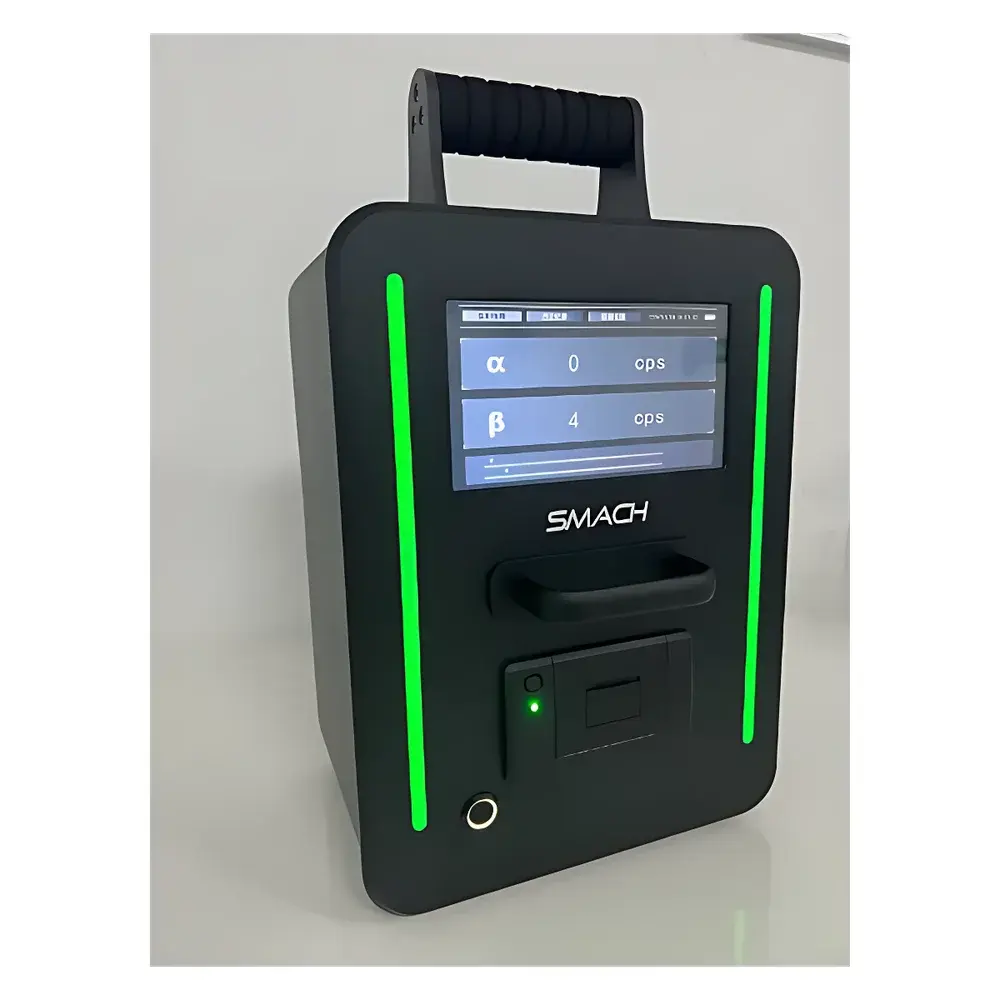
SMACH RZ500 Alpha/Beta Nasal Swab Radioactivity Counter
| Brand | SMACH |
|---|---|
| Model | RZ500 |
| Instrument Type | Benchtop Alpha/Beta Scintillation Counter for Nasal Swab Assays |
| Detection Principle | ZnS(Ag)/Plastic Scintillation |
| Measurement Range | 0–10,000 cps |
| Sensitivity | ≥0.1 Bq/m³ for ²³⁹Pu α-activity (air-equivalent) |
| Detector Window Diameter | 30 mm |
| Detection Efficiency | ²³⁹Pu ≥28%, ⁹⁰Sr–⁹⁰Y ≥50%, ³⁶Cl ≥42%, ⁶⁰Co ≥10%, ²⁴¹Am ≥40% |
| Background Count Rate | α ≤0.005 cm⁻²·min⁻¹ |
| Intrinsic Error | ±10% (max) |
| Display | 7-inch capacitive touchscreen |
| Power | AC adapter + rechargeable Li-ion battery (≥30 h runtime) |
| Operating Temperature | −10 °C to +50 °C |
| Weight | ~13 kg |
| Compliance | Designed per IEC 61000-4 EMC standards |
Overview
The SMACH RZ500 Alpha/Beta Nasal Swab Radioactivity Counter is a purpose-built benchtop scintillation counter engineered for rapid, on-site assessment of internal contamination risk following radiological incidents. Unlike general-purpose survey meters or air samplers, the RZ500 employs dual-layer ZnS(Ag)/plastic scintillation detection optimized for simultaneous α and β particle discrimination from direct nasal swab specimens—eliminating the need for sample dissolution, planchet preparation, or laboratory-based liquid scintillation counting. Its measurement principle relies on pulse-shape discrimination (PSD) and energy threshold gating to differentiate α emissions (4–9 MeV) from β emissions (0.1–2.3 MeV), enabling real-time, quantitative activity estimation in Bq per unit volume (Bq/m³ equivalent) without calibration transfer errors. Designed for first-response triage in nuclear medicine departments, reactor control rooms, fuel cycle facilities, and emergency health physics units, the RZ500 delivers field-deployable performance while maintaining metrological traceability to national radionuclide standards.
Key Features
- Benchtop configuration with integrated 7-inch capacitive touchscreen interface—no external PC required for operation or result interpretation
- Direct nasal swab assay capability: swabs inserted into dedicated sample chamber; no disassembly, no planchets, no chemical processing
- Real-time α/β discrimination via dual-channel pulse analysis and adjustable energy windows
- Auto-switching between total count mode and net count mode (background-subtracted)
- Onboard thermal printer for immediate hardcopy documentation of measurement ID, time stamp, count rate, and activity estimate
- Internal non-volatile memory stores ≥10,000 measurement records with full metadata (operator ID, location tag, sample ID, date/time)
- USB 2.0 interface for encrypted data export in CSV format—compatible with LIMS integration and regulatory reporting workflows
- Rechargeable lithium-ion battery supporting ≥30 hours of continuous operation under typical field conditions (25 °C, 50% display brightness)
- Ruggedized aluminum chassis with IP54-rated enclosure for dust and splash resistance during transport and deployment
Sample Compatibility & Compliance
The RZ500 accepts standard sterile cotton or synthetic fiber nasal swabs (diameter ≤20 mm, length ≤150 mm) placed directly onto the 30-mm-diameter scintillation window. No sample digestion, acid leaching, or filtration is required. The instrument meets functional requirements outlined in IAEA Safety Guide RS-G-1.8 (Monitoring for Occupational Exposure) and aligns with technical expectations in ANSI N13.30-2022 (Performance Criteria for Health Physics Instrumentation). While not certified as a Class I medical device under FDA 21 CFR Part 820, its measurement methodology supports compliance with ICRP Publication 130 recommendations for early internal dose screening. Data logging and export functionality are configurable to meet GLP audit-trail requirements—including operator authentication, timestamped event logs, and write-protected record retention.
Software & Data Management
Firmware v3.2 includes embedded measurement algorithms compliant with ISO 8529-1:2022 (Reference neutron radiations) for background correction and efficiency compensation across radionuclide-specific energy spectra. All measurements are time-stamped using an onboard RTC synchronized to UTC via optional GPS module (sold separately). Exported CSV files contain columns for Sample_ID, DateTime_UTC, Gross_Counts, Net_Counts, Alpha_Rate_cps, Beta_Rate_cps, Estimated_Activity_Bq_m3, Detector_Temp_C, Battery_Voltage_V, and Operator_Code. Audit log entries record firmware updates, calibration resets, and parameter changes—retained for ≥18 months in flash memory. No cloud connectivity or remote telemetry is implemented, preserving data sovereignty in regulated environments.
Applications
- Triage screening of personnel after suspected inhalation exposure in nuclear power plant emergencies or radiopharmaceutical handling incidents
- Verification of respiratory protection effectiveness during routine maintenance in hot cells or gloveboxes
- Quality assurance testing of HEPA filter integrity in radiology suite ventilation systems
- Field validation of decontamination efficacy following surface wipe assays in decommissioning projects
- Regulatory compliance monitoring for occupational exposure limits per ICRP 103 and EURATOM Directive 2013/59
- Training platform for health physics students and radiation safety officers on alpha/beta spectroscopy fundamentals
FAQ
Can the RZ500 quantify specific radionuclides like ¹³¹I or ²⁴¹Am in mixed samples?
No—it provides gross α and β count rates and activity estimates based on reference efficiencies. Isotopic identification requires gamma spectrometry or alpha spectrometry with energy resolution.
Is calibration traceable to national standards?
Yes: factory calibration uses NIST-traceable ²⁴¹Am (α) and ⁹⁰Sr–⁹⁰Y (β) point sources; user-accessible calibration verification routines are included.
Does the instrument require annual recalibration?
Per ISO/IEC 17025 guidance, recalibration is recommended every 12 months or after any physical shock exceeding 50 g-force.
What is the minimum detectable activity (MDA) for ²³⁹Pu in nasal swab samples?
At 10-minute counting time and typical swab geometry, MDA is 0.1 Bq/m³ air-equivalent, assuming background subtraction and 95% confidence level.
Can data be imported into common radiation management software (e.g., RadPro, GammaVision)?
Yes—CSV output is structured for direct ingestion into third-party dose calculation engines and regulatory reporting modules.
Related Products







