
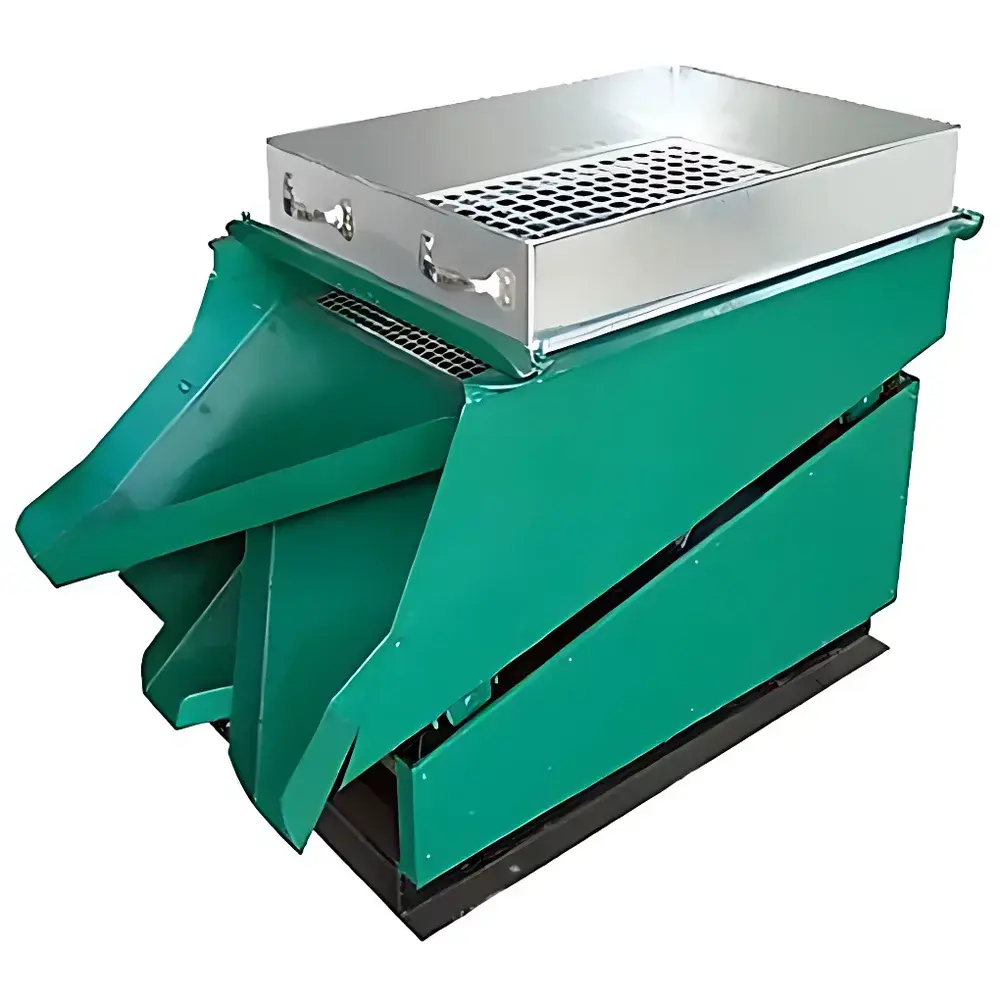
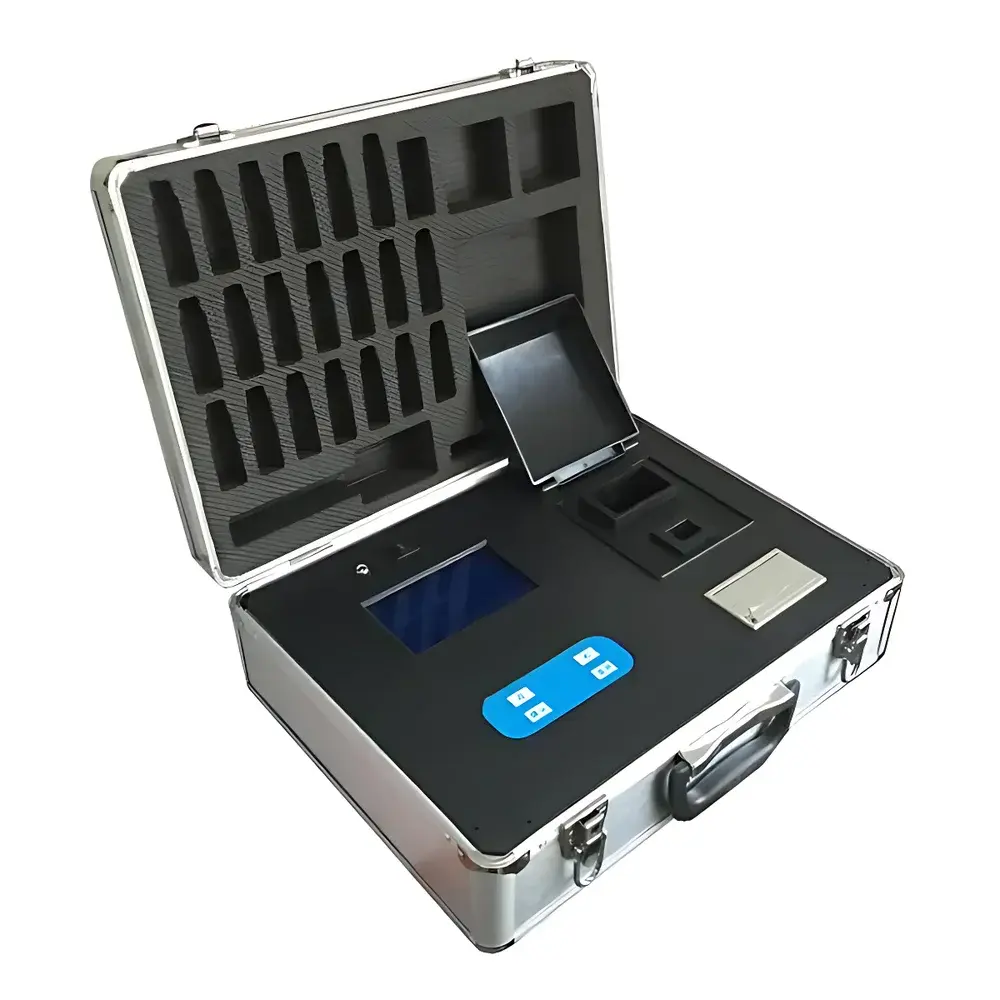
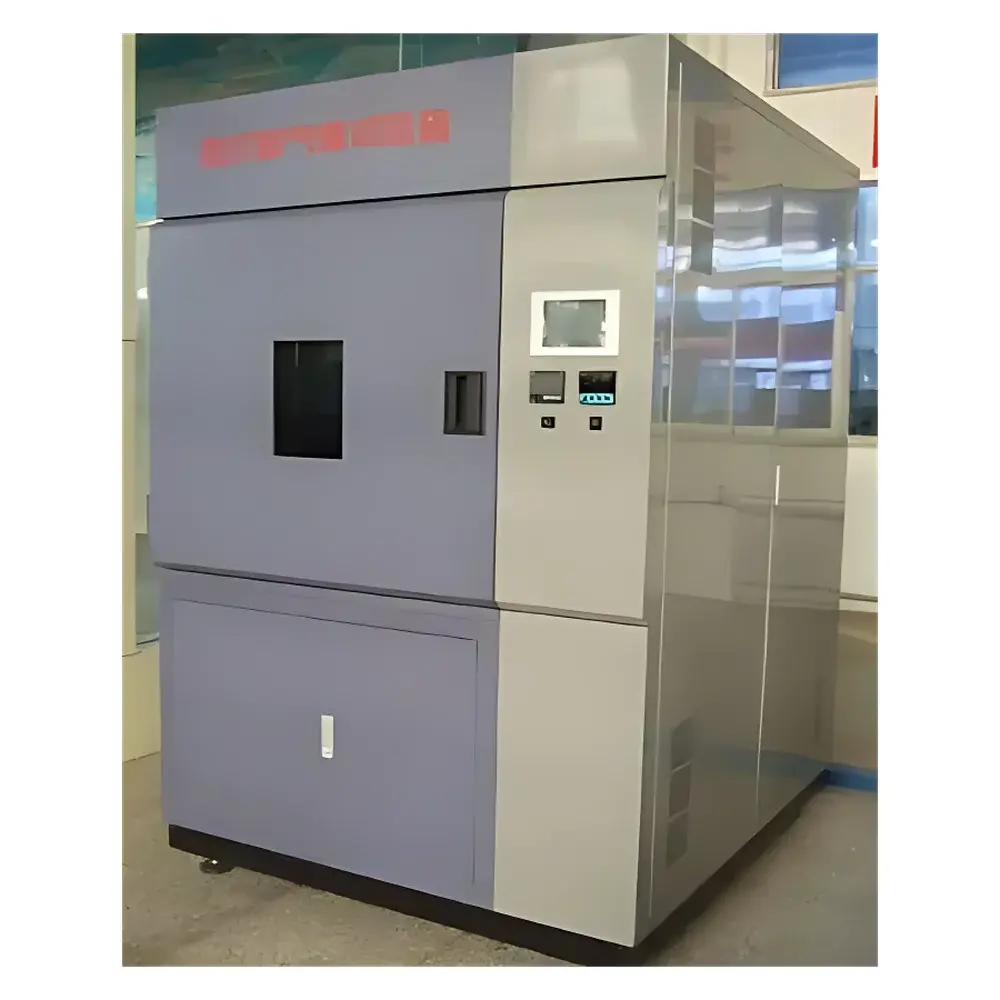
HengaoDe H27737 Reciprocating Multi-Deck Automatic Coal Sieving Machine
| Brand | HengaoDe |
|---|---|
| Origin | Beijing, China |
| Manufacturer Type | Authorized Distributor |
| Country of Origin | China |
| Model | H27737 |
| Price | USD 135 (FOB Beijing) |
| Sieve Deck Count | 1–5 layers |
| Max. Feed Particle Size | ≤50 mm |
| Stroke Amplitude | 40 mm |
| Oscillation Frequency | 240 cycles/min |
| Standard Sieve Tray Dimensions | 700 × 500 × 150 mm (customizable) |
| Motor Power | 0.75 kW (Y90S-6) |
| Supply Voltage | 3-phase 380 V, 50 Hz |
| Net Weight | 100 kg |
| Overall Dimensions | 1100 × 540 × 650 mm |
Overview
The HengaoDe H27737 Reciprocating Multi-Deck Automatic Coal Sieving Machine is an electromechanical laboratory and industrial sample preparation instrument engineered for standardized particle size distribution analysis of bulk granular materials—primarily coal, but also applicable to ores, aggregates, biomass, and other dry, free-flowing particulates. It replaces labor-intensive manual sieving with a controlled reciprocating motion driven by a three-phase induction motor, enabling simultaneous multi-fraction separation in a single operation. The device operates on the principle of mechanical stratification via horizontal oscillation: particles are subjected to inertial displacement across stacked sieve decks with progressively finer apertures, allowing precise fractionation based on nominal mesh size. Its design conforms to core principles outlined in ISO 2591-1:1988 (Methods for sieving of granular materials) and ASTM D4292 (Standard Test Method for Determining the Sieve Analysis of Granular Materials), supporting reproducible, auditable sample division for quality control, compliance reporting, and feedstock characterization.
Key Features
- Reciprocating motion mechanism with adjustable stroke amplitude (40 mm) and fixed frequency (240 cycles/min) ensures consistent energy input across all sieve decks.
- Modular sieve tray configuration supports 1–5 independent layers; each tray is independently removable and replaceable with user-specified aperture sizes (e.g., ASTM E11 or ISO 3310-1 compliant meshes).
- Customizable tray dimensions (standard: 700 × 500 × 150 mm) accommodate diverse throughput requirements and integration with downstream analytical workflows (e.g., proximate analysis, calorimetry, or elemental testing).
- Integrated collection hoppers minimize cross-contamination and reduce post-sieving handling time—critical for high-volume coal preparation labs complying with ISO/IEC 17025 accreditation requirements.
- Rugged steel frame construction (powder-coated A3 carbon steel housing) ensures long-term dimensional stability under continuous operation in industrial environments.
- Compliance-ready electrical architecture: CE-marked motor, IP54-rated enclosure, and overload-protected power circuitry aligned with IEC 60204-1 safety standards.
Sample Compatibility & Compliance
The H27737 accommodates dry, non-cohesive, and moderately abrasive granular samples with maximum particle size ≤50 mm and bulk density <2.5 g/cm³. It is routinely deployed in coal preparation plants, geological survey laboratories, and cement raw material QA/QC facilities where adherence to national and international coal testing standards—including GB/T 477–2008 (Chinese standard for coal sampling and analysis), ASTM D3174 (ash content determination), and ISO 19581 (coal and coke—determination of particle size distribution)—is mandatory. All structural components contacting sample material are fabricated from corrosion-resistant mild steel with food-grade epoxy coating to prevent metal leaching during prolonged use. No hazardous substances (e.g., lead, cadmium, or hexavalent chromium) are used in manufacturing, satisfying RoHS Directive 2011/65/EU requirements.
Software & Data Management
As a standalone mechanical instrument, the H27737 does not incorporate embedded software or digital data logging. However, its deterministic mechanical behavior enables full traceability when integrated into LIMS or ELN platforms via external documentation protocols. Operators record sieve stack configuration, feed mass, retention weights per fraction, and environmental conditions (temperature/humidity) using standardized paper-based or electronic worksheets compliant with GLP Annex 11 and 21 CFR Part 11 audit trails. Optional barcode-labeled sieve trays and calibrated digital balances (e.g., Mettler Toledo XP series) facilitate automated data entry and reduce transcription errors during reporting.
Applications
- Coal quality assessment: particle size grading prior to pulverized coal injection (PCI) or coking blend formulation.
- Mineral processing R&D: optimization of crushing/grinding circuits through rapid feedback on product size distribution.
- Environmental monitoring: preparation of soil or sediment sub-samples for heavy metal extraction and speciation analysis.
- Fuel certification: verification of compliance with contractual particle size specifications (e.g., ASTM D388 for coal rank classification).
- Educational laboratories: hands-on instruction in particle technology, mass balance calculations, and statistical process control fundamentals.
FAQ
What particle size ranges can be resolved using the H27737?
The machine itself imposes no intrinsic resolution limit—the achievable gradation depends solely on the selected mesh sizes. Common configurations include 50 mm → 25 mm → 13.2 mm → 6.3 mm → 3.35 mm stacks per GB/T 477–2008, or ASTM E11 standard series (e.g., 2 in → 1 in → ½ in → ¼ in → No. 4). Custom meshes down to 75 µm are supported upon request.
Is the unit suitable for wet sieving?
No. The H27737 is designed exclusively for dry sieving applications. Wet or slurry-based separation requires dedicated hydraulic or ultrasonic sieving systems compliant with ISO 10121.
Can it be integrated with automated sample feeding systems?
Yes. The top feed opening (1100 × 540 mm) accepts standard vibratory feeders or gravity chutes. Integration with programmable logic controllers (PLCs) is possible via optional 4–20 mA analog output for stroke monitoring.
What maintenance intervals are recommended?
Lubrication of the crankshaft bearing every 500 operating hours; visual inspection of belt tension and sieve frame fasteners before each shift; annual calibration of motor speed using a handheld tachometer traceable to NIST standards.
Does the device meet explosion-proof requirements for underground coal mine use?
No. The H27737 is rated for general-purpose industrial environments only (IP54). For hazardous locations (e.g., Zone 21 dust atmospheres), certified ATEX/IECEx alternatives must be specified separately.





