
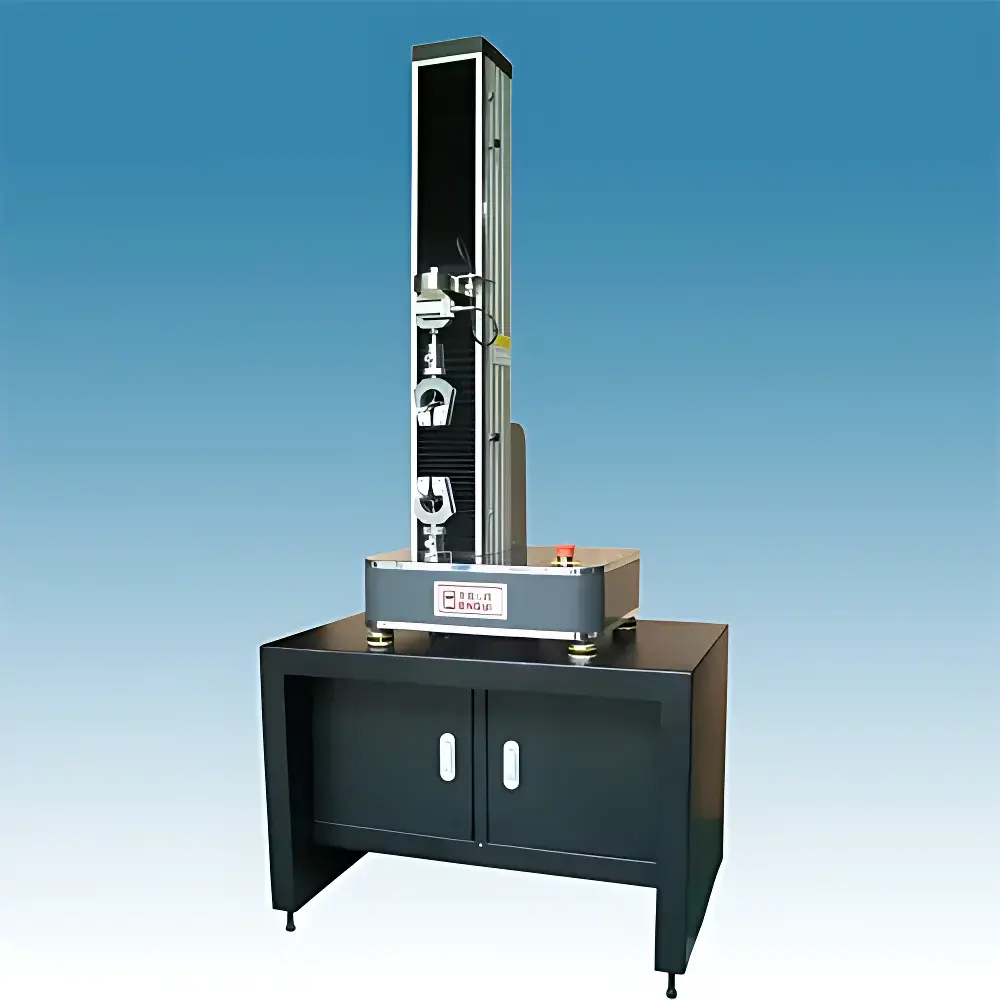
Hengyi HY-0580LKJ Animal Bone Three-Point Bending Tester
| Brand | Hengyi |
|---|---|
| Origin | Shanghai, China |
| Manufacturer Type | Direct Manufacturer |
| Regional Category | Domestic (China) |
| Model | HY-0580LKJ |
| Price Range | USD 2,800–7,100 |
| Instrument Type | Electromechanical Universal Testing Machine |
| Maximum Test Load | 5 kN |
| Force Measurement Range | 0.001–100% of Full Scale |
| Force Accuracy | ±0.5% of reading |
| Test Stroke | 800 mm |
| Displacement Resolution | 0.001 mm |
| Load Cell Options | 1 N to 5,000 N (multi-range configurable) |
| Crosshead Speed | 0.001–500 mm/min (adjustable) |
| Speed Accuracy | ±0.5% of set value |
| Displacement Accuracy | ±0.5% of reading |
| Strain Control Range | 0.002–6% FS/s |
| Stress Control Range | 0.005–6% FS/s |
| Effective Test Width | 120 mm |
| Power Supply | 220 V AC, 50 Hz, 750 W |
| Net Weight | 95 kg |
| Dimensions (W×D×H) | 470 × 400 × 1510 mm |
Overview
The Hengyi HY-0580LKJ Animal Bone Three-Point Bending Tester is a precision-engineered electromechanical universal testing system designed specifically for biomechanical characterization of biological and biomaterial specimens under static and quasi-static loading conditions. Based on ASTM F2118, ISO 178, and ISO 527 standards, the system implements closed-loop servo-controlled displacement and force regulation to deliver high reproducibility in three-point bending, four-point bending, axial tension, compression, shear, pull-out, and fatigue testing. Its modular architecture supports interchangeable load cells (1 N to 5 kN), adjustable crosshead travel (800 mm), and sub-micron displacement resolution (0.001 mm), enabling rigorous mechanical evaluation of heterogeneous soft and hard tissues—including cortical bone, trabecular bone, cortical-cancellous composites, osteosynthetic implants (e.g., screws, plates, intramedullary nails), vascular grafts, hydrogels, artificial skin, and spinal fusion devices. The tester operates within ambient laboratory conditions (20–40 °C, 20–80% RH) and complies with IEC 61000-6-3 (EMC) and IEC 61000-6-2 (immunity) requirements.
Key Features
- High-fidelity force measurement with ±0.5% accuracy across full scale, supported by multi-range load cell configuration (1 N–5,000 N) and 500,000-count A/D resolution—ensuring linearity and stability without internal range switching.
- Programmable crosshead speed from 0.001 to 500 mm/min with ±0.5% speed fidelity, enabling strain-rate-sensitive protocols per ASTM D638 and ISO 527-1.
- Dual-mode control architecture: stress-controlled (0.005–6% FS/s) and strain-controlled (0.002–6% FS/s) modes, each with adaptive error compensation below and above 0.05% FS/s thresholds.
- Integrated safety subsystems including electronic limit switches, overload protection (110% FS cutoff), automatic return-to-start, programmable stop triggers (load-, displacement-, or time-based), and real-time self-diagnostic monitoring of drive voltage, current, and thermal load.
- Ergonomic test space: 120 mm effective width and 800 mm vertical stroke accommodate standardized bone beam geometries (e.g., murine femur, rat tibia, porcine vertebral bodies) as well as large-format orthopedic constructs (e.g., interbody cages, pedicle screw assemblies).
- Robust structural frame (95 kg mass, steel-reinforced base) minimizes vibrational coupling and ensures mechanical stability during low-force microtesting (<10 N) and high-load implant validation (up to 5 kN).
Sample Compatibility & Compliance
The HY-0580LKJ is validated for mechanical testing of both native and synthetic biomaterials per internationally recognized regulatory frameworks. It supports specimen geometries compliant with ASTM F2118 (for bone strength assessment), ISO 178 (flexural properties of plastics), ISO 527 (tensile testing), and ISO 14801 (dental implant mechanical testing). Tested materials include but are not limited to: cortical bone sections (human, bovine, ovine, murine), cancellous bone cores, demineralized bone matrix (DBM), calcium phosphate scaffolds, PEEK, Ti-6Al-4V, CoCr alloys, UHMWPE, hydrogels (e.g., alginate, collagen, GelMA), decellularized tissue matrices, vascular stents, annulus fibrosus analogues, and composite spinal fixation systems. All test methods adhere to GLP-aligned data integrity principles, with audit-trail-capable software logging all parameter changes, calibration events, and operator actions.
Software & Data Management
Control and analysis are performed via Hengyi’s proprietary WinTest Pro v4.2 software suite—designed for ISO/IEC 17025-compliant laboratories. The interface supports method-driven test sequencing, real-time curve overlay (force-displacement, stress-strain, load-cycle), automated peak detection (yield, ultimate, failure), and export of raw ASCII data with timestamped metadata. Calibration certificates are digitally signed and traceable to CNAS-accredited reference standards. For regulated environments, optional 21 CFR Part 11 compliance packages provide electronic signatures, role-based access control, and immutable audit logs. Data files conform to ASTM E1434 and ISO/IEC 17025 Annex A.2 requirements for long-term archival and third-party verification.
Applications
- Mechanical phenotyping of murine and rat long bones in osteoporosis, osteogenesis imperfecta, and fracture-healing studies.
- Validation of biodegradable bone fixation devices (Mg alloys, PLLA screws) under physiological loading profiles.
- Flexural modulus and bending strength quantification of cortical bone beams per ASTM F2118–22 Section 6.3.
- Tensile testing of soft tissue–implant interfaces (e.g., tendon-to-bone healing, ligament graft fixation).
- Cyclic fatigue assessment of spinal fusion constructs (pedicle screws + rods) under ISO 12189-compliant waveforms.
- Compression testing of vertebral body substitutes and intervertebral disc prostheses per ISO 18192-1.
- Shear and pull-out testing of dental and orthopedic screws in synthetic bone blocks (Sawbones®) and cadaveric specimens.
FAQ
What standards does the HY-0580LKJ comply with for bone mechanical testing?
It supports test protocols aligned with ASTM F2118, ISO 178, ISO 527, ISO 14801, and ISO 12189, with hardware and software calibrated to meet ISO/IEC 17025 metrological requirements.
Can the system perform cyclic fatigue testing?
Yes—WinTest Pro enables user-defined sine, triangle, trapezoidal, and custom waveform loading profiles with cycle counting, amplitude modulation, and R-ratio control up to 10⁶ cycles.
Is the displacement resolution sufficient for micro-scale bone testing?
With 0.001 mm resolution and ±0.5% displacement accuracy over 800 mm stroke, it meets the sensitivity requirements for small-animal bone beam deflection measurements (e.g., mouse femur bending, where mid-span deflection is typically 0.1–2.0 mm).
How is data integrity ensured in regulated research environments?
Optional 21 CFR Part 11 modules provide electronic signatures, audit trails, data encryption, and role-based permissions—fully supporting FDA, EMA, and PMDA submissions.
What maintenance is required for long-term calibration stability?
Annual recalibration against traceable deadweight standards is recommended; onboard diagnostics monitor encoder drift, motor torque consistency, and load cell zero stability daily during startup.



