
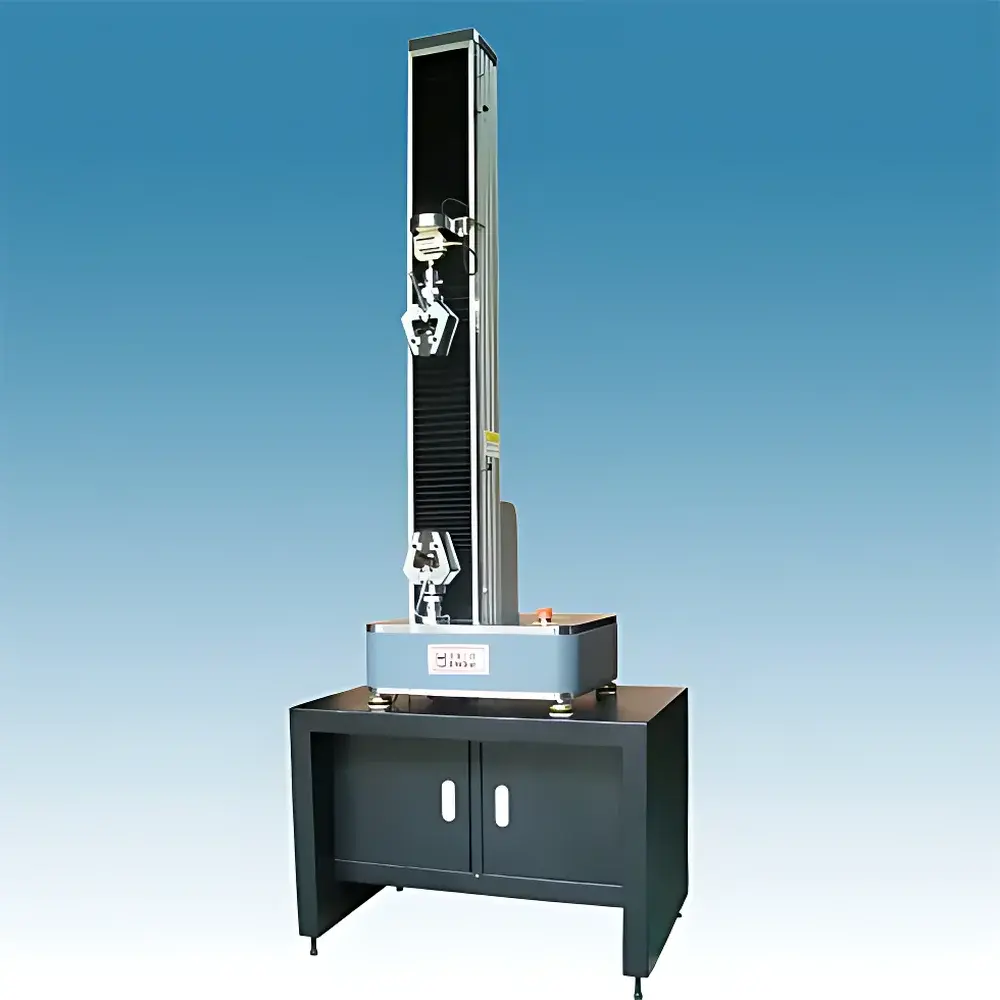
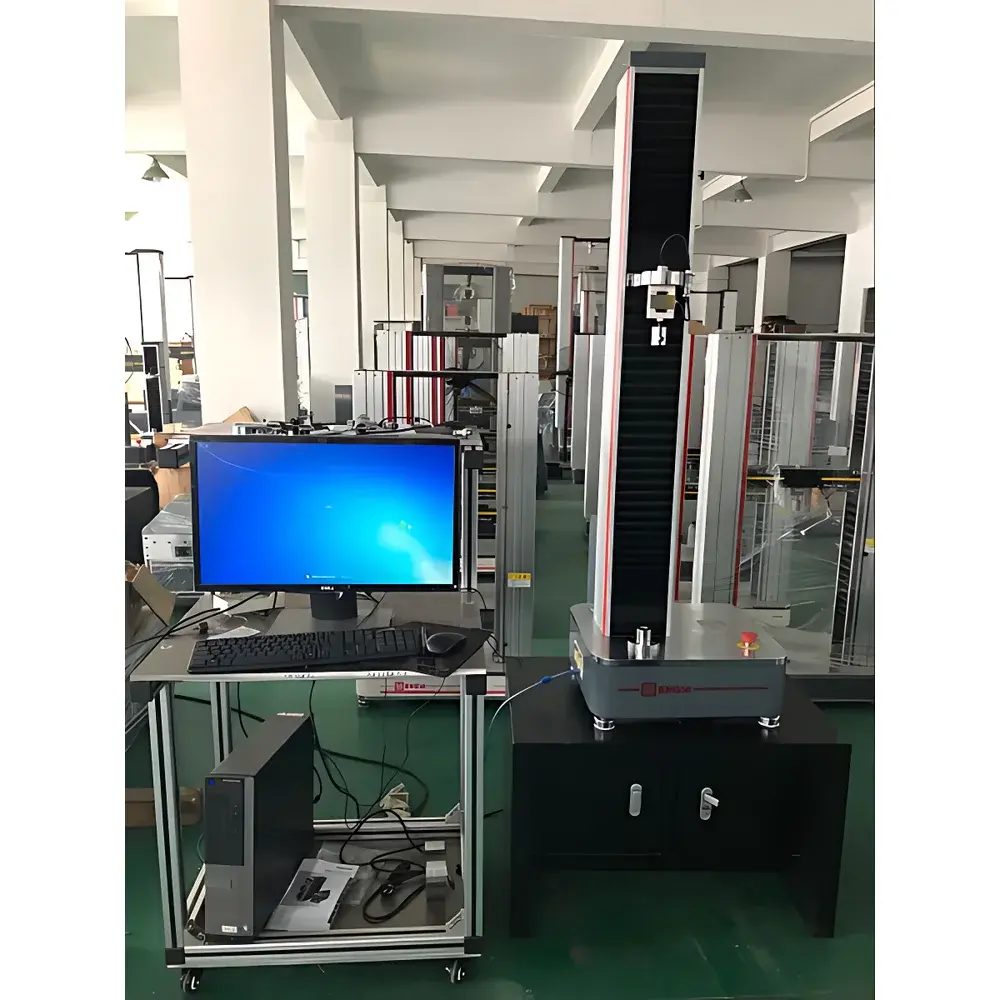
Hengyi HY-0580UTTGGB Orthopedic Biomaterials Universal Testing Machine
| Brand | Hengyi |
|---|---|
| Origin | Shanghai, China |
| Manufacturer Type | Direct Manufacturer |
| Product Category | Domestic |
| Model | HY-0580UTTGGB |
| Instrument Type | Electromechanical Universal Testing Machine |
| Load Capacity Options | 1 N to 5000 N (interchangeable load cells) |
| Accuracy Class | ≤ 0.5 |
| Effective Test Width | 120 mm |
| Effective Test Height | 800 mm |
| Speed Range | 0.001–500 mm/min |
| Speed Accuracy | ±0.5% of indicated value |
| Force Resolution | ±500,000 counts at full scale (no internal range switching) |
| Force Measurement Range | 0.1%–100% FS |
| Displacement Accuracy | ±0.5% of indicated value |
| Strain Measurement Accuracy | ±0.5% of indicated value |
| Stress Control Rate Range | 0.005–6% FS/s |
| Strain Control Rate Range | 0.002–6% FS/s |
| Constant-Load/Displacement/Strain Control Range | 0.5–100% FS |
| Protection Features | Electronic limit switches, overload protection (>110% FS), real-time system diagnostics |
| Power Supply | 220 V AC, 50 Hz, 750 W |
| Dimensions (W×D×H) | 470 × 400 × 1510 mm |
| Weight | 95 kg |
| Operating Environment | 20–40 °C, 20–80% RH |
Overview
The Hengyi HY-0580UTTGGB Orthopedic Biomaterials Universal Testing Machine is a high-precision electromechanical testing system engineered for static and quasi-static mechanical characterization of orthopedic implants, biomaterials, and structural tissue analogs. It operates on the principle of controlled axial force application via a servo-motor-driven crosshead, enabling accurate measurement of tensile, compressive, flexural, shear, peel, puncture, and pull-out responses under displacement-, load-, or strain-controlled conditions. Designed specifically for regulatory-compliant biomechanical evaluation, the system supports standardized test protocols required by ISO 14879, ASTM F543, ASTM F1717, ISO 7206-4, and key Chinese medical device standards including YY/T 1504-2016 (axial pull-out of bone screws), YY/T 0342-2002 (bending stiffness of bone plates), and YY/T 0662-2008 (mechanical testing of asymmetric-threaded screws). Its modular load cell architecture—supporting capacities from 1 N to 5000 N—ensures traceable force measurement across soft-tissue sutures, polymer scaffolds, metallic fixation devices, and composite spinal implants.
Key Features
- 0.5-class accuracy certified force measurement with ±500,000-count resolution across full scale—no auto-ranging or internal switching, ensuring consistent linearity and repeatability.
- Wide dynamic speed range (0.001–500 mm/min) with ±0.5% speed fidelity, enabling both slow creep tests and rapid failure characterization.
- Dual-mode motion control: precise closed-loop stress/strain rate regulation (0.002–6% FS/s) compliant with ISO 6892-1 Annex B and ASTM E8/E21 requirements.
- Integrated electronic limit protection, automatic return-to-start, and programmable stop triggers (load-, displacement-, or time-based), minimizing operator intervention and enhancing test reproducibility.
- Rugged single-column frame (95 kg mass, 470 × 400 × 1510 mm footprint) with reinforced crosshead guidance and low-inertia drive system for minimal oscillation during high-sensitivity measurements.
- Real-time diagnostic monitoring of motor current, encoder feedback, load cell output, and thermal load—immediate fault isolation and hardware-level safeguard activation.
Sample Compatibility & Compliance
The HY-0580UTTGGB accommodates diverse specimen geometries and mechanical behaviors encountered in orthopedic R&D and quality assurance. Validated test configurations include cortical bone analogs (PMMA, polyurethane foam), metallic osteosynthesis devices (titanium alloy plates, stainless steel intramedullary nails), resorbable polymers (PLLA, PCL screws), soft-tissue substitutes (collagen scaffolds, synthetic ligaments), and hybrid constructs (ceramic-coated implants, fiber-reinforced composites). All mechanical test methods align with internationally recognized regulatory frameworks: GB/T 228.1-2010 (tensile testing), YY/T 0017-2008 (bending strength of bone plates), ISO 5832-3 (titanium alloys), and FDA-recognized consensus standards for implant mechanical validation. The system’s mechanical design complies with GB/T 2611-2007 (general technical requirements for testing machines) and includes documented traceability to national metrological standards.
Software & Data Management
The embedded control software provides ISO/IEC 17025-aligned test sequence definition, real-time curve overlay, and automated report generation per YY/T 0662-2008 and ASTM F2118 annexes. Raw data export is supported in CSV and XML formats, preserving timestamped force-displacement-strain arrays with full metadata (test ID, operator, calibration certificate number, environmental logs). Audit trails record all parameter modifications, test starts/stops, and system alerts—fully compliant with GLP and GMP documentation requirements. Optional 21 CFR Part 11 add-on enables electronic signatures, role-based access control, and immutable data archiving for regulated medical device submissions.
Applications
- Mechanical validation of spinal fusion cages, vertebral body replacements, and interbody devices under compression and torsion-simulated loading.
- Pull-out strength assessment of cancellous bone screws per YY/T 1504-2016 and ASTM F543.
- Bending fatigue life evaluation of locking plates and intramedullary rods using cyclic load control up to 10⁶ cycles.
- Tensile property mapping of electrospun nanofibrous membranes used in tendon repair scaffolds.
- Shear interface strength quantification between bioactive coatings (HA, TCP) and metallic substrates.
- Creep and stress-relaxation profiling of hydrogel-based cartilage substitutes under physiological loading profiles.
FAQ
Does the HY-0580UTTGGB support ASTM F2118-compliant suture tensile testing?
Yes—the system meets all displacement control, grip alignment, and data sampling requirements specified in ASTM F2118 for surgical suture evaluation, including initial tension ramping and break detection thresholds.
Can multiple load cells be calibrated and switched within a single test session?
Yes—each load cell is individually calibrated and digitally registered; the software auto-detects capacity and applies corresponding scaling factors without manual recalibration.
Is the system compatible with third-party extensometers or video-based strain measurement systems?
Yes—standard analog/digital I/O ports support synchronization with LVDTs, clip-on extensometers, and DIC systems via TTL trigger and analog voltage input.
What documentation is provided for regulatory submissions?
Factory calibration certificates (traceable to CNAS-accredited labs), mechanical verification reports, software validation summary, and compliance matrices against YY, GB, ASTM, and ISO standards are included.
How is thermal drift compensated during long-duration creep tests?
The system employs real-time zero-point tracking with periodic auto-nulling routines and temperature-stabilized signal conditioning circuits to maintain baseline integrity over multi-hour tests.



