
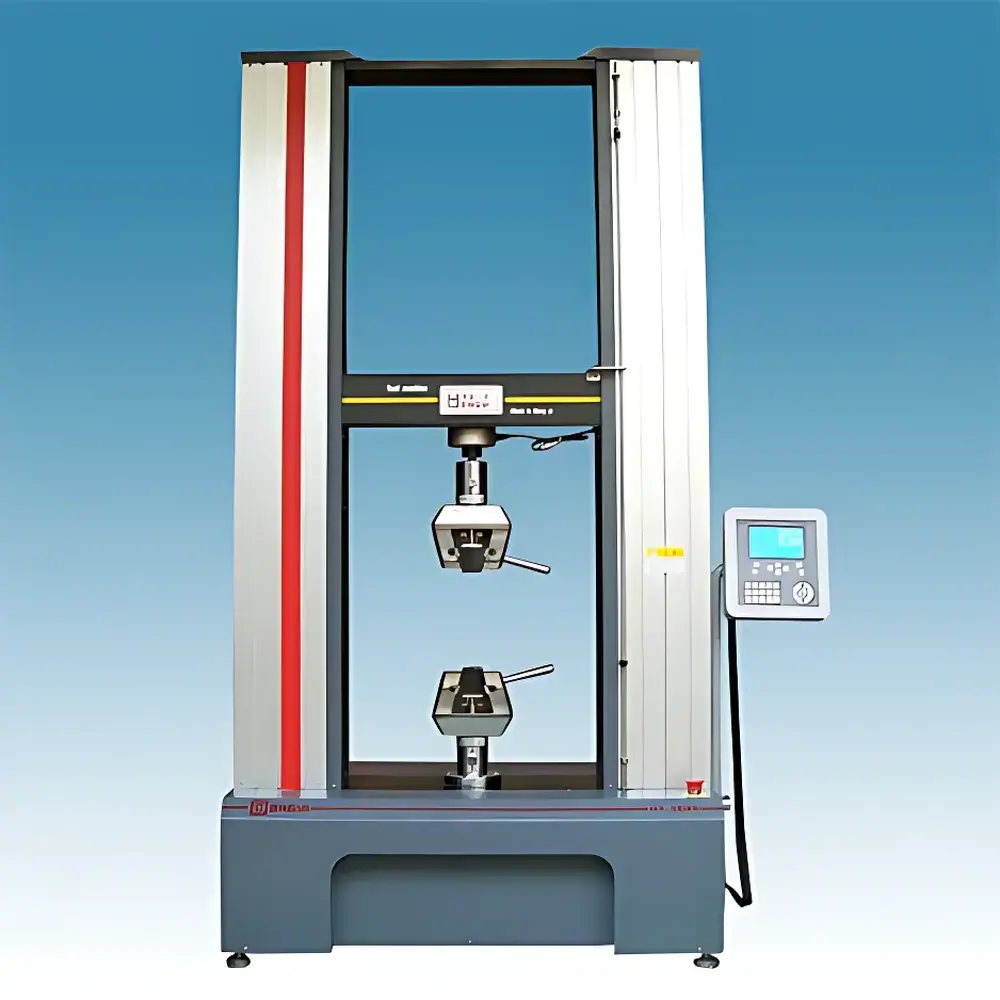
Hengyi HY-10080 Floor-Standing Universal Tensile Testing Machine
| Brand | Hengyi / Hengyitest |
|---|---|
| Origin | Shanghai, China |
| Manufacturer Type | Direct Manufacturer |
| Product Category | Domestic |
| Model | HY-10080YUBH |
| Max Test Load | 100 kN |
| Force Measurement Range | 0.01–100% FS |
| Force Accuracy | ±0.5% of reading |
| Test Stroke | 800 mm |
| Displacement Resolution | 0.001 mm |
| Speed Range | 0.001–500 mm/min |
| Speed Accuracy | ±0.5% of set value |
| Displacement Accuracy | ±0.5% of reading |
| Strain Control Rate Range | 0.002–6% FS/s |
| Stress Control Rate Range | 0.005–6% FS/s |
| Load Frame Dimensions (W×D×H) | 1000 × 680 × 2200 mm |
| Weight | 1250 kg |
| Power Supply | 220 V AC, 2000 W |
| Effective Test Width | 600 mm (expandable) |
| Safety Features | Electronic limit protection, overload auto-stop (>110% FS), real-time system diagnostics |
Overview
The Hengyi HY-10080 Floor-Standing Universal Tensile Testing Machine is a high-capacity, dual-column electromechanical testing system engineered for precision static mechanical characterization of structural and functional materials under uniaxial loading conditions. Based on servo-controlled electromechanical actuation and closed-loop digital feedback architecture, it complies with fundamental principles defined in ISO 6892-1 (metallic materials — tensile testing), ASTM E4 (load verification), ASTM E8/E8M (tensile testing of metals), and ASTM D638/D3039 (plastics and composites). Designed for laboratory and industrial quality control environments, the HY-10080 supports both tension and compression modes within a single rigid load frame—eliminating the need for separate dedicated machines. Its 100 kN capacity, 800 mm vertical travel, and 600 mm test width accommodate large-scale specimens including automotive crash components, aerospace laminates, welded joints, and structural steel coupons.
Key Features
- Rigid floor-standing龙门 (portal) frame with reinforced crosshead guidance and high-stiffness column design, minimizing deflection during high-load testing
- High-resolution force measurement system calibrated to ±0.5% of reading across full scale (100 kN), with internal 500,000-count A/D resolution and no range switching required
- Displacement sensing via high-precision rotary encoder coupled to ball-screw drive, delivering 0.001 mm resolution and ±0.5% accuracy over full stroke
- Three independent closed-loop control modes: stress, strain, and displacement—with seamless real-time switching during active tests
- Programmable test sequences supporting multi-step protocols: ramp-hold, cyclic loading, creep, relaxation, and conditional termination (e.g., at preset load, displacement, or time)
- Integrated safety architecture including electronic end-limit switches, overload cut-off (>110% FS), emergency stop circuitry, and automatic return-to-home function
- Real-time self-diagnostic monitoring of motor current, drive voltage, thermal status, and sensor integrity—triggering protective shutdown upon anomaly detection
- Adjustable test space: standard 800 mm working height and 600 mm width, extendable per user specification for oversized samples
Sample Compatibility & Compliance
The HY-10080 accommodates a broad spectrum of specimen geometries and material classes—including metallic alloys (steel, aluminum, titanium), polymer matrices (thermoplastics, elastomers), fiber-reinforced composites (CFRP, GFRP), adhesives, textiles, and biomedical implants. Gripping solutions include wedge-action tensile grips, compression platens, bend fixtures (3-point/4-point), shear adapters, peel fixtures, and custom tooling interfaces. All mechanical test data comply with traceability requirements under ISO/IEC 17025 and support GLP/GMP documentation workflows. The system’s force calibration protocol aligns with ISO 7500-1 Class 0.5 verification standards, while displacement and speed performance meet ASTM E251 and ISO 5893 criteria. Optional accessories enable compliance with specific industry test methods such as ISO 178 (flexural properties), ISO 14129 (interlaminar shear), and USP (mechanical testing of pharmaceutical packaging).
Software & Data Management
Control and analysis are performed via Hengyi’s proprietary Windows-based software platform, featuring intuitive graphical interface, real-time curve overlay, and configurable test templates. The software supports automated parameter calculation per ISO 6892-1 and ASTM E8, including yield strength (Rp0.2, ReH/ReL), ultimate tensile strength (Rm), elongation at break (A%), Young’s modulus (E), Poisson’s ratio (ν), and reduction of area (Z%). Raw data export is available in CSV, XML, and PDF formats; all test logs include timestamped metadata, operator ID, environmental conditions (if connected to optional sensors), and full audit trail compliant with FDA 21 CFR Part 11 requirements (when configured with electronic signature and access controls). Data archiving follows hierarchical folder structure with versioned backups, and remote monitoring is supported via Ethernet TCP/IP interface.
Applications
- Mechanical validation of structural welds and brazed joints in automotive chassis and powertrain assemblies
- Tensile and compressive property mapping of carbon-fiber prepreg laminates during aerospace qualification
- Quality assurance of medical device components (e.g., orthopedic fixation plates, suture anchors) per ISO 5832 and ASTM F2503
- Characterization of thermoplastic elastomer behavior under variable strain rates for consumer electronics housing design
- Creep rupture testing of high-performance polymers used in oil & gas downhole tools
- Interfacial bond strength evaluation of metal–polymer hybrid structures in EV battery enclosures
- Educational use in university materials science labs for standardized undergraduate mechanical testing curricula
FAQ
What standards does the HY-10080 conform to for force calibration and verification?
The system meets ISO 7500-1 Class 0.5 accuracy requirements for static force measurement verification. Load cells are factory-calibrated against NIST-traceable reference standards, and periodic recalibration intervals follow ISO/IEC 17025 guidelines.
Can the machine perform cyclic fatigue testing?
While primarily optimized for static and quasi-static tests, the HY-10080 supports low-frequency cyclic loading up to 5 Hz when equipped with optional high-speed servo amplifier and dynamic load cell—subject to amplitude limitations per ASTM E466.
Is third-party certification (e.g., CE, UL) available?
Yes—CE marking is provided for machines supplied to EU markets, with full conformity documentation covering Machinery Directive 2006/42/EC and EMC Directive 2014/30/EU. UL listing can be arranged upon request for North American deployment.
What maintenance is required for long-term accuracy retention?
Recommended preventive maintenance includes quarterly lubrication of lead screws, annual verification of encoder alignment and load cell zero stability, and biannual recalibration of force and displacement channels using certified reference artifacts.
How is test method compliance documented for audit purposes?
Each test report includes embedded metadata referencing applicable standards (e.g., “Test per ASTM D638 Type I”), raw channel timestamps, calibration certificate IDs, and operator authentication—fully compatible with LIMS integration and regulatory inspection readiness.



