
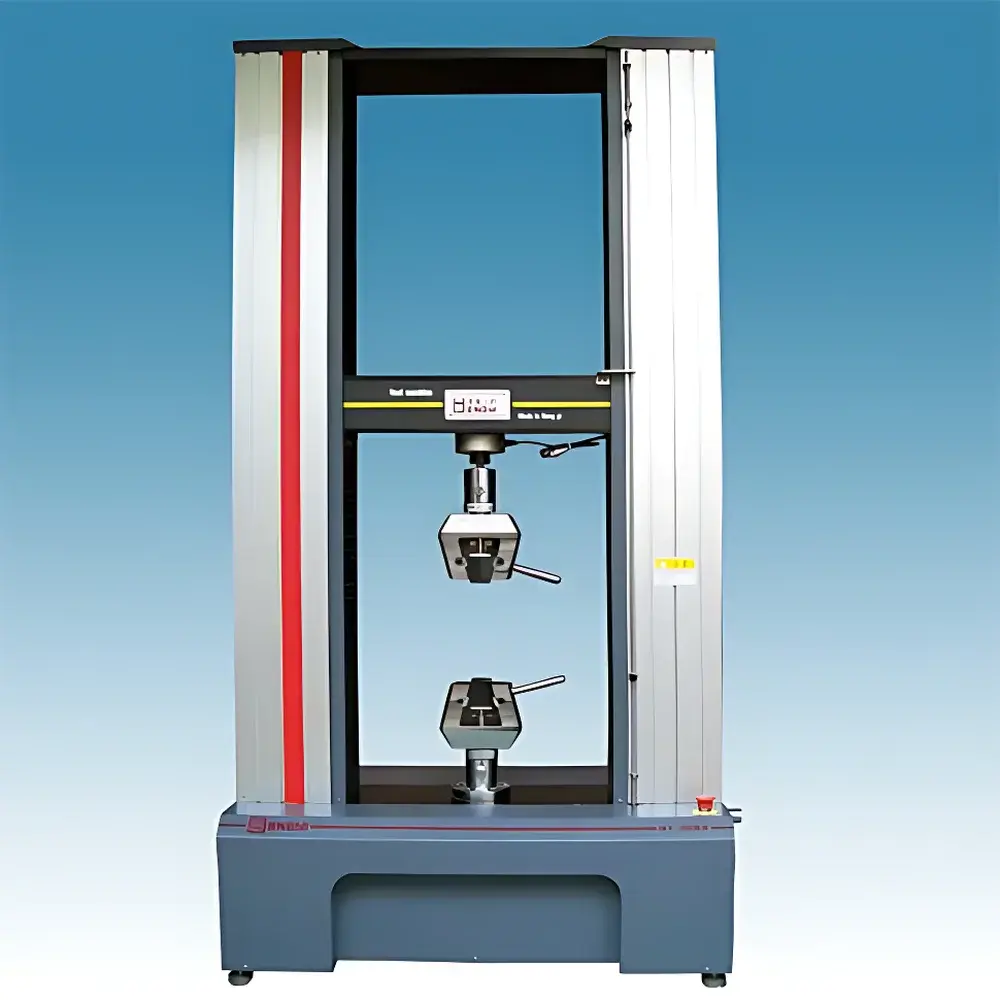
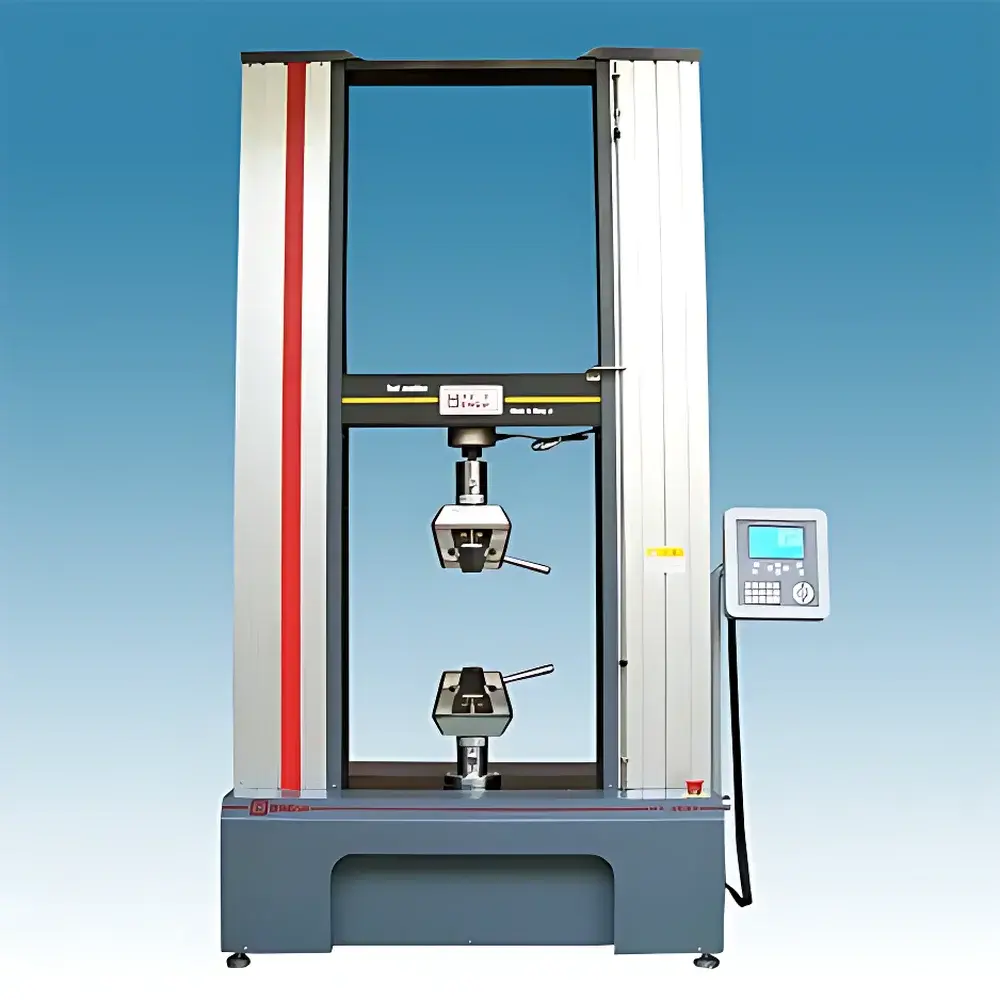
Hengyi HY-10080ERRR Universal Tensile Testing Machine for Automotive Welded Components
| Brand | Hengyi |
|---|---|
| Origin | Shanghai, China |
| Manufacturer Type | Direct Manufacturer |
| Product Category | Domestic |
| Model | HY-10080ERRR |
| Instrument Type | Electromechanical Tensile Testing Machine |
| Maximum Test Load | 100 kN |
| Force Measurement Range | 0.001–100% FS |
| Force Accuracy | ±0.5% of reading |
| Test Stroke | 800 mm |
| Displacement Resolution | 0.001 mm |
| Effective Test Width | 600 mm (expandable) |
| Crosshead Speed Range | 0.001–500 mm/min |
| Speed Accuracy | ±0.5% of set value |
| Displacement Measurement Accuracy | ±0.5% of reading |
| Strain Control Rate Range | 0.002–6% FS/s |
| Stress Control Rate Range | 0.005–6% FS/s |
| Load Cell Options | 1 N to 100 kN (multi-range configurable) |
| Power Supply | 220 V AC, 2000 W |
| Machine Weight | 1250 kg |
| Dimensions (W×D×H) | 1000 × 680 × 2200 mm |
Overview
The Hengyi HY-10080ERRR is a high-stability,龙门式 (portal-frame) electromechanical universal tensile testing machine engineered for precise mechanical characterization of welded automotive components, metallic alloys, composite assemblies, and structural fasteners. It operates on the principle of controlled uniaxial force application—measuring load via high-accuracy load cells and displacement via precision optical encoders—to determine tensile strength, yield point, elongation at break, modulus of elasticity, compressive resistance, flexural rigidity, shear integrity, and weld peel strength in accordance with standardized test protocols. Designed for integration into Tier-1 supplier QA labs and OEM R&D facilities, the system complies with fundamental mechanical testing architecture requirements defined in ISO 7500-1 (Class 0.5 accuracy), ASTM E4, ASTM E8/E8M, and ISO 6892-1 for metallic materials. Its rigid cast-iron frame, dual-column guided crosshead, and servo-controlled AC motor drive ensure minimal deflection under full-load conditions (100 kN), delivering high reproducibility across repeated test cycles.
Key Features
- Class 0.5 force measurement accuracy per ISO 7500-1, validated across full dynamic range (0.001–100% FS) without internal range switching
- High-resolution displacement detection (0.001 mm) with ±0.5% linearity over 800 mm effective stroke
- Multi-mode closed-loop control: stress rate, strain rate, and displacement rate—freely inter-switchable during active testing
- Configurable load cell suite supporting seamless transition from micro-force (1 N) to high-capacity (100 kN) applications
- Dual-speed manual/automatic crosshead positioning with electronic limit protection and emergency overload cutoff (>110% FS)
- Real-time auto-diagnostic monitoring of drive system, load cell signal integrity, encoder feedback, and power supply stability
- Integrated safety logic: programmable stop triggers based on elapsed time, target displacement, or preset load threshold
- Robust portal-frame construction (1250 kg mass) minimizing resonance and ensuring long-term dimensional stability in production lab environments
Sample Compatibility & Compliance
The HY-10080ERRR accommodates standard and custom fixtures—including wedge-action tensile grips, compression platens, three/four-point bend fixtures, and specialized weld peel jigs—for testing stamped sheet metal, spot-welded joints, laser-welded brackets, nut-on-sheet assemblies, and reinforced polymer-metal hybrids. Sample width capacity starts at 600 mm (expandable), with vertical clearance up to 800 mm—sufficient for full-scale A-pillar reinforcements or subframe assemblies. All mechanical test procedures executed on this platform support traceable compliance with ISO 14272 (spot weld tensile shear), ISO 14273 (tensile testing of projection welds), SAE J187 (weld strength evaluation), and VW 60314 (automotive component mechanical verification). Data acquisition meets GLP/GMP documentation prerequisites, with audit-ready timestamping and user-access logging.
Software & Data Management
The embedded Windows-based control software provides real-time graphing of stress–strain, load–displacement, and creep/relaxation curves. Raw data export is supported in CSV, Excel (.xlsx), and universal ASCII formats. Calibration certificates are digitally signed and stored with version-controlled metadata. The system supports optional 21 CFR Part 11-compliant configuration—including electronic signatures, role-based access control, and immutable audit trails—for regulated automotive Tier-1 suppliers undergoing IATF 16949 audits. Third-party integration via TCP/IP or RS-232 enables synchronization with MES platforms (e.g., Siemens Opcenter, PTC ThingWorx) for automated test result ingestion and SPC dashboarding.
Applications
- Quantification of lap-shear strength and failure mode analysis of resistance spot welds in body-in-white assemblies
- Tensile evaluation of M6–M12 threaded inserts post-welding onto aluminum or high-strength steel substrates
- Compression testing of crash-relevant energy-absorbing foam-metal composites
- Flexural stiffness assessment of instrument panel carrier structures under static loading
- Shear and peel testing of adhesive-bonded hybrid joints (e.g., CFRP-to-aluminum)
- Validation of weld process parameters (current, time, electrode force) against mechanical performance thresholds
- Long-term creep behavior monitoring of thermoplastic weld seams under constant load
FAQ
What standards does the HY-10080ERRR comply with for automotive weld testing?
It supports ISO 14272, ISO 14273, SAE J187, and OEM-specific specifications including VW 60314 and Ford WSS-M99P1111-A.
Can the system perform both tensile and compression tests on the same specimen setup?
Yes—the dual-acting actuator and reversible load cell mounting allow seamless transition between tension and compression modes without hardware reconfiguration.
Is third-party calibration certification included with delivery?
Each unit ships with a factory-issued ISO/IEC 17025-accredited calibration report covering force, displacement, and speed channels.
How is data integrity ensured during extended unattended testing?
The system implements non-volatile memory buffering, automatic save-on-interrupt, and CRC-verified data streaming to prevent loss during power fluctuation or network interruption.
Does the software support multi-user permission levels for QA and engineering teams?
Yes—administrator, operator, and viewer roles are configurable with granular permissions for method editing, test execution, and report generation.



