
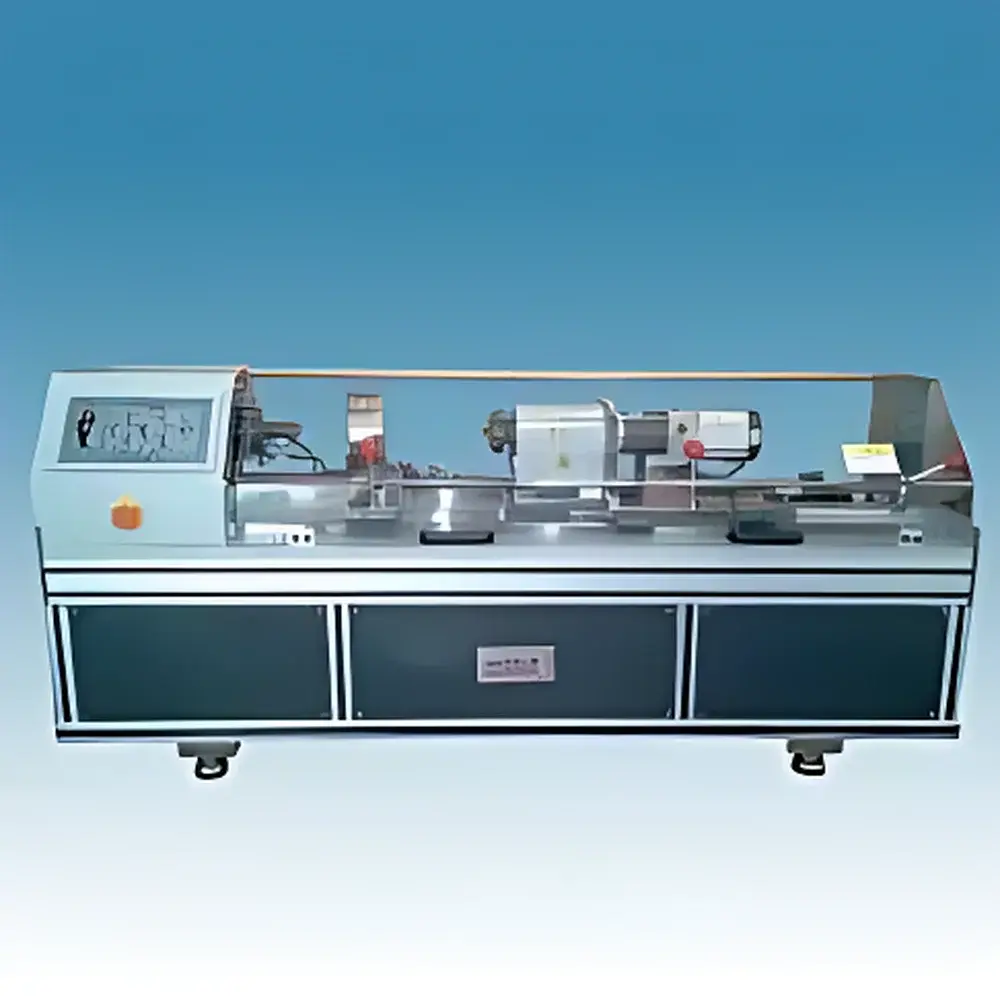
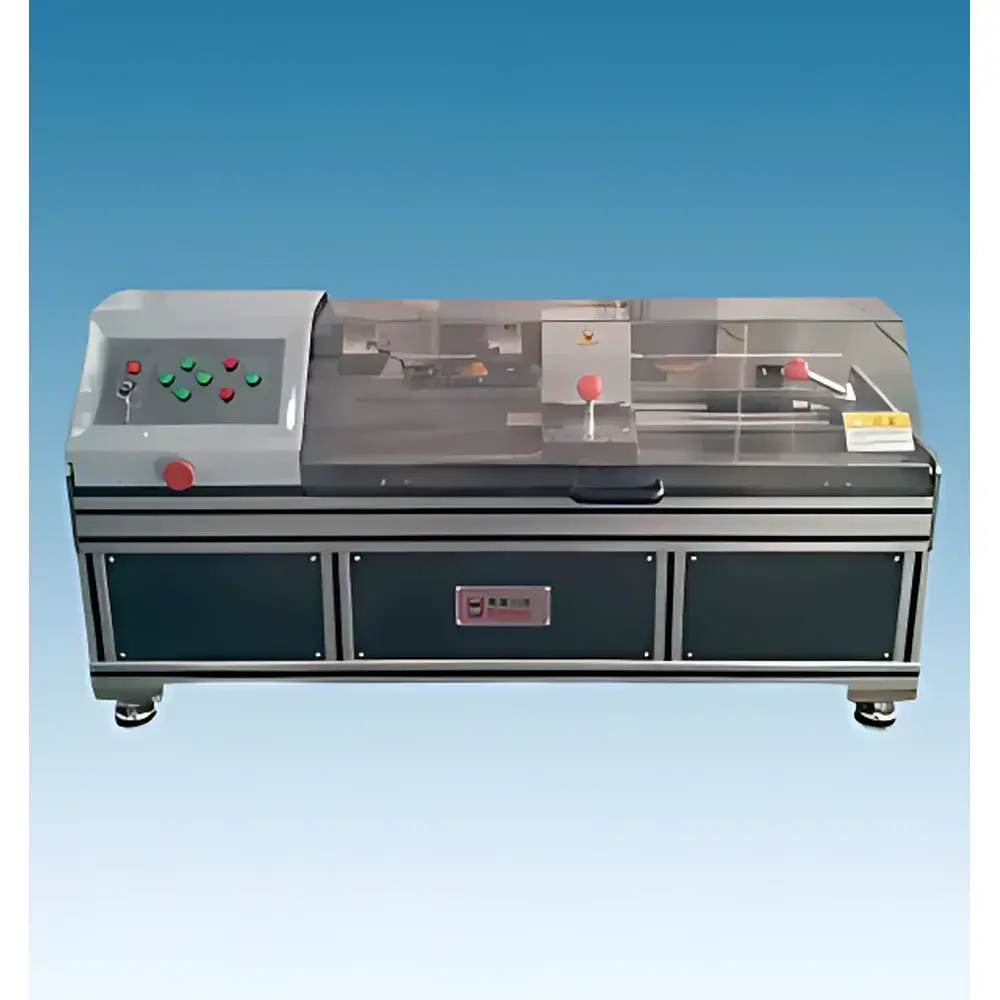
Hengyi HY-100N·mRTG Microcomputer-Controlled Electronic Torsion Testing Machine
| Brand | Hengyi |
|---|---|
| Origin | Shanghai, China |
| Manufacturer Type | Direct Manufacturer |
| Model | HY-100N·mRTG |
| Max Torque | 100 N·m |
| Torque Measurement Range | 0.1–100 N·m |
| Torque Resolution | 1/500,000 FS |
| Torque Accuracy | ±0.5% |
| Twist Angle Range | 0–100,000° (or continuous) |
| Twist Angle Resolution | 0.0045° |
| Angular Velocity Range | 0–1000°/min |
| Angular Velocity Accuracy | ±0.5% |
| Clamp Spacing | 200 mm (customizable) |
| Specimen Diameter Capacity | Φ1–Φ5 mm |
| Power Supply | Single-phase 0.4 kW |
| Weight | 200 kg |
| Compliance | JB/T 9370–1999, GB/T 10128–2007, JJG 269, GB/T 6329–1996, GB/T 7124–2008, JC/T 989–2006 |
Overview
The Hengyi HY-100N·mRTG is a precision-engineered microcomputer-controlled electronic torsion testing machine designed for quantitative mechanical characterization of adhesive joints and structural bonding interfaces under controlled torsional loading. Unlike conventional tensile testers, this system applies pure torque to bonded specimens—simulating real-world service conditions where rotational stress dominates failure modes (e.g., screw-threaded assemblies, rotating shaft couplings, or torque-sensitive medical implants). It operates on the principle of controlled angular displacement with high-fidelity torque feedback, enabling measurement of torsional stiffness, yield torque, ultimate breakaway torque, and post-yield energy absorption. The instrument conforms to internationally referenced test standards including GB/T 10128–2007 (equivalent to ISO 7800), JB/T 9370–1999, and JJG 269 for metrological verification. Its architecture integrates a high-resolution servo-motor drive, dual-channel digital signal acquisition, and real-time closed-loop control—ensuring repeatability better than ±0.5% across the full torque range.
Key Features
- Full-scale torque capacity of 100 N·m with extended low-end sensitivity down to 0.1 N·m—enabling accurate characterization of both high-strength structural adhesives and low-torque anaerobic threadlockers.
- Ultra-high torque resolution of 1 part in 500,000 full scale (FS), supported by a 24-bit analog-to-digital converter and temperature-compensated strain-gauge transducer.
- Precision twist angle measurement with 0.0045° resolution and ±0.5% accuracy over 0–100,000° range—facilitating detection of micro-slip onset and progressive debonding.
- Bidirectional automated torsion control (clockwise/counterclockwise) with programmable ramp rates, dwell periods, and cyclic profiles—essential for fatigue and hysteresis analysis.
- Modular clamping system accommodating cylindrical specimens from Φ1 mm to Φ5 mm; custom fixtures available for non-standard geometries (e.g., lap-shear torsion coupons, bone-implant interfaces).
- Integrated electronic controller with Ethernet interface—decoupling real-time motion control from host PC operations to ensure deterministic timing and eliminate OS-level latency.
Sample Compatibility & Compliance
The HY-100N·mRTG supports standardized test configurations for epoxy, polyurethane, cyanoacrylate, phenolic, urea-formaldehyde, and anaerobic adhesives per GB/T 6329–1996 (adhesive butt-joint tensile strength) and GB/T 7124–2008 (rigid-to-rigid lap shear). It also accommodates non-adhesive applications—including metallic wires, polymer rods, orthopedic screws, and dental implant abutments—under GB/T 10128–2007. All hardware and firmware comply with JB/T 9370–1999 technical specifications for torsion testing machines. Calibration traceability follows JJG 269 national verification regulations, with optional NIST-traceable certificate documentation. Data audit trails meet GLP/GMP requirements, supporting FDA 21 CFR Part 11-compliant environments when paired with validated software modules.
Software & Data Management
The bundled Hengyi TestSuite v4.2 provides ISO/IEC 17025-aligned data acquisition and reporting. Real-time plotting includes synchronized torque–time, torque–twist angle, and twist angle–time curves. Raw data streams are saved in ASCII CSV format with metadata headers (test ID, operator, timestamp, calibration ID, environmental conditions). Advanced analysis tools calculate torsional modulus, plastic deformation angle, fracture energy (area under torque–angle curve), and statistical summaries across test batches. Export options include PDF reports compliant with GB/T 7714 citation standards, Excel-compatible datasets, and image exports (PNG/SVG) of all plots. Role-based user access control, electronic signatures, and immutable audit logs are configurable for regulated laboratories.
Applications
- Quantification of breakaway torque for anaerobic threadlockers used in automotive powertrain assemblies.
- Evaluation of torsional durability in epoxy-bonded carbon fiber composite joints subjected to thermal cycling.
- Comparative assessment of cure kinetics via time-resolved torque development during in-situ UV or thermal curing.
- Mechanical validation of biocompatible adhesives in orthopedic device fixation systems (e.g., cementless stem–bone interfaces).
- Quality control screening of batch-to-batch consistency in structural adhesive manufacturing per ISO 9001 Clause 8.5.1.
- Research into interfacial failure mechanisms using high-speed torque transients coupled with digital image correlation (DIC).
FAQ
What adhesive standards does the HY-100N·mRTG directly support?
It natively implements test protocols from GB/T 6329–1996, GB/T 7124–2008, and JC/T 989–2006. Custom method templates can be imported for ASTM D3846, ISO 10365, or internal SOPs.
Can the system perform cyclic torsion fatigue tests?
Yes—software-defined waveforms (sinusoidal, trapezoidal, random) with up to 10⁶ cycles and variable amplitude/frequency profiles are fully supported.
Is third-party calibration certification available?
Factory calibration includes traceable certificates per JJG 269; optional UKAS/NIST-traceable recalibration services are offered annually.
How is specimen alignment ensured during torsion testing?
Precision-machined self-centering collets with radial runout < 0.01 mm and axial float compensation minimize bending moments—critical for valid pure-torsion interpretation.
Does the system meet cybersecurity requirements for networked lab environments?
Firmware supports TLS 1.2 encrypted communications, role-based authentication, and firewall-configurable port lockdown—aligned with IEC 62443-3-3 Level 1.



