
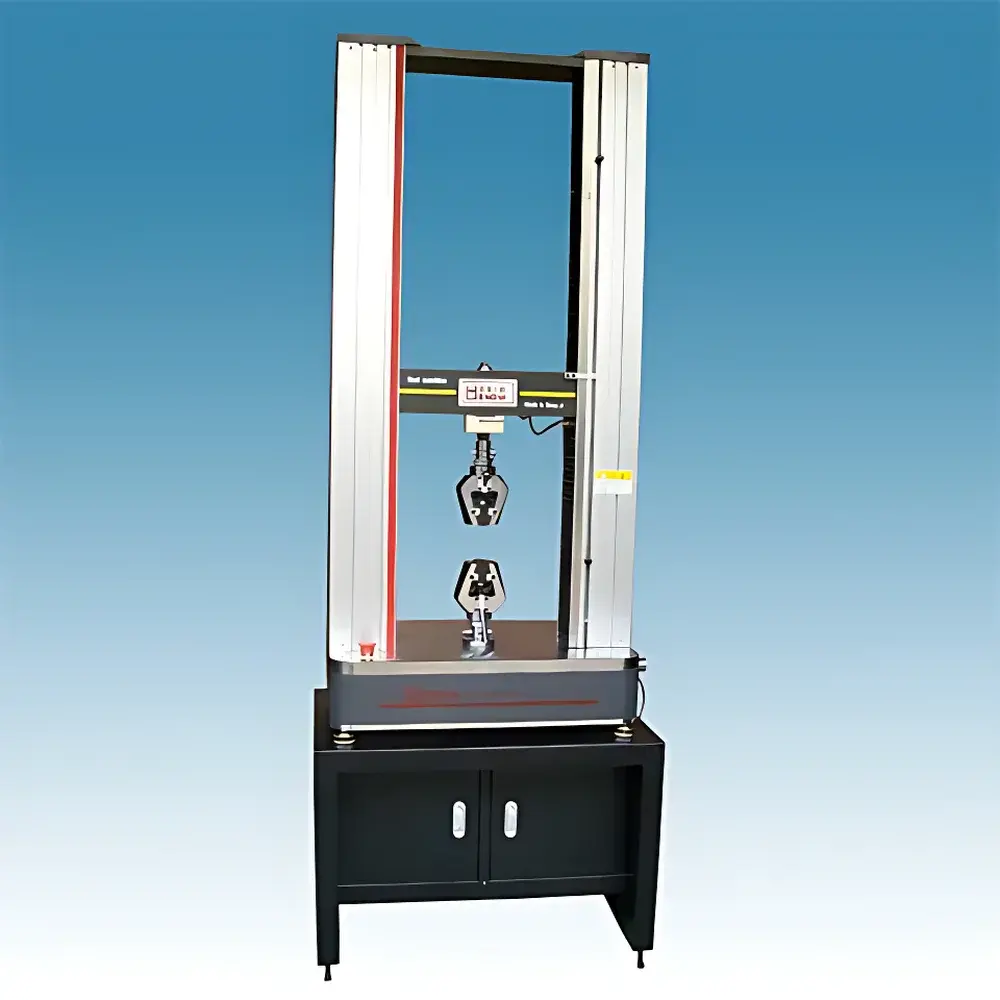
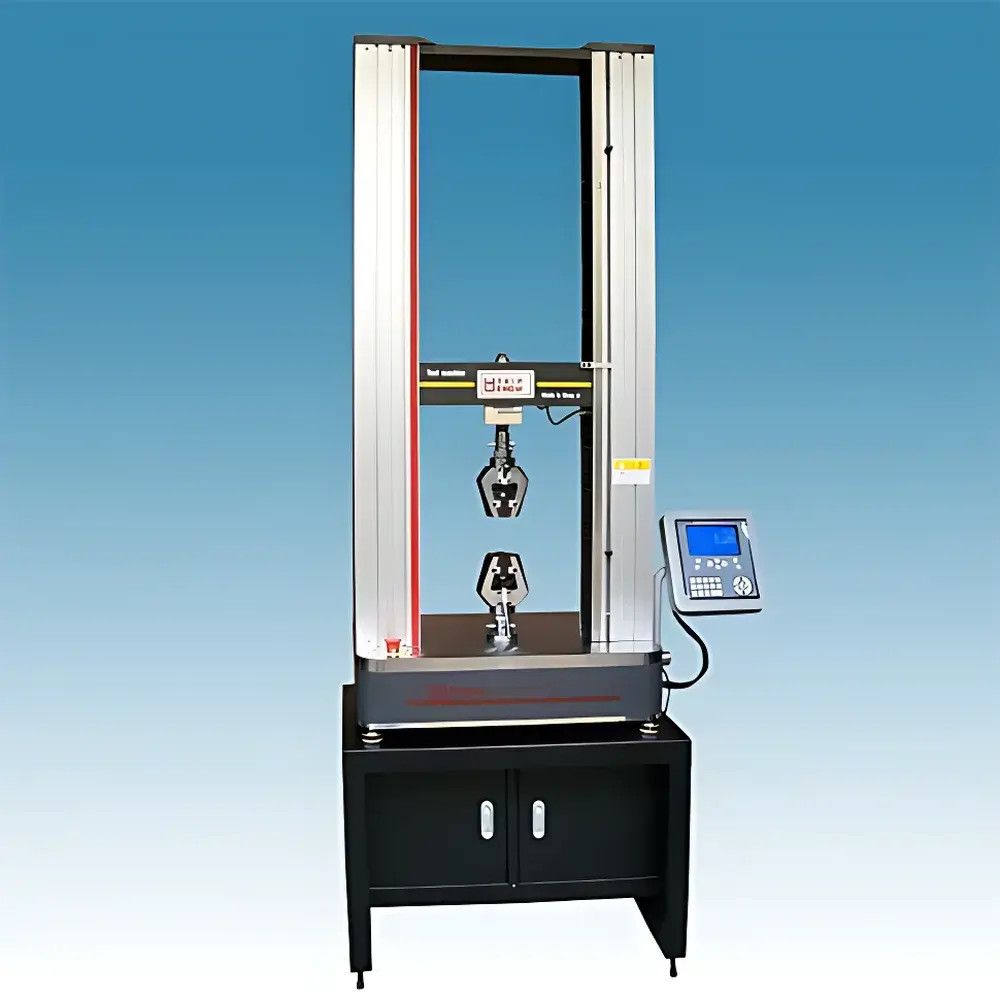
Hengyi HY-1080 Servo-Controlled Tensile Testing Machine
| Brand | Hengyi / Hengyitest |
|---|---|
| Origin | Shanghai, China |
| Manufacturer Type | Direct Manufacturer |
| Regional Category | Domestic (China) |
| Model | HY-1080AAAA |
| Instrument Type | Electromechanical Tensile Testing Machine |
| Maximum Test Load | 10 kN |
| Load Measurement Range | 0.001–100% of Full Scale |
| Load Accuracy | ±0.5% FS |
| Stroke | 800 mm |
| Displacement Resolution | 0.001 mm |
| Test Speed Range | 0.001–500 mm/min |
| Speed Accuracy | ±0.5% |
| Displacement Accuracy | ±0.5% |
| Safety Features | Electronic Limit Switches, Emergency Stop Button |
| Power Supply | 220 V AC |
| Unit Weight | ~210 kg |
| Footprint | 700 × 420 × 1600 mm (W × D × H) |
| Effective Width | 380 mm (expandable) |
| Software | HYtestV7.0 Multi-language Control & Analysis Platform (9 languages), Supports ASTM, ISO, JIS, DIN, GB/T, YB, YY, QC, SY, SL, BB, HG, CB, JT, JG, YD Standards |
| Units | N, kN, lbf, kgf, tf, g, lb, kPa, MPa |
Overview
The Hengyi HY-1080 is a precision-engineered, servo-controlled electromechanical tensile testing machine designed for static mechanical property evaluation of metallic and non-metallic materials under uniaxial loading conditions. It operates on the fundamental principle of controlled displacement actuation via a high-response AC servo motor coupled with a precision ball-screw transmission system, enabling accurate force–displacement–time data acquisition in compliance with standardized quasi-static test protocols. The system is calibrated to meet Class 0.5 accuracy per ISO 7500-1 and ASTM E4, making it suitable for routine quality control, R&D validation, and regulatory submission testing across wire & cable, automotive components, polymer films, elastomers, textiles, and composite laminates.
Key Features
- Robust dual-column frame constructed from high-rigidity steel with aluminum alloy safety enclosure—optimized for vibration damping and operator protection during high-force tensile events.
- 10 kN load cell with integrated temperature compensation and digital signal conditioning, delivering consistent linearity and repeatability across the full 0.001–100% FS measurement range.
- High-resolution encoder-based displacement measurement system with 0.001 mm resolution and ±0.5% accuracy—traceable to national metrological standards.
- Wide dynamic speed range (0.001–500 mm/min), adjustable in real time without hardware modification, supporting both low-strain-rate creep studies and rapid failure characterization.
- Dual-mode control architecture: closed-loop force control for yield point determination and closed-loop displacement control for modulus and elongation analysis—both compliant with ISO 6892-1 and ASTM D638/D882.
- Integrated safety subsystem including programmable electronic limit switches, hardware-triggered emergency stop circuitry, and software-enforced stroke boundaries—fully aligned with EN ISO 12100 and IEC 61508 functional safety requirements.
Sample Compatibility & Compliance
The HY-1080 accommodates specimens ranging from fine-diameter bare copper/aluminum wires (≥0.1 mm) to multi-strand armored cables (up to Ø25 mm), as well as flat polymer strips, rubber sheets, textile yarns, and metal foils. Grip configurations include pneumatic wedge grips, screw-action vise grips, and custom-designed clamps for brittle or low-adhesion materials. All test methods implemented through HYtestV7.0 are structured to satisfy mandatory clauses in ISO 179, ISO 527, ASTM D3039, ASTM B33, IEC 60811-501, UL 1581, and GB/T 2951 series. The machine’s traceability documentation supports GLP-compliant audit trails, including calibration certificates, uncertainty budgets, and verification reports aligned with ISO/IEC 17025 requirements.
Software & Data Management
Hengyi HYtestV7.0 is a Windows-based, FDA 21 CFR Part 11-ready control and analysis platform. It provides role-based user access, electronic signatures, audit logging of all parameter changes and test executions, and immutable raw data export in CSV, XML, and PDF formats. The software features real-time curve overlay, automatic yield point detection (0.2% offset method), tangent modulus calculation, and customizable report templates preconfigured for ISO, ASTM, and GB/T standard output fields. Multi-language UI (English, German, French, Spanish, Japanese, Korean, Russian, Portuguese, Chinese) and unit flexibility (N, kN, lbf, kgf, MPa, psi, % strain) ensure global deployment readiness. All firmware and algorithm updates are digitally signed and version-controlled to maintain integrity across laboratory networks.
Applications
- Tensile strength, yield strength (Rp0.2), ultimate tensile strength (UTS), and elongation at break of copper/aluminum conductors per IEC 60228 and GB/T 3956.
- Stress–strain behavior of cross-linked polyethylene (XLPE), ethylene propylene rubber (EPR), and flame-retardant PVC insulation layers per UL 1581 and EN 50363.
- Mechanical performance validation of fiber-optic cable reinforcement members (aramid yarns, FRP rods) under axial load per Telcordia GR-20.
- Peel strength of laminated packaging films (e.g., PET/Alu/PE) per ASTM F904.
- Compression testing of cable jackets and grommets per ASTM D575 and ISO 7743.
- Flex life and bending endurance of portable cords per UL 62 and CSA C22.2 No. 49.
FAQ
What international standards does the HY-1080 support out-of-the-box?
The system includes preloaded test methods conforming to ASTM D638, D882, D3039, B33; ISO 6892-1, 527, 179; IEC 60811-501; GB/T 228.1, 2951, 3956; and UL 1581 Clause 1060.
Can the machine be integrated into an existing LIMS or MES environment?
Yes—HYtestV7.0 supports OPC UA and TCP/IP-based data streaming, enabling bidirectional communication with laboratory information management systems and enterprise manufacturing execution platforms.
Is third-party calibration certification available?
Hengyi provides ISO/IEC 17025-accredited calibration services through CNAS-recognized partner labs, including full uncertainty analysis and certificate of conformity.
Does the system support automated batch testing with pass/fail logic?
Yes—customizable acceptance criteria (e.g., UTS ≥ X MPa, elongation ≥ Y%) can be embedded in test sequences, triggering automatic result classification and digital flagging of outliers.
What maintenance intervals are recommended for long-term accuracy retention?
Biannual verification of load cell linearity, displacement encoder drift, and grip alignment is advised; annual full recalibration is recommended for GLP/GMP-regulated environments.



