
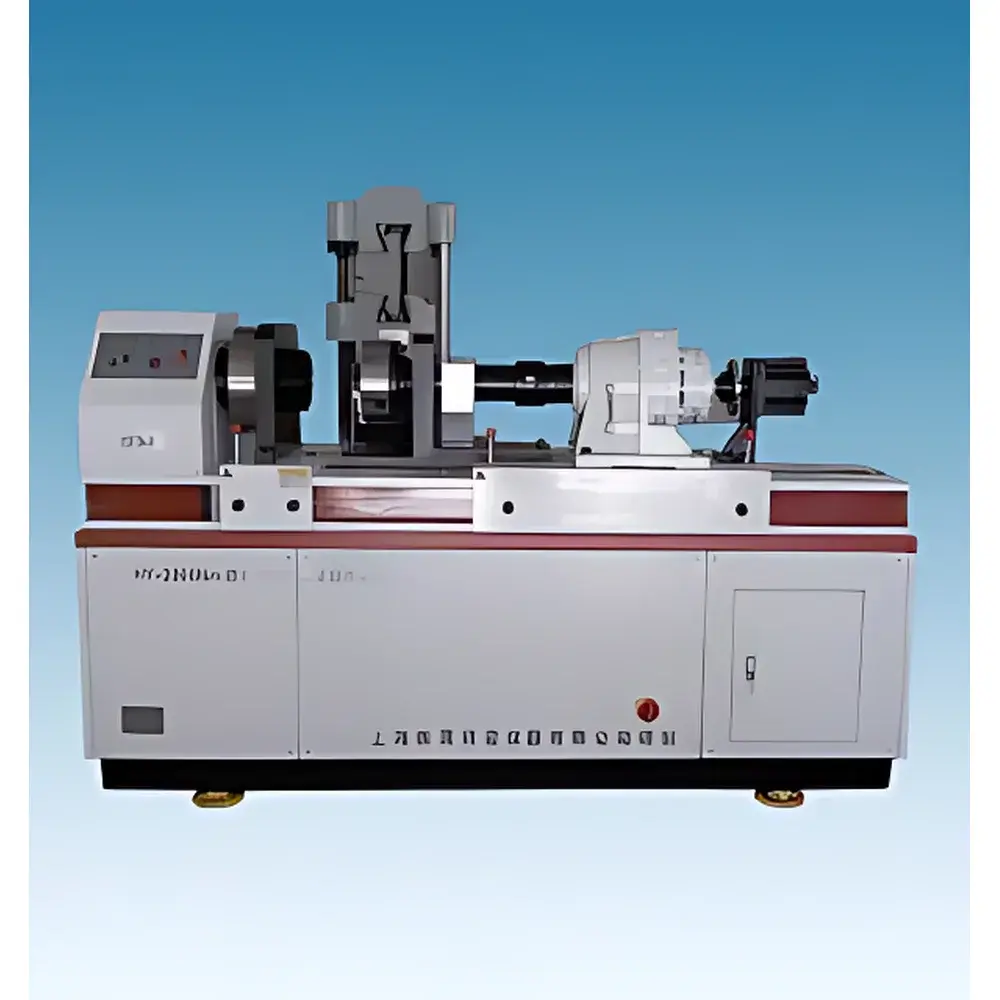
Hengyi HY-2000N·m Computer-Controlled Torsion Testing Machine
| Brand | Hengyi |
|---|---|
| Origin | Shanghai, China |
| Manufacturer Type | Direct Manufacturer |
| Model | HY-2000N·m |
| Torque Capacity | 2000 N·m |
| Torque Measurement Accuracy | ±0.5% FS |
| Angular Displacement Range | 0–100,000° (or continuous) |
| Angular Accuracy | ±0.5% |
| Twist Speed Range | 0–1000 °/min |
| Gauge Length Adjustment | up to 1500 mm |
| Specimen Diameter Range | Φ6–Φ32 mm (customizable) |
| Power Supply | Single-phase 1.5 kW |
| Dimensions (L×W×H) | ≈2800×540×1250 mm |
| Weight | 1700 kg |
Overview
The Hengyi HY-2000N·m Computer-Controlled Torsion Testing Machine is a precision-engineered, horizontal-axis torsional testing system designed for static and quasi-static mechanical characterization of metallic, polymeric, composite, and ceramic materials under pure torsional loading. It operates on the principle of controlled angular displacement or torque-controlled actuation, enabling direct measurement of torsional stiffness, shear modulus (G), proportional limit shear stress (τp), yield torque, ultimate torque, and torsional ductility. The system complies with fundamental mechanics-of-materials test theory and supports standardized torsion testing protocols defined in ISO 7800, ASTM E143 (Shear Modulus), ASTM D3497 (Torsional Stiffness of Rods), GB/T 10128 (Metallic Materials — Torsion Testing), and JIS Z 2241. Its rigid welded steel frame, high-inertia flywheel-free drivetrain, and closed-loop servo control architecture ensure minimal dynamic compliance and high reproducibility across repeated load-unload cycles.
Key Features
- High-capacity 2000 N·m torque capacity with ±0.5% full-scale accuracy, certified via traceable calibration against national metrological standards;
- Integrated Panasonic AC servo motor and drive system delivering precise speed control over 0–1000 °/min (±0.5% speed accuracy) and a dynamic speed ratio of 1:2,000,000;
- Dual high-fidelity transduction: calibrated S-type torque sensor (West Instruments, 2000 N·m range) and imported optical rotary encoder (resolution ≤ 0.01°, repeatability ±0.02°);
- Modular jaw system accommodating specimens from Φ6 mm to Φ32 mm; optional custom fixtures available for non-cylindrical or threaded components;
- ARM32-based real-time controller (56 MIPS processing capability) with 100 Hz data acquisition rate, supporting true closed-loop torque, angle, and rate control;
- Industrial-grade enclosure with electrostatically applied high-gloss powder coating; structural mass of 1700 kg ensures vibration damping and operational stability;
- Comprehensive safety interlocks including emergency stop, torque overload cutoff, and software-defined mechanical limits.
Sample Compatibility & Compliance
The HY-2000N·m accommodates solid rods, hollow tubes, fasteners, drive shafts, biomedical implants, and structural connectors. Specimen geometry is constrained only by maximum gauge length (1500 mm) and cross-sectional diameter (Φ6–Φ32 mm). With optional accessories—including non-contact extensometers, cryogenic environmental chambers, and high-temperature furnace kits—the system extends into advanced research domains such as temperature-dependent shear behavior or fatigue-torsion coupling studies. All firmware and software modules adhere to GLP/GMP documentation requirements, with audit-trail-enabled test logs, user-access controls, and electronic signature support aligned with FDA 21 CFR Part 11 readiness. Test reports are exportable in PDF, CSV, and XML formats compliant with ISO/IEC 17025 laboratory accreditation criteria.
Software & Data Management
Control and analysis are performed using Hengyi’s proprietary Windows-based test platform—developed in-house and validated per IEC 62304 for medical device software lifecycle rigor. The interface supports multi-step test programming (e.g., ramp-hold-ramp, cyclic torsion, creep), real-time curve overlay, and post-test parameter extraction including G-value regression (via linear region slope of τ–γ curve), τp, torsional yield point (ASTM E143 method), and energy absorption (area under torque-angle curve). Raw data streams are timestamped at 10 ms intervals, stored in binary format for integrity, and backed up automatically to network drives. Export functions include automated report generation with institutional headers, digital signatures, and metadata embedding (operator ID, calibration date, environmental conditions).
Applications
- Quality assurance of automotive driveline components (propeller shafts, CV joints, steering columns);
- R&D evaluation of torsional fatigue life in aerospace fasteners and turbine blade root attachments;
- Mechanical validation of orthopedic bone screws and spinal rods per ISO 5832-3 and ASTM F565;
- Shear modulus determination for elastomeric isolators and viscoelastic polymer composites;
- Calibration reference for secondary torsion standards in national metrology institutes;
- Curriculum-based experiments in undergraduate mechanics labs (e.g., Saint-Venant’s torsion theory verification).
FAQ
What international standards does the HY-2000N·m support out-of-the-box?
The system includes pre-configured test methods for GB/T 10128, ISO 7800, ASTM E143, ASTM D3497, and JIS Z 2241. Custom protocol templates can be authored using the built-in script editor.
Is the software compatible with LIMS or MES integration?
Yes—via TCP/IP socket communication and RESTful API endpoints (available under OEM licensing), enabling bidirectional data exchange with laboratory information management systems.
Can the machine perform cyclic torsion tests?
Absolutely. The ARM32 controller supports programmable sinusoidal, triangular, trapezoidal, and random waveforms with frequency up to 5 Hz and phase synchronization between torque and angle channels.
Does the system meet electromagnetic compatibility (EMC) requirements for EU laboratories?
It conforms to EN 61326-1:2013 (industrial environment) and carries CE marking under the Machinery Directive 2006/42/EC.
What is the recommended calibration interval?
Annual calibration is advised per ISO/IEC 17025; torque sensor recalibration must be performed by an accredited provider using dead-weight or hydraulic reference standards.



