
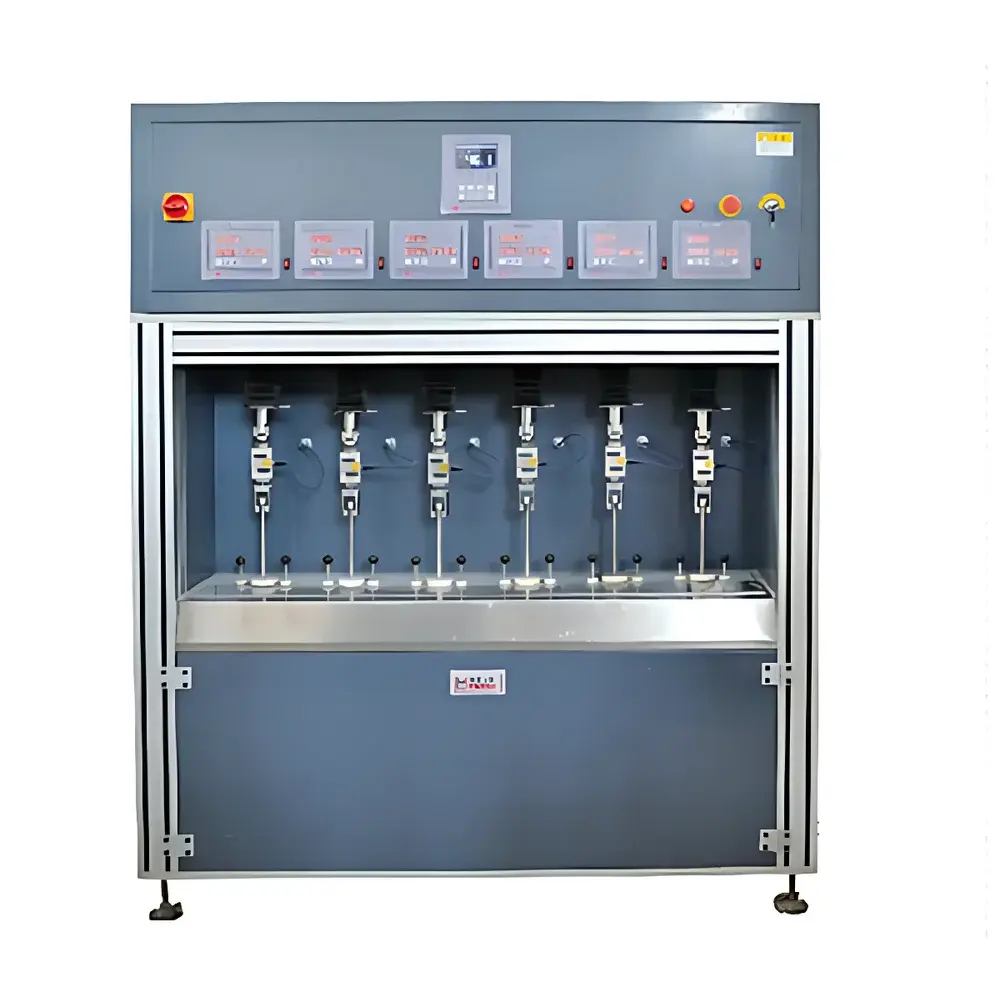
Hengyi HY-QKRB Full-Notch Tensile Creep Testing Machine for Polyethylene
| Brand | Hengyi / Hengyitest |
|---|---|
| Origin | Shanghai, China |
| Manufacturer Type | Direct Manufacturer |
| Region | Domestic (China) |
| Model | HY-QKRBTHHH |
| Load Capacity | 2000 N (interchangeable load cells available below 2000 N) |
| Force Accuracy | Class 0.5 |
| Effective Force Range | 0.4–99.999% of full scale |
| Test Width | 120 mm |
| Test Space | 200 mm |
| Speed Range | 0.001–100 mm/min (adjustable) |
| Speed Accuracy | ±1% of indicated value |
| Displacement & Strain Measurement Accuracy | ±1% of indicated value |
| Test Stations | 12 independent stations |
| Temperature Control Bath Range | Ambient to 95 °C |
| Temperature Stability | ±0.5 °C |
| Control System | PC-based software (bilingual Chinese/English) |
| Power Requirement | 220 V, 10 kW |
| Weight | 850 kg |
| Dimensions (W×D×H) | 1620 × 850 × 1750 mm |
| Compliance | GB/T 15820–1995, GB/T 11546, GB/T 32682–2016, ISO 16770, ISO 899-1, ISO 3501 |
Overview
The Hengyi HY-QKRB Full-Notch Tensile Creep Testing Machine is a purpose-built, multi-station mechanical testing system engineered for the standardized evaluation of environmental stress cracking (ESC) resistance in polyethylene (PE) and other thermoplastic polymers under sustained static tensile loading. It operates on the principle of full-notch creep testing (FNCT), as defined in ISO 16770 and GB/T 32682–2016, where pre-notched specimens are subjected to constant tensile stress in a controlled thermal–chemical environment—typically elevated temperature water or surfactant solution—to accelerate ESC initiation and propagation. Unlike conventional uniaxial creep testers, the HY-QKRB integrates 12 independently actuated test stations with individual load application, displacement monitoring, and thermal immersion capability, enabling statistically robust time-to-failure data generation across multiple stress levels within a single test run. Its design adheres to the fundamental mechanics of linear viscoelasticity and fracture kinetics in semi-crystalline polymers, making it suitable for quality assurance in PE pipe manufacturing, material development, and third-party certification laboratories requiring traceable, reproducible ESC performance assessment.
Key Features
- Twelve fully independent test stations, each equipped with precision electromechanical loading actuators and real-time force feedback control—eliminating cross-talk between specimens and ensuring high inter-test reproducibility.
- Modular elastic support architecture isolates mechanical vibration and thermal drift across stations, maintaining measurement integrity during long-duration tests (up to 10,000 hours).
- Integrated thermostatic bath with PID-controlled heating and circulation ensures uniform temperature distribution (±0.5 °C stability) across all 12 immersion zones, critical for compliance with ISO 16770 Annex A requirements.
- Interchangeable load cells (rated up to 2000 N) allow flexible configuration for low-force ESC screening or high-load pipe pull-out validation per GB/T 15820.
- Bilingual (English/Chinese) PC-based control software provides automated test sequencing, real-time data acquisition at configurable sampling intervals, and built-in calculation of time-to-failure (tf) at user-defined stress levels.
- Comprehensive hardware safety layer includes over-travel limit switches, thermal cutoffs, load cell overload protection, and self-diagnostic boot-up verification—meeting IEC 61000-6-2 EMC immunity standards for industrial laboratory environments.
Sample Compatibility & Compliance
The HY-QKRB accommodates standard FNCT specimens per ISO 16770 (10 mm × 4 mm × 4 mm, with 0.3 mm deep notch) and ASTM D1693-type geometries, as well as custom pipe coupons and joint assemblies for pull-out testing in accordance with GB/T 15820. Specimen holders are corrosion-resistant (316 stainless steel) and compatible with aqueous surfactant solutions (e.g., Igepal CO-630), ethanol/water mixtures, or deionized water. The system is validated for conformance to ISO 899-1 (tensile creep), ISO 3501 (plastic deformation under constant load), and GB/T 11546 (creep behavior of plastics). All test reports include metadata traceable to calibration certificates (force, displacement, temperature), supporting GLP-compliant documentation and FDA 21 CFR Part 11 audit readiness when configured with electronic signature modules.
Software & Data Management
The embedded Windows-based software suite supports method-driven test definition: users specify stress level (MPa), bath medium, target temperature, duration, and sampling frequency. Raw data streams—including applied force (N), crosshead displacement (mm), elapsed time (h), and bath temperature (°C)—are logged synchronously at ≥10 Hz and stored in vendor-neutral CSV and HDF5 formats. Automated post-processing generates standard output curves: displacement vs. time, stress vs. time, and log(tf) vs. applied stress (for master curve construction). Statistical analysis tools compute median failure time, Weibull shape/scale parameters, and confidence intervals per ISO 204:2021. Data archiving complies with ISO/IEC 17025 clause 7.5.2; audit trails record operator ID, timestamp, parameter changes, and calibration events with immutable hashing.
Applications
- Environmental stress cracking (ESC) resistance ranking of HDPE resins used in gas/water distribution pipes.
- Validation of fusion joint integrity in PE100 pipe systems per ISO 4427 series.
- Comparative evaluation of antioxidant package efficacy under accelerated aging conditions.
- Regulatory submission testing for CE marking (EN 1555), NSF/ANSI 61, and AS/NZS 4130.
- Root-cause analysis of field failures linked to residual stresses or chemical exposure.
- Material qualification for offshore cable jacketing and geomembrane applications.
FAQ
What standards does the HY-QKRB explicitly support?
It is fully aligned with ISO 16770 (FNCT), ISO 899-1 (tensile creep), GB/T 32682–2016, GB/T 15820 (pull-out), and GB/T 11546—covering both ESC and general creep behavior in polyolefins.
Can the system perform simultaneous tests at different temperatures?
No—temperature is uniformly controlled across the entire bath; however, stress levels and specimen geometry can be varied per station to enable multi-level experimental designs within one thermal condition.
Is third-party calibration certification included?
Factory calibration is performed using NIST-traceable deadweight standards for force and certified LVDTs for displacement; optional UKAS-accredited calibration certificates are available upon request.
How is data integrity ensured during extended tests?
The system employs redundant storage (local SSD + network backup), cyclic checksum verification, and automatic recovery from power interruption without data loss.
Does the software support automated report generation for regulatory submissions?
Yes—predefined templates generate PDF reports compliant with ISO/IEC 17025, including uncertainty budgets, calibration history, raw data appendices, and pass/fail determinations against specified criteria.



