
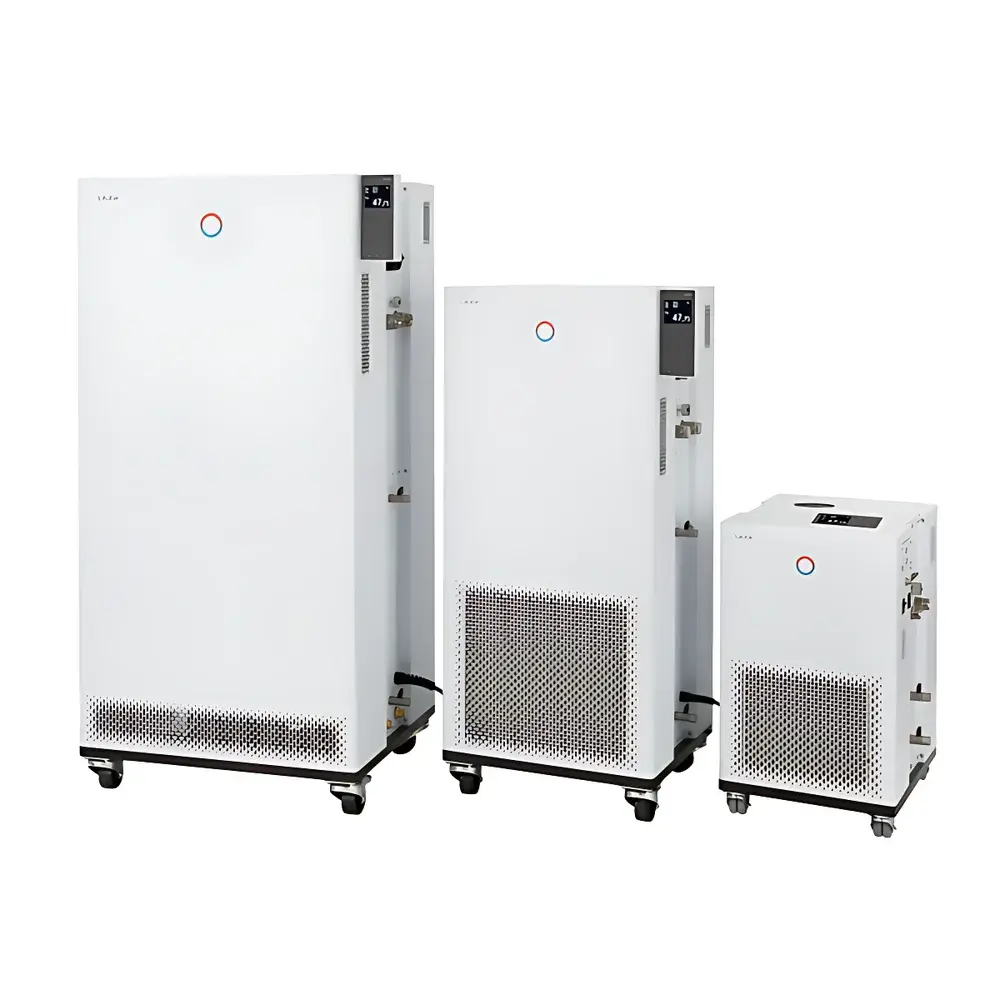
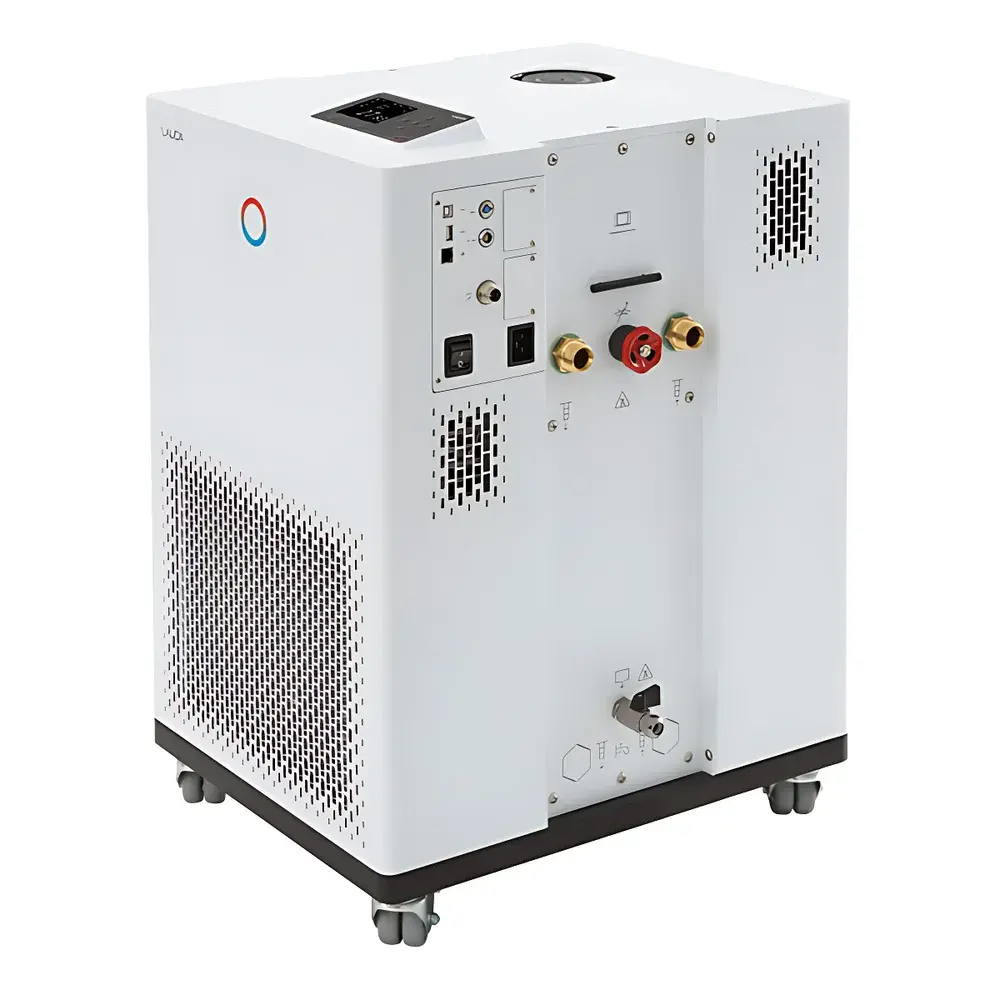
LAUDA Integral T IN 230 TW High-Performance Circulating Chiller with Integrated Heating and Cooling
| Brand | LAUDA |
|---|---|
| Origin | Germany |
| Model | IN 230 TW |
| Instrument Type | Integrated Circulating Chiller |
| Cooling Method | Water-Cooled |
| Temperature Range | –30 to 120 °C |
| Refrigeration Capacity | 2300 W |
| Temperature Stability | ±0.05 °C |
| Pump Pressure | 3.5 bar |
| Pump Flow Rate | 40 L/min |
| Reservoir Volume | 3.6–8.7 L |
| Operating Mode | Continuous |
Overview
The LAUDA Integral T IN 230 TW is a high-precision, integrated circulating chiller engineered for dynamic external temperature control of laboratory and pilot-scale process equipment. Based on a dual-function thermoregulation architecture—combining electric resistance heating and vapor-compression refrigeration—the system delivers seamless, bidirectional thermal management across an exceptionally wide operational range of –30 °C to +120 °C. Its compact internal fluid volume minimizes thermal inertia, enabling rapid ramp rates during both heating and cooling phases—critical for applications requiring tight thermal transients, such as reaction calorimetry, polymer synthesis, or crystallization studies. The unit employs a semi-closed expansion loop design with large-volume expansion capacity, facilitating efficient air purging without interrupting circulation—a key advantage in multi-instrument lab environments where frequent reconfiguration of external devices (e.g., jacketed reactors, spectrometers, or chromatography columns) is routine.
Key Features
- Full-range temperature control from –30 °C to +120 °C using R-449A refrigerant (GWP = 1397), compliant with EU Regulation (EU) No 517/2014 on fluorinated greenhouse gases
- High-stability thermal regulation with ±0.05 °C temperature stability at setpoint, achieved via fully electronic PID controller with adaptive parameter tuning
- Robust immersion-type pressure pump delivering up to 40 L/min at 3.5 bar, with digital pressure display and adjustable bypass valve for precise pressure limiting (protecting pressure-sensitive peripherals such as glass reactors)
- Modular communication interface architecture: standard Ethernet (integrated web server), USB, and Pt100 input; optional expansion modules support RS232/485, Profibus, analog I/O, dry-contact, or EtherCAT protocols
- LAUDA SmartCool digital cooling management system optimizes compressor cycling based on real-time thermal load, reducing energy consumption and extending component service life
- Color TFT touchscreen with graphical temperature curve visualization, six-language menu navigation (English, German, French, Spanish, Italian, Russian), and intuitive text-based UI
- PowerAdapt technology dynamically adjusts heating output to match available mains power capacity, preventing circuit overloads in shared lab infrastructure
- Comprehensive safety suite including Tmax overtemperature protection with audible alarm, leak-resistant sealed pump housing, and automatic fault logging
Sample Compatibility & Compliance
The IN 230 TW is designed for integration with a broad spectrum of external equipment requiring precise thermal coupling—including jacketed glass reactors, rotary evaporators, HPLC column ovens, laser sources, and material testing fixtures. Its G 3/4″ threaded inlet/outlet ports and 3/4″ hose compatibility ensure secure, low-leakage connections. The system meets CE marking requirements under the EU Machinery Directive 2006/42/EC and Low Voltage Directive 2014/35/EU. Electrical safety complies with EN 61010-1:2019 for laboratory equipment. Refrigerant handling and labeling conform to EN 378-1:2016. While not inherently GLP/GMP-certified, its audit-ready features—including timestamped event logs, programmable setpoint sequences (150 segments across 5 programs), and remote diagnostics—support validation workflows aligned with ISO/IEC 17025 and FDA 21 CFR Part 11 when deployed within controlled quality systems.
Software & Data Management
Embedded firmware includes a built-in web server accessible via any browser on the local network—enabling full remote operation from PCs, tablets, or smartphones without proprietary software installation. The system supports real-time monitoring of temperature, pressure, pump status, refrigerant saturation, and power draw. All setpoints, alarms, and program steps are stored with timestamps and user identifiers. Diagnostic self-test routines verify sensor integrity, pump performance, and refrigeration cycle efficiency. Data export is supported via USB mass storage (CSV format) or periodic HTTP POST to designated endpoints. Optional LAUDA LabManager software (sold separately) enables centralized fleet monitoring, automated report generation, and integration with LIMS or MES platforms through standardized RESTful APIs.
Applications
- Process development and scale-up studies requiring reproducible thermal profiles across exothermic/endothermic reactions
- Calibration and qualification of temperature-sensitive analytical instruments (e.g., DSC, TGA, rheometers)
- Stabilization of high-power optical components (lasers, detectors) subject to thermal drift
- Controlled crystallization and polymorph screening in pharmaceutical R&D
- Thermal conditioning of battery cells and electrolyte test cells in electrochemical labs
- Long-duration stability testing of materials under accelerated thermal cycling protocols
FAQ
What is the minimum and maximum recommended heat transfer fluid volume?
The reservoir requires a minimum fill of 3.6 L for stable operation and accommodates up to 8.7 L to support extended external loops or high-thermal-mass applications.
Can the unit operate continuously at its temperature extremes?
Yes—rated for uninterrupted operation across the full –30 °C to +120 °C range, provided ambient conditions remain within 5–40 °C and cooling water supply meets specified flow (≥3 L/min), temperature (≤15 °C), and pressure differential (0.8–3 bar) requirements.
Is the system compatible with external Pt100 sensors for cascade control?
Yes—standard Pt100 input allows direct connection of external reference sensors for advanced control strategies, including cascade or feedforward configurations.
Does the device support protocol-level integration into industrial automation networks?
With optional fieldbus modules (Profibus, EtherCAT, or analog I/O), the IN 230 TW can be integrated into PLC-controlled environments and supports Modbus TCP over Ethernet for SCADA interoperability.
How does SmartCool contribute to energy efficiency?
SmartCool monitors real-time cooling demand and modulates compressor activation—not just on/off cycling—reducing peak loads, minimizing wear, and lowering average power consumption by up to 22% compared to conventional fixed-speed compressors under partial-load conditions.
Related Products



