
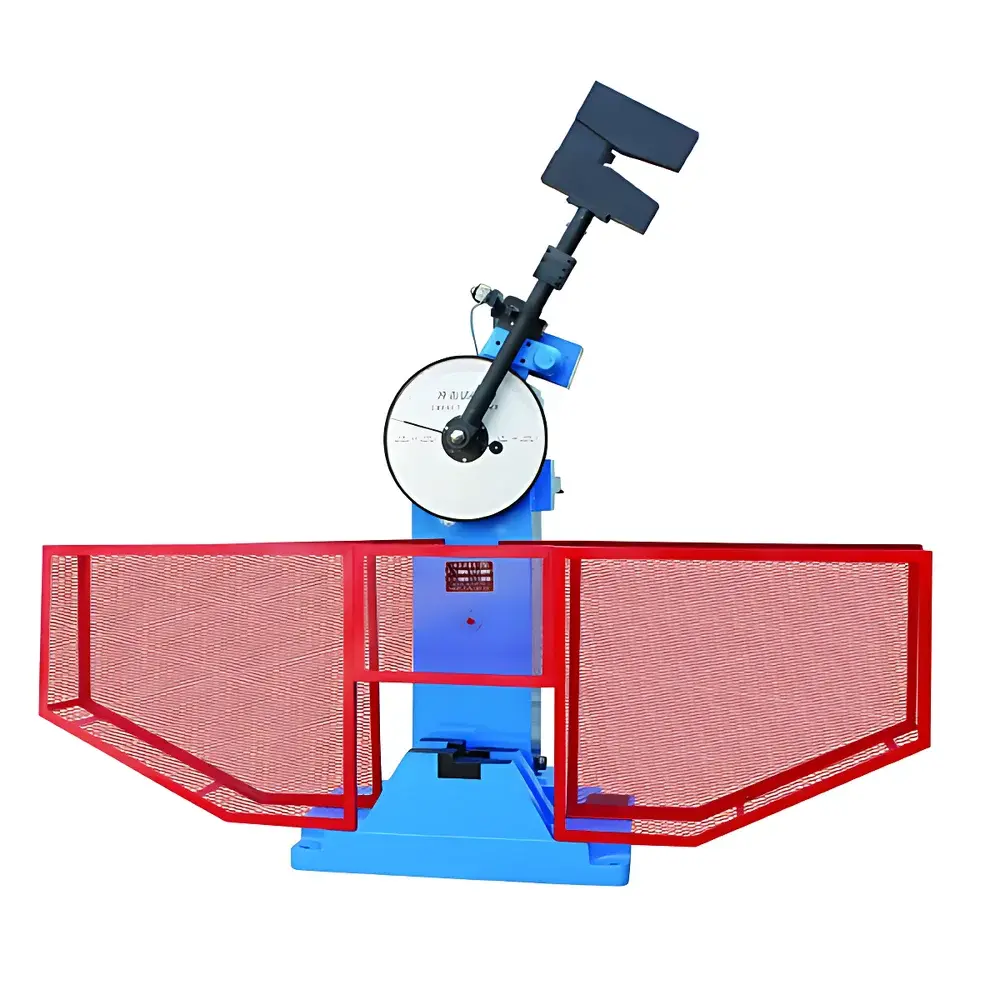
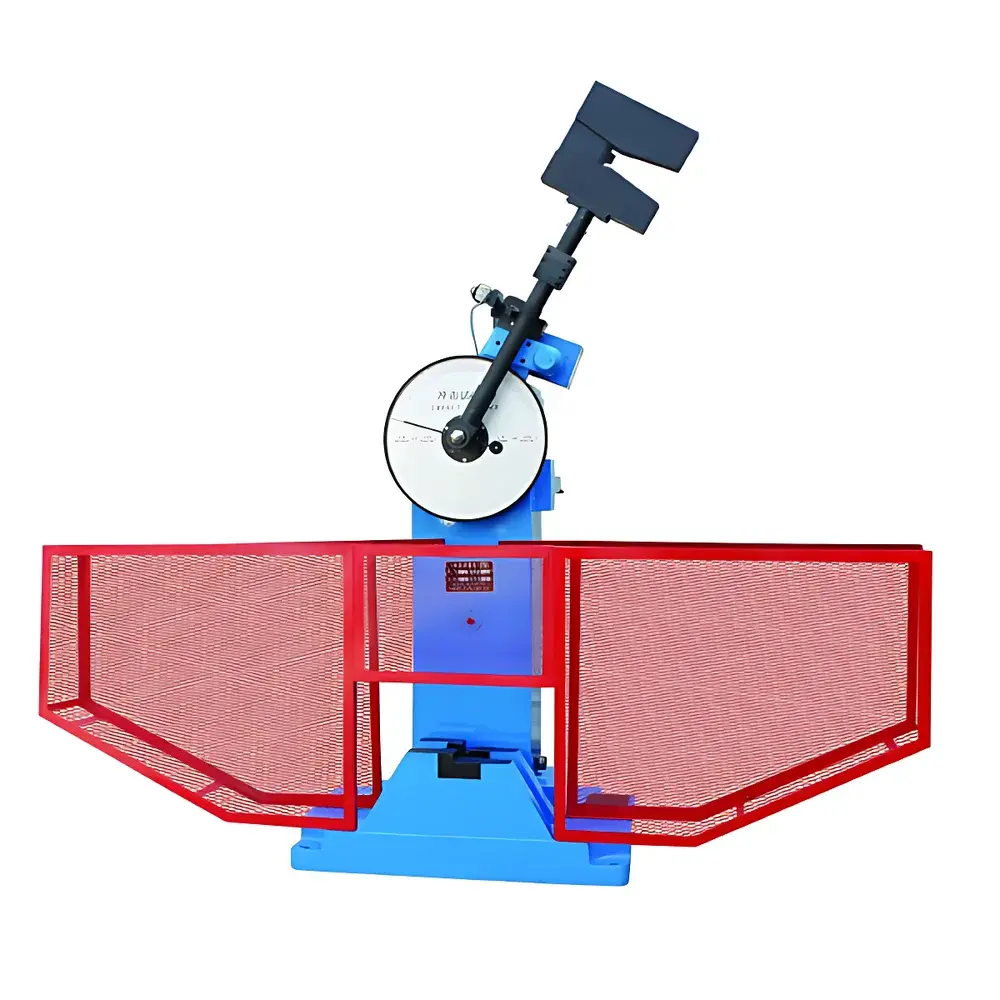
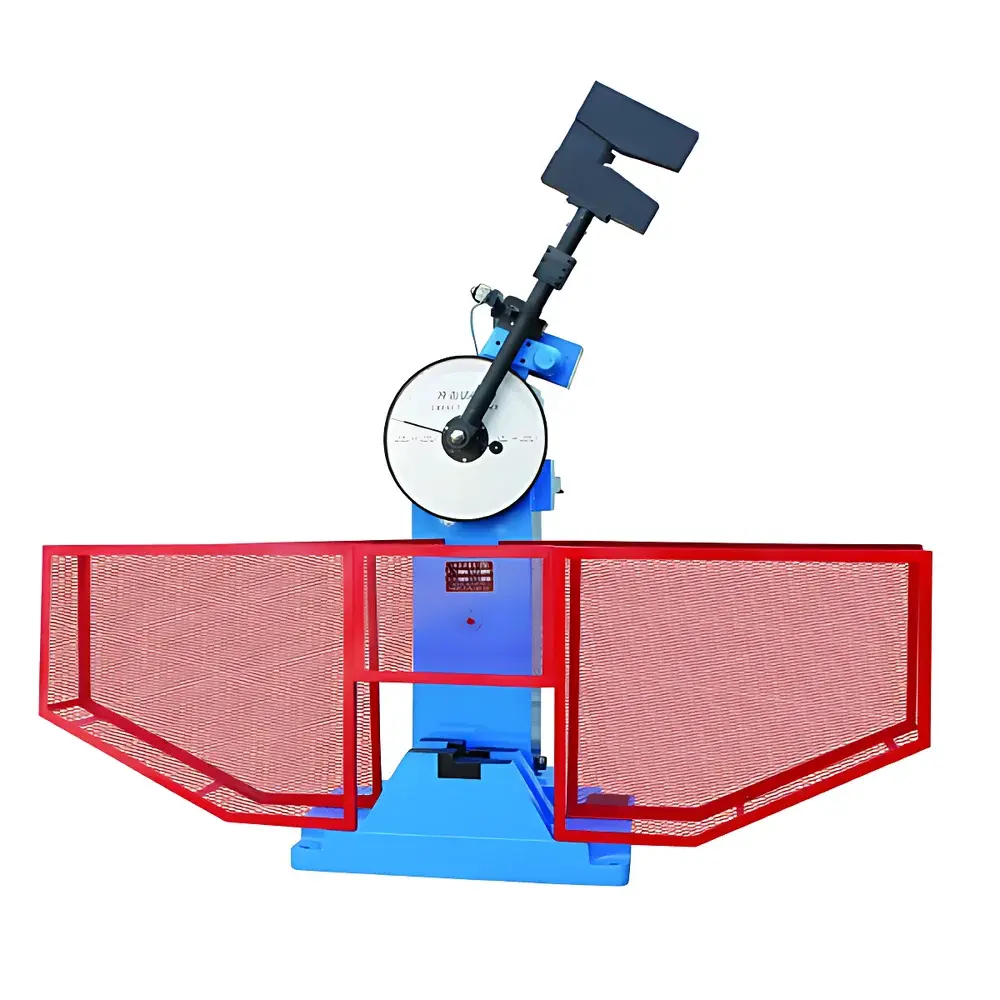
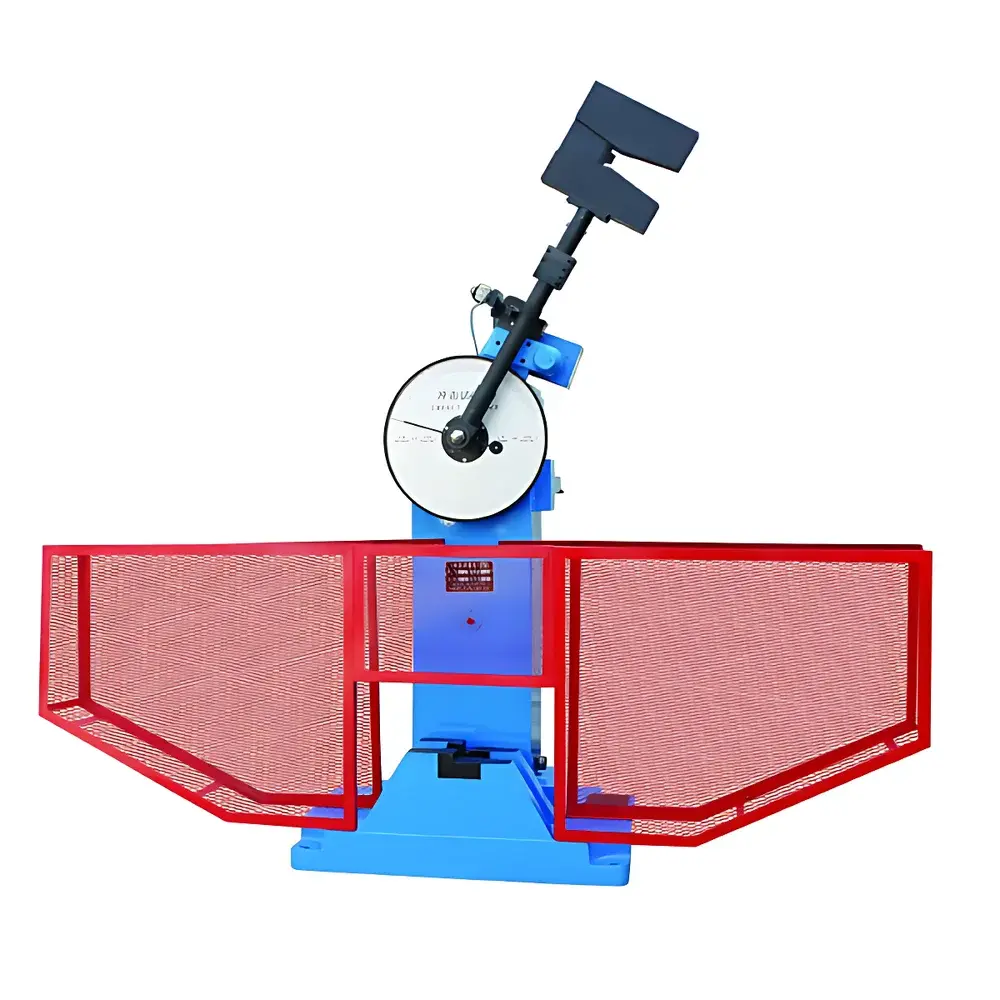
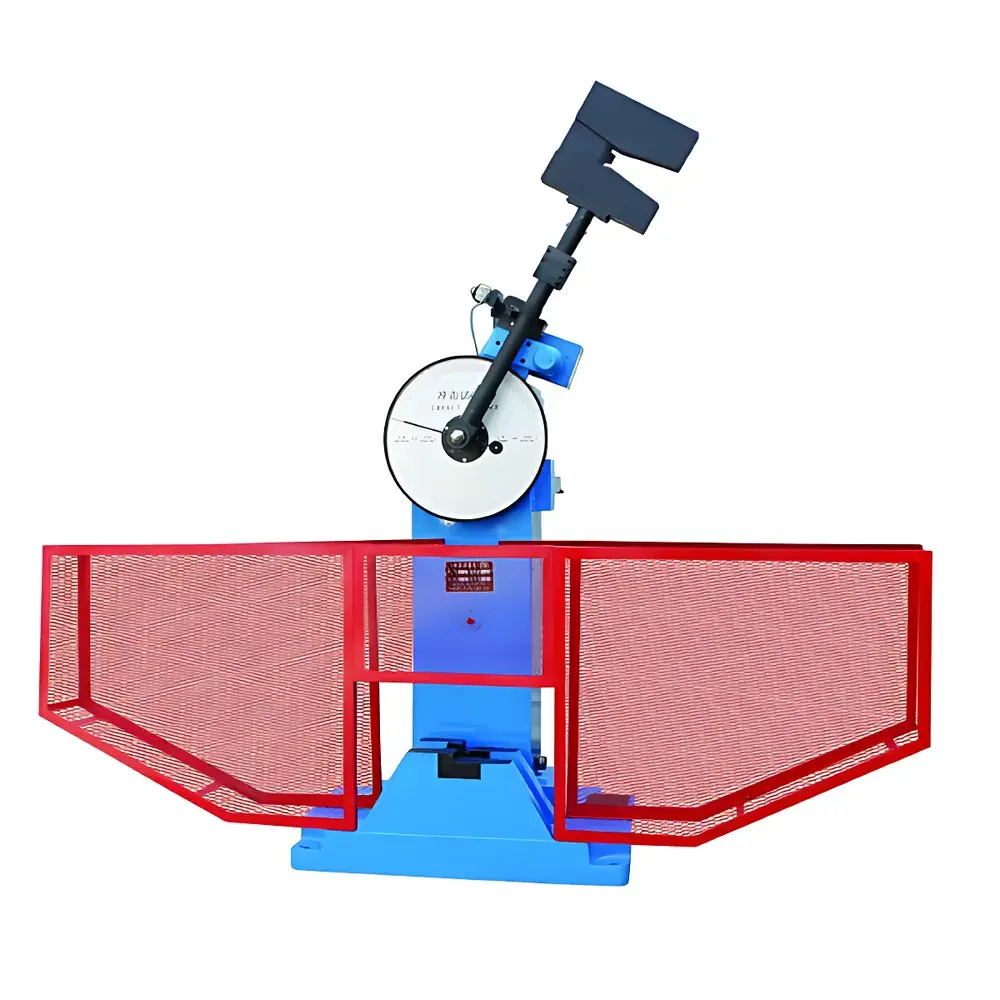
Hengyi HY(BC)-300J Semi-Automatic Charpy Impact Testing Machine
| Brand | Hengyi |
|---|---|
| Origin | Shanghai, China |
| Manufacturer Type | Direct Manufacturer |
| Model | HY(BC)-300J |
| Impact Energy | 300 J (with dual-range pendulum: 0–300 J / 0–150 J) |
| Impact Velocity | 5.2 m/s |
| Pendulum Moment (Impact Constant) | M = 160.7695 N·m (300 J range), M = 80.3848 N·m (150 J range) |
| Maximum Lifting Height | 300 J equivalent |
| Pendulum Pre-Lift Angle | 150° |
| Distance from Pendulum Axis to Impact Point | 750 mm |
| Anvil Span | 40 mm |
| Notch Radius (Anvil) | R 1.0–1.5 mm |
| Hammer Blade Radius | R 2.0–2.5 mm |
| Hammer Blade Angle | 30° |
| Hammer Blade Thickness | 16 mm |
| Angular Measurement Range | 0–360° |
| Angular Resolution | ≤0.06° |
| Specimen Dimensions | 10 × 10 × 55 mm (standard) |
| Machine Dimensions (L×W×H) | 2150 × 640 × 1400 mm |
| Machine Weight | 420 kg |
| Power Supply | 3-phase 4-wire, 380 V, 50 Hz, 400 W total (main motor: 250 W) |
| Compliance | GB/T 3808–2002, GB/T 229–2007, JJG 145–2007 |
Overview
The Hengyi HY(BC)-300J Semi-Automatic Charpy Impact Testing Machine is a precision-engineered pendulum-type impact tester designed for quantitative evaluation of metallic materials’ resistance to dynamic loading under standardized Charpy V-notch or U-notch conditions. It operates on the fundamental principle of conservation of mechanical energy: the kinetic energy imparted by a gravity-driven pendulum is partially absorbed during fracture of a notched specimen, with the residual energy measured via angular displacement of the pendulum arm. The difference between initial potential energy and post-impact residual energy—displayed directly on a calibrated dual-range analog scale—is reported as the absorbed energy (in joules), a critical parameter in assessing material toughness, ductile-to-brittle transition behavior, and structural integrity under sudden load events.
Key Features
- Semi-automatic operation with electromechanical lifting, release, and repositioning of the pendulum—eliminating manual handling while retaining operator control over test initiation and safety interlocks.
- Dual-range pendulum system: standard 300 J configuration with dedicated 150 J pendulum included, enabling high-resolution measurement across broad energy ranges without recalibration.
- High-rigidity cast-steel frame and reinforced base structure ensure minimal frame deflection (<0.01 mm under full 300 J impact), preserving measurement fidelity and long-term repeatability.
- High-torque electromagnetic clutch and 250 W servo-assisted lifting motor guarantee smooth, vibration-free pendulum elevation and controlled descent—critical for minimizing parasitic energy loss and maintaining ASTM/ISO-compliant impact velocity tolerance (±0.1 m/s at 5.2 m/s).
- Precision-machined anvil assembly with adjustable support geometry: 40 mm span, 11° support surface inclination, and traceable R1.0–1.5 mm anvil radius per ISO 148-1 Annex A.
- Calibrated hammer blade with 30° included angle, 16 mm thickness, and R2.0–2.5 mm tip radius—fully compliant with GB/T 229–2007 and ASTM E23 requirements for Charpy testing.
- Angular encoder with ≤0.06° resolution enables sub-joule energy resolution (1 J = 0.56° at 300 J range), supporting rigorous uncertainty analysis per ISO/IEC 17025.
Sample Compatibility & Compliance
The HY(BC)-300J accommodates standard Charpy specimens measuring 10 mm × 10 mm × 55 mm, with optional fixtures available for 5 mm and 7.5 mm thickness variants. Specimen alignment is ensured via precision-ground V-groove supports and micrometer-adjustable lateral positioning. The instrument meets national verification requirements per JJG 145–2007 and performance validation criteria defined in GB/T 3808–2002. Its mechanical architecture and metrological traceability allow straightforward adaptation to international standards—including ASTM E23 (Method A), EN 10045-1, ISO 148-1:2016 (Charpy), and ISO 83:1975 (Izod)—through documented configuration changes (e.g., anvil geometry, hammer radius, and support spacing). All configurations maintain full compatibility with GLP documentation workflows and audit-ready calibration records.
Software & Data Management
While the base HY(BC)-300J operates via analog energy readout, optional digital upgrade kits integrate a high-speed angular encoder and USB-connected data acquisition module. This enables real-time torque-angle curve capture, automated energy calculation, and export of ASCII or CSV files containing timestamped test metadata (specimen ID, temperature, operator, environmental conditions). Software modules support statistical analysis per ISO 554 and ASTM E23 Annex X2, including confidence interval estimation for mean absorbed energy and transition temperature determination (e.g., T27J, T50%). Full audit trail functionality complies with FDA 21 CFR Part 11 requirements when deployed in regulated environments, including electronic signatures, user access levels, and immutable log archiving.
Applications
- Quality control of structural steels, alloy tool steels, and cast irons in foundries, rolling mills, and heavy equipment manufacturing.
- Toughness screening of weldments and heat-affected zones (HAZ) per AWS D1.1 and ISO 15614.
- Material qualification for pressure vessels, pipelines, and offshore platforms under ASME BPVC Section VIII and API RP 579.
- Research into low-temperature embrittlement mechanisms in cryogenic alloys and nuclear-grade reactor steels.
- Verification of tempering and quenching process consistency in heat treatment facilities.
- Third-party certification testing accredited to ISO/IEC 17025 for metallurgical laboratories.
FAQ
What standards does the HY(BC)-300J comply with natively?
It is fully certified to GB/T 3808–2002 (verification), GB/T 229–2007 (test method), and JJG 145–2007 (calibration). With minor hardware adjustments, it satisfies ASTM E23, EN 10045-1, ISO 148-1, and ISO 83.
Can the machine perform both Charpy and Izod tests?
Yes—by replacing the anvil assembly and reconfiguring specimen clamping geometry, the system supports Izod testing per ISO 83 and ASTM D256 with appropriate accessories.
Is the energy scale traceable to national metrology institutes?
Yes—pendulum moment (M) is determined via static calibration using NIST-traceable torque standards; angular scale is verified against optical encoders calibrated to ISO 16063-11.
What maintenance intervals are recommended for long-term accuracy?
Annual verification of pendulum moment, anvil geometry, and hammer radius is required per GB/T 3808; biannual lubrication of pivot bearings and quarterly inspection of clutch engagement force are advised.
Does the system support temperature-controlled testing?
The base unit does not include environmental chambers, but it is mechanically compatible with ASTM E23-compliant low-temperature baths (–196 °C to +150 °C) and high-temperature ovens (up to 300 °C) via external mounting interfaces.



