
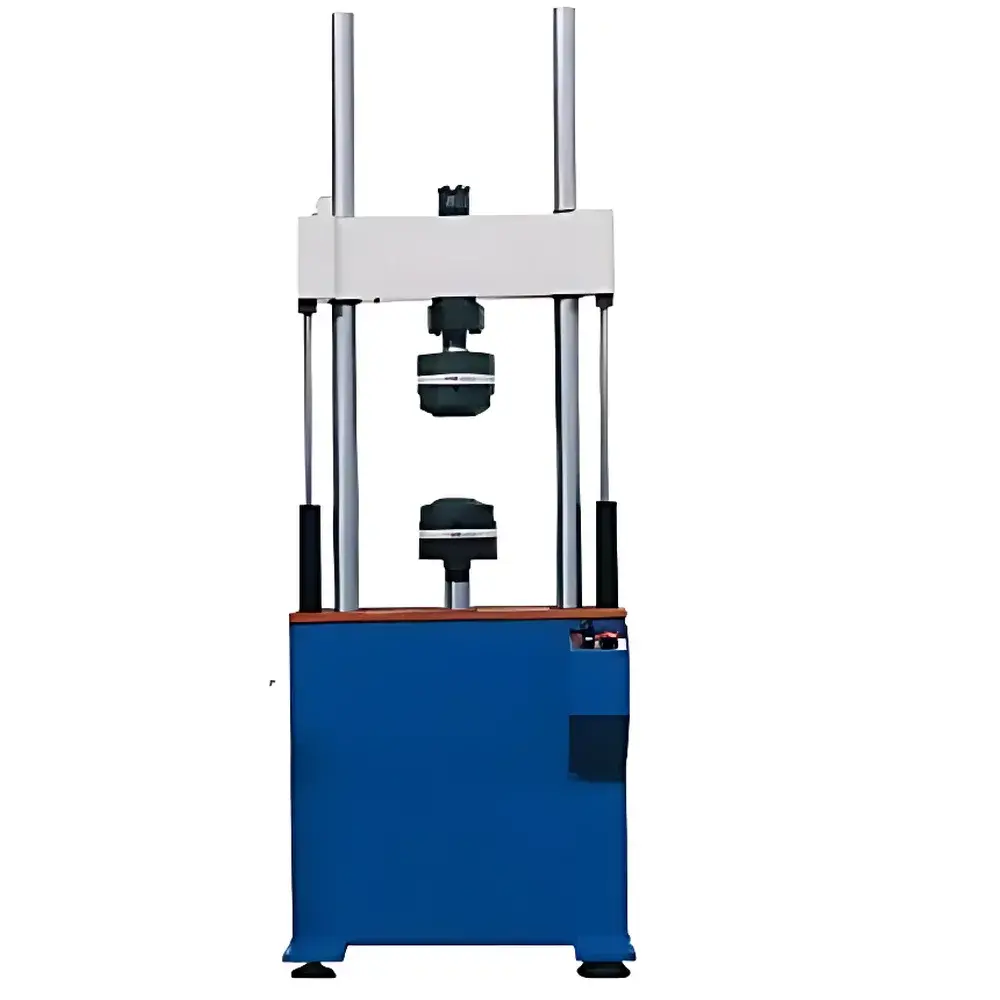
Hengyi HY(DP)5020 Dynamic Tension-Compression Fatigue Testing Machine for Joint Simulation
| Brand | Hengyi |
|---|---|
| Origin | Shanghai, China |
| Manufacturer Type | Direct Manufacturer |
| Product Category | Domestic |
| Model | HY(DP)5020 |
| Price Range | USD 14,000 – 43,000 |
| Instrument Type | High-Frequency Fatigue Testing Machine |
| Maximum Test Load | ±5000 N |
| Frequency Range | 0–10 Hz |
| Machine Weight | 600 kg |
| Force Resolution | 0.01 N |
| Force Accuracy | Class 1 (±1% of reading) |
| Displacement Accuracy | Class 1 (±0.1 mm per 10 mm) |
| Displacement Range | ±100 mm (0–200 mm stroke) |
| Displacement Resolution | 0.01 mm |
| Control Accuracy | ±1% |
| Waveform Options | Sine, Cosine, Square, Triangle, Sawtooth |
| Horizontal Test Space | 450 mm |
| Vertical Test Height | 500 mm |
| Tensile Test Space | 300 mm |
| Compressive Test Space | 500 mm |
| Dimensions (L×W×H) | ~680 × 700 × 2500 mm |
| Power Supply | 380 V AC, 5 kW |
Overview
The Hengyi HY(DP)5020 Dynamic Tension-Compression Fatigue Testing Machine is an electromechanical servo-controlled system engineered for biomechanical simulation and material fatigue evaluation under cyclic axial loading conditions. Designed specifically for orthopedic joint implant testing—including total knee, hip, and spinal components—the system applies controlled, time-varying tensile and compressive loads to replicate physiological gait cycles, stair climbing, or squatting motions. It operates on a closed-loop electrodynamic actuation principle, where digital signal processing (DSP) ensures precise real-time regulation of force, displacement, and waveform fidelity across frequencies from static (0 Hz) up to 10 Hz. This frequency range aligns with ISO 14242-1:2016 (implants for joint replacement—fatigue testing of knee joint prostheses) and ASTM F1800-21 (standard guide for fatigue testing of orthopaedic implant materials), making it suitable for preclinical validation in GLP-compliant laboratories.
Key Features
- High-fidelity dual-axis control architecture supporting simultaneous force- and displacement-driven test modes
- Class 1 force transducer (±5000 N full-scale) with 0.01 N resolution and traceable calibration per ISO 376
- Linear variable differential transformer (LVDT)-based displacement feedback with ±100 mm stroke and 0.01 mm resolution
- Programmable multi-waveform generation (sine, cosine, square, triangle, sawtooth) with phase-synchronized output
- Integrated safety subsystem including overload cutoff, frequency limit enforcement, amplitude watchdog, and emergency stop interlock
- Rigid C-frame construction (600 kg mass) minimizing resonance interference below 25 Hz; optimized for low-noise, high-reproducibility operation
- Modular fixture interface accommodating custom joint-specific夹具 (e.g., tibial tray mounts, acetabular cup holders) per ASTM F2022-22
Sample Compatibility & Compliance
The HY(DP)5020 accommodates a broad spectrum of orthopedic specimens: metallic (CoCr, Ti-6Al-4V), polymeric (UHMWPE, PEEK), ceramic (Al₂O₃, ZrO₂), and composite implants. Its 450 mm horizontal clearance and 500 mm vertical height support large-format joint constructs—including modular revision systems and constrained liners. The machine meets mechanical requirements for ISO 14242-1 (knee), ISO 14243-1 (hip), and ISO 12189 (spinal fusion devices). All control algorithms and data acquisition comply with FDA 21 CFR Part 11 electronic record integrity standards when paired with validated software configuration. Audit trails, user access levels, and electronic signatures are fully supported in the operational firmware.
Software & Data Management
Control and analysis are performed via Windows-based Hengyi TestMaster v4.x software, communicating over RS-232/USB serial protocol. The interface supports real-time plotting of force–time, displacement–time, and force–displacement hysteresis loops, with dynamic axis scaling, customizable grid density, and selectable smoothing filters. Data is stored using three configurable strategies: fixed-time interval (e.g., 100 Hz sampling), cycle-triggered capture, or event-based logging (e.g., at peak load or yield onset). Protection logic includes programmable termination triggers—cycle count, force degradation (>5% drop from baseline), or deviation from target waveform RMS error. Export options include native .hdt binary files, CSV, Excel (.xlsx), and Word (.docx) reports compliant with ISO/IEC 17025 documentation requirements. Each report embeds metadata: operator ID, ambient temperature/humidity, calibration certificate IDs, and raw waveform checksums.
Applications
- Fatigue life assessment of total joint arthroplasty components per ISO 14242 and ISO 14243
- Cyclic compression testing of intervertebral disc prostheses and vertebral body replacements
- Creep and stress-relaxation characterization of viscoelastic biomaterials under dynamic load
- Validation of additive-manufactured lattice structures for load-bearing orthopedic implants
- Comparative wear simulation studies using coupled motion rigs (when integrated with optional rotational modules)
- Material qualification for FDA 510(k) or CE Mark submissions requiring mechanical durability evidence
FAQ
What standards does the HY(DP)5020 support for orthopedic device testing?
It natively supports ISO 14242-1 (knee), ISO 14243-1 (hip), ISO 12189 (spinal), and ASTM F1800 for methodology alignment; calibration traceability follows ISO 376 and ISO 7500-1.
Can the machine perform both tension and compression within a single test sequence?
Yes—bidirectional actuation enables seamless transition between tensile and compressive phases within one waveform cycle, critical for simulating physiological joint kinematics.
Is remote monitoring or networked data export possible?
The system supports TCP/IP-enabled data streaming to local network servers via optional Ethernet module; all exported reports include embedded digital signatures for regulatory audit readiness.
What is the typical lead time for custom fixture development?
Standard fixtures ship with the system; application-specific fixtures (e.g., cruciate ligament anchor testers) require 4–6 weeks after final mechanical drawings approval.
Does the software meet FDA 21 CFR Part 11 requirements?
Yes—when deployed with role-based user accounts, electronic signatures, and immutable audit logs enabled, the software satisfies Part 11 criteria for electronic records and signatures in regulated environments.



