
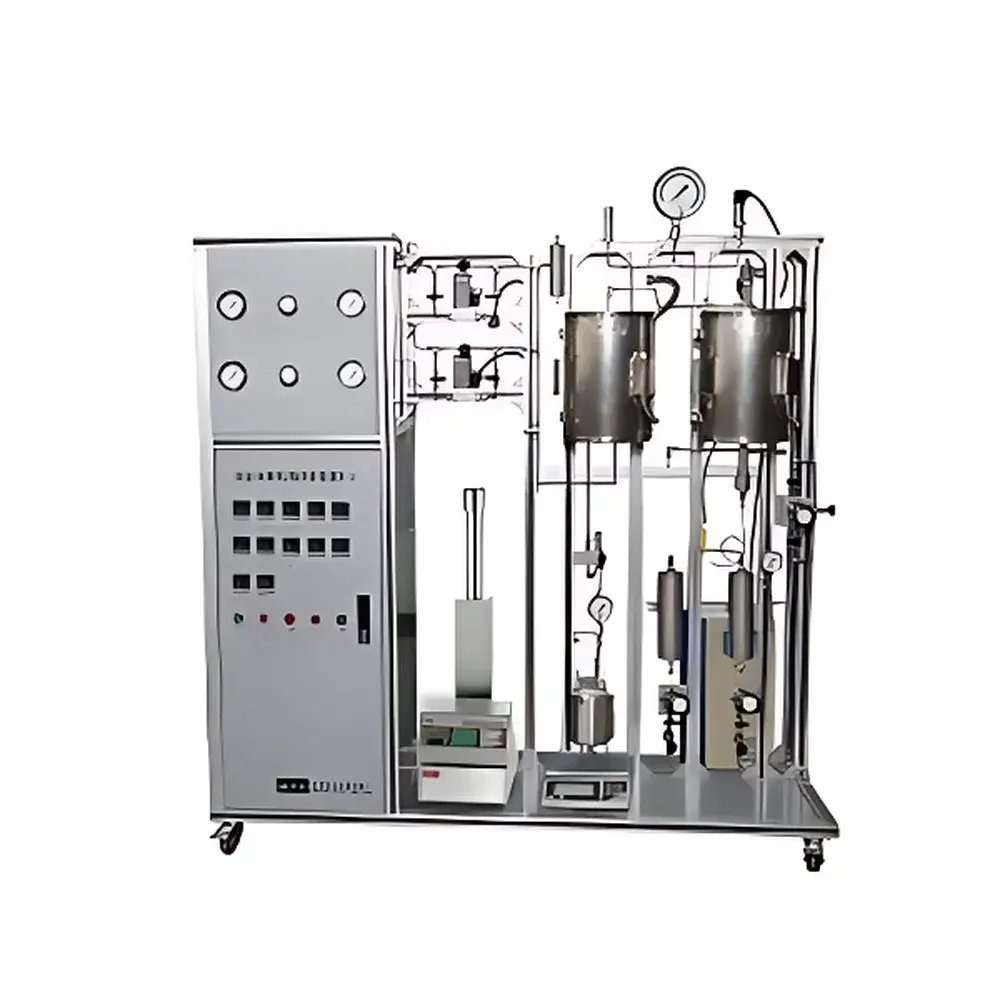
Henven R-3 Fixed-Bed Catalyst Evaluation System
| Brand | Henven |
|---|---|
| Origin | Beijing, China |
| Manufacturer Type | Direct Manufacturer |
| Country of Origin | China |
| Model | R-3 |
| Pricing | Upon Request |
| Catalyst Bed Volume | 10 mL |
| Maximum Operating Temperature | 500 °C |
| Maximum Operating Pressure | 20.0 MPa |
| Construction Material | ASTM A240 S31603 (316 Stainless Steel) |
| Gas Compatibility | H₂, N₂, HF (hydrofluoric acid service) |
| Reactor Tube Dimensions | 1/2″ OD × 18″ length (12.7 mm × 457 mm) |
| Process Interface | 1/4″ VCR/SS Swagelok fittings |
| Temperature Control | Zoned linear ramping & long-term isothermal stability (< ±0.5 °C over 24 h) |
| Pressure Monitoring | Dual redundant transducers with 0.1 MPa resolution |
| Flow Measurement | Mass flow controllers (MFCs) for H₂/N₂, corrosion-resistant for HF-compatible service |
| Control Interface | Integrated 10.1″ industrial-grade LCD touchscreen (IP65-rated) |
| Embedded Control System | Renmai Fluidized-Bed Logic Engine (supports auto-triggered logic sequences based on sensor inputs) |
| Safety Architecture | Independent thermal & pressure fault detection with hardwired shutdown interlocks and audible/visual alarms |
Overview
The Henven R-3 Fixed-Bed Catalyst Evaluation System is an engineered platform for quantitative catalytic performance assessment under industrially relevant high-pressure, high-temperature conditions. It operates on the principle of steady-state continuous-flow heterogeneous catalysis, where gaseous or vapor-phase reactants pass through a packed catalyst bed while thermodynamic and kinetic parameters—including conversion, selectivity, deactivation rate, and apparent activation energy—are derived from real-time process data. Designed specifically for corrosive feedstock compatibility—including anhydrous hydrogen fluoride (HF)—the system employs ASTM A240 S31603 stainless steel throughout all wetted components, including reactor tube, manifolds, valves, and instrumentation tubing. Its modular architecture supports both single-pass and recirculating configurations, enabling studies ranging from fundamental kinetics to long-duration stability testing (up to 500 hours). The R-3 meets mechanical integrity requirements per ASME BPVC Section VIII Div. 1 and incorporates dual-redundant pressure sensing with fail-safe venting pathways compliant with ISO 4126-1 for overpressure protection.
Key Features
- Corrosion-resilient construction: Full-wetted-path 316 stainless steel rated for continuous exposure to HF, H₂, N₂, and mixed acidic gas streams at up to 20.0 MPa and 500 °C.
- Zoned thermal management: Three independently controlled heating zones enable axial temperature profiling across the catalyst bed—critical for identifying hot spots and validating radial uniformity in fixed-bed reactors.
- Embedded Renmai control logic engine: A deterministic real-time control system that executes programmable logic sequences (e.g., pressure ramp → temperature hold → flow step change) triggered by threshold-crossing events from embedded sensors.
- High-fidelity process monitoring: Integrated MFCs (±0.5% FS accuracy), Class 1/100 platinum RTDs (IEC 60751 AA grade), and piezoresistive pressure transducers (0.1 MPa resolution) provide synchronized, time-stamped data at 10 Hz sampling rate.
- Dual-layer safety architecture: Independent hardware-based watchdog circuit monitors critical T/P nodes; software-level alarm logic provides configurable thresholds, escalation protocols, and automatic valve actuation per IEC 61511 SIL 1 requirements.
- Human-machine interface: 10.1″ capacitive touchscreen with multi-language support (English, Chinese, Spanish), offline recipe storage (≥100 protocols), and USB export of raw CSV datasets with metadata tagging.
Sample Compatibility & Compliance
The R-3 accommodates solid catalysts in pellet, extrudate, or granular form with particle diameters ranging from 0.25 mm to 5.0 mm. Catalyst loading volume is precisely calibrated to 10 mL (±0.1 mL), supporting standardized activity comparisons per ASTM D3226 and ISO 11546. HF compatibility has been validated via ASTM G31 immersion testing and ASTM G123 crevice corrosion evaluation under simulated process conditions (200 °C, 10 MPa, 100% HF). All pressure-retaining components conform to PED 2014/68/EU and bear CE marking. Electrical design complies with IEC 61000-6-2/6-4 EMC standards. The system supports GLP-compliant operation with audit-trail-enabled parameter logging (per FDA 21 CFR Part 11 Annex 11 requirements when paired with validated third-party LIMS integration).
Software & Data Management
The embedded Renmai OS v3.2 provides native data acquisition, visualization, and basic analysis without external PC dependency. Real-time plots include multi-channel T/P/F trends with adjustable timebases (1 s to 24 h), derivative overlays (dT/dt, dP/dt), and alarm event timelines. Raw data exports include timestamped .CSV files containing sensor IDs, engineering units, calibration coefficients, and firmware revision tags—enabling traceability per ISO/IEC 17025. Optional Ethernet/WiFi connectivity enables remote monitoring via Modbus TCP or OPC UA (UA Profile for Analytical Devices). When integrated with laboratory informatics systems, the R-3 supports structured metadata injection (e.g., catalyst batch ID, operator ID, SOP version) to ensure alignment with digital lab frameworks.
Applications
- Hydrofluorination catalysis: Kinetic modeling of fluorination reactions using HF feedstocks (e.g., production of HFC-134a, HFO-1234yf).
- Sulfur-resistant reforming catalyst screening: Long-term stability testing under H₂S co-feed conditions at 450–500 °C and 15–20 MPa.
- Ammonia synthesis catalyst benchmarking: Comparative activity evaluation of promoted Fe- and Ru-based catalysts under stoichiometric N₂/H₂ ratios.
- CO₂ hydrogenation studies: Methanation and methanol synthesis kinetics with precise control of H₂/CO₂ partial pressures and temperature gradients.
- Deactivation mechanism analysis: In situ regeneration cycles with programmed O₂ pulses, coupled with post-run XRD/XPS sample retrieval ports.
FAQ
Is the R-3 certified for HF service?
Yes—the entire process train, including reactor tube, valves, and pressure transducers, is constructed from ASTM A240 S31603 and qualified per ASTM G31 for continuous HF exposure up to 500 °C.
Can the system operate in recirculation mode?
Yes—optional gas recirculation loop with magnetic drive pump, inline cooler, and automated bypass valve enables closed-loop testing with composition tracking via integrated GC port.
What level of temperature uniformity is achievable across the catalyst bed?
Axial temperature deviation is ≤±1.2 °C over the full 457 mm heated length during isothermal operation at 450 °C, verified by embedded multi-point RTD mapping.
Does the system support automated catalyst reduction protocols?
Yes—pre-programmed H₂ ramp sequences with pressure-compensated flow control and exotherm detection logic are included in standard firmware.
How is calibration traceability maintained?
All sensors ship with NIST-traceable calibration certificates; onboard self-test routines verify zero/span drift before each run, with logs stored in immutable audit trail format.



