
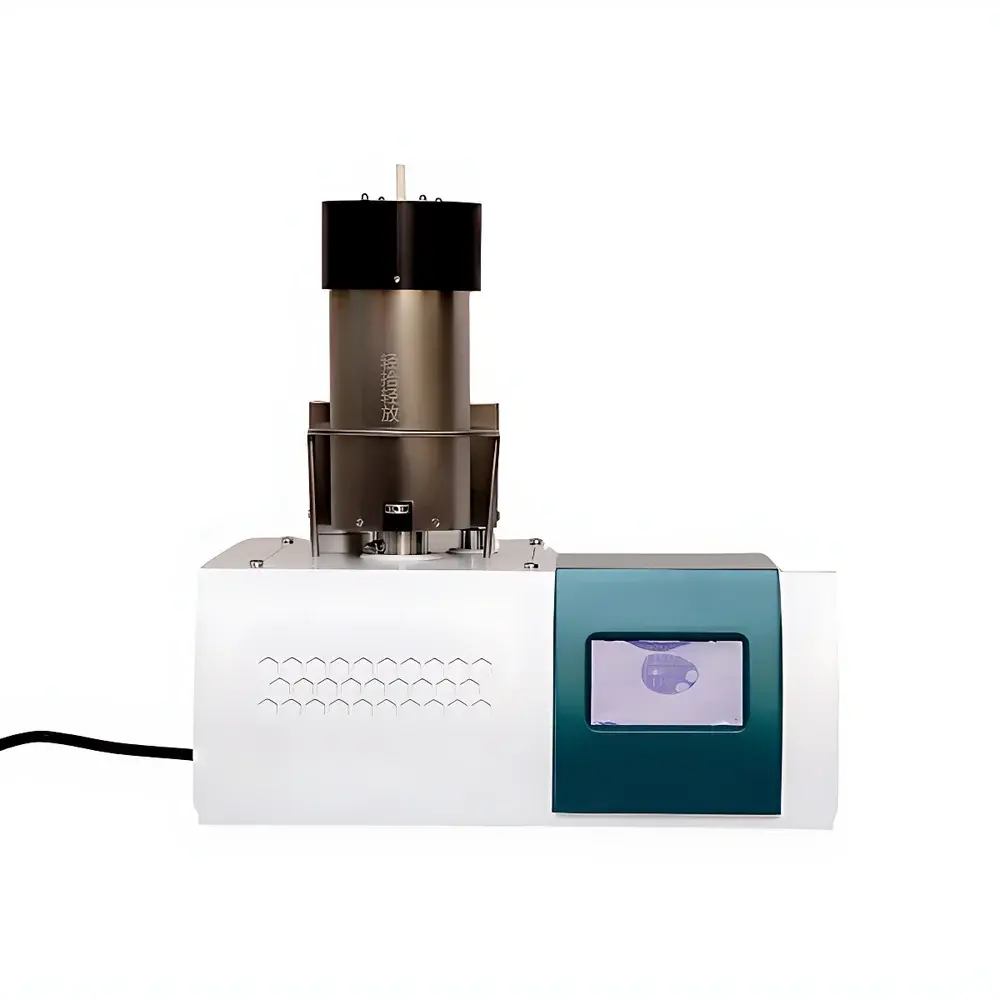
Henven HCR-2 Differential Thermal Analyzer
| Brand | Henven |
|---|---|
| Origin | Beijing, China |
| Manufacturer Type | Direct Manufacturer |
| Instrument Type | DTA (Differential Thermal Analysis) |
| Model | HCR-2 |
| Temperature Range | Ambient to 1250 °C |
| Temperature Accuracy | ±0.1 °C |
| Temperature Stability | ±0.1 °C |
| Heating/Cooling Rate | 0.1–100 K/min (user-definable) |
| DTA Sensitivity | 0.01 μV |
| DTA Noise Level | <0.01 μV |
| DSC Measurement Range | ±1–±500 mW |
| DSC Precision | ±0.1 μW |
| Sample Capacity | Single-sample configuration |
| Control Mode | Manual sample loading |
| Thermal Program Modes | Ramp heating, isothermal hold (up to 72 h at any temperature within range) |
| Atmosphere Control | Dual-channel mass flow controller (MFC)-based gas delivery with automatic switching |
| Vacuum Capability (optional) | 2.5×10⁻² Pa |
| Signal Output Range | ±10–±2000 μV (auto-ranging) |
| Standard Crucibles | Al₂O₃ (0.06 mL or 0.12 mL) |
| Optional Crucibles | Aluminum, graphite, quartz, platinum |
| Interface | Integrated LCD display showing furnace temperature, sample temperature, gas status, and real-time signal |
| Software Features | Oxidation Induction Time (OIT) analysis, crystallization kinetics modeling, step-cooling curve generation, peak integration, enthalpy calculation, activation energy estimation (multiple algorithms), Tg determination, specific heat comparison method, calibration support (In, Sn, Pb), screenshot capture at arbitrary timestamps, user-defined formula implementation |
Overview
The Henven HCR-2 Differential Thermal Analyzer (DTA) is a precision laboratory instrument engineered for quantitative thermal event detection under controlled atmospheric and thermal conditions. Operating on the fundamental principle of differential thermal analysis, the HCR-2 continuously measures the temperature difference (ΔT) between a sample and an inert reference material as both are subjected to identical, programmable thermal profiles—typically linear heating or extended isothermal holds. Unlike DSC instruments that quantify heat flow, DTA detects exothermic or endothermic transitions as inflections or peaks in the ΔT vs. temperature curve, providing high-sensitivity identification of phase transformations, decomposition onset, glass transitions, oxidation induction periods, and solid-state reaction kinetics. Designed for rigorous materials R&D, quality control, and regulatory-compliant thermal characterization, the HCR-2 delivers reproducible baseline stability and low-noise signal acquisition across its full operational range from ambient to 1250 °C.
Key Features
- High-resolution DTA detection with 0.01 μV sensitivity and sub-0.01 μV noise floor, enabling reliable detection of subtle thermal events in polymers, ceramics, pharmaceuticals, and metal alloys.
- Dual thermocouple architecture: one dedicated to furnace temperature monitoring (active at all times), the other to real-time sample temperature—ensuring traceable thermal gradient tracking independent of heating state.
- Integrated dual-channel mass flow controller (MFC) system supporting precise, repeatable, and dynamically switchable gas environments (e.g., N₂, O₂, Ar, synthetic air); optional corrosion-resistant MFC modules available for aggressive atmospheres (e.g., H₂S, Cl₂, HF).
- Programmable thermal control supporting ramp rates from 0.1 to 100 K/min and isothermal holds up to 72 hours at any temperature point within the 1250 °C range—critical for aging studies, OIT determination per ASTM D3895, and long-term stability assessment.
- Auto-ranging analog signal acquisition (±10–±2000 μV) with real-time gain optimization, eliminating manual range selection and minimizing saturation risk during sharp thermal transitions.
- Modular hardware interface supports optional vacuum unit (2.5×10⁻² Pa), GC/MS transfer line with active heating (RT–200 °C), and customizable crucible configurations—including high-purity alumina (standard), aluminum, quartz, graphite, and platinum—to accommodate reactive, volatile, or high-temperature samples.
Sample Compatibility & Compliance
The HCR-2 accommodates solid, powder, and thin-film specimens in standard 0.06 mL or 0.12 mL alumina crucibles, with alternative crucible materials selected based on chemical compatibility and upper-temperature limits. Its robust mechanical design and sealed furnace chamber meet IEC 61010-1 safety requirements for laboratory electrical equipment. The instrument supports GLP/GMP-aligned workflows through audit-trail-capable software logging (user actions, method parameters, calibration records, and raw data timestamps). While not inherently 21 CFR Part 11 compliant out-of-the-box, the system architecture permits integration with validated electronic signature and data integrity modules upon customer specification. Data outputs conform to ASTM E1131 (standard test method for compositional analysis by DTA) and ISO 11357 series (plastics—differential scanning calorimetry), facilitating cross-laboratory comparability and regulatory submission readiness.
Software & Data Management
The proprietary HCR-2 acquisition and analysis suite provides comprehensive post-run processing without requiring third-party platforms. Core functions include automatic peak detection and baseline correction, area integration for qualitative transition intensity assessment, enthalpy estimation via reference calibration (In, Sn, Pb), multi-method activation energy calculation (Ozawa, Kissinger, Friedman), Tg determination using tangent or inflection algorithms, and comparative specific heat evaluation using the stepwise method. The software supports user-defined mathematical expressions for custom parameter derivation—enabling rapid adaptation to novel analytical protocols. All raw thermograms and processed results are stored in open ASCII format for interoperability with MATLAB, Python (NumPy/Pandas), or LIMS systems. Real-time screenshot capture at user-defined intervals ensures documentation of transient behavior during dynamic experiments.
Applications
The HCR-2 serves critical roles across academic, industrial, and regulatory laboratories. In polymer science, it characterizes melting points, cold crystallization, degradation onset, and oxidative stability (OIT) for polyolefins per ASTM D3895 and ISO 11357-6. In metallurgy, it identifies eutectic temperatures, solidus/liquidus boundaries, and precipitation kinetics in aluminum and titanium alloys. Ceramic researchers employ it to map sintering stages, phase formation sequences (e.g., mullitization), and thermal expansion anomalies. Pharmaceutical labs use it for polymorph screening, excipient compatibility testing, and stability-indicating assay development—particularly where DSC-based heat flow quantification is secondary to transition temperature fidelity. Its compatibility with reactive gas atmospheres also enables in-situ study of catalytic oxidation, sulfidation, and nitridation processes in functional materials.
FAQ
What is the difference between DTA and DSC functionality in the HCR-2?
The HCR-2 is fundamentally a DTA instrument, measuring temperature difference (ΔT) between sample and reference. However, its calibrated signal path and software algorithms permit semi-quantitative heat flow estimation (labeled “DSC mode” in software), though absolute enthalpy values require separate DSC calibration standards.
Can the HCR-2 perform simultaneous TG-DTA measurements?
No—the HCR-2 is a dedicated DTA platform without integrated microbalance. Thermogravimetric coupling requires external TGA instrumentation and synchronized data acquisition via external trigger or time-aligned export.
Is calibration traceable to national standards?
Yes—users may perform temperature calibration using NIST-traceable reference materials (In, Sn, Pb), and energy calibration is supported via certified reference metals with known enthalpies of fusion.
What maintenance is required for long-term stability?
Routine verification of thermocouple integrity, MFC zero/span calibration, furnace insulation inspection, and crucible cleanliness are recommended quarterly; full system recalibration is advised annually or after major component replacement.
Does the software support automated method sequencing for unattended operation?
Yes—the method editor allows stacking of multiple thermal programs (e.g., heat → hold → cool → reheat) with inter-step delays and conditional triggers, enabling overnight or weekend runs with full data logging.



