
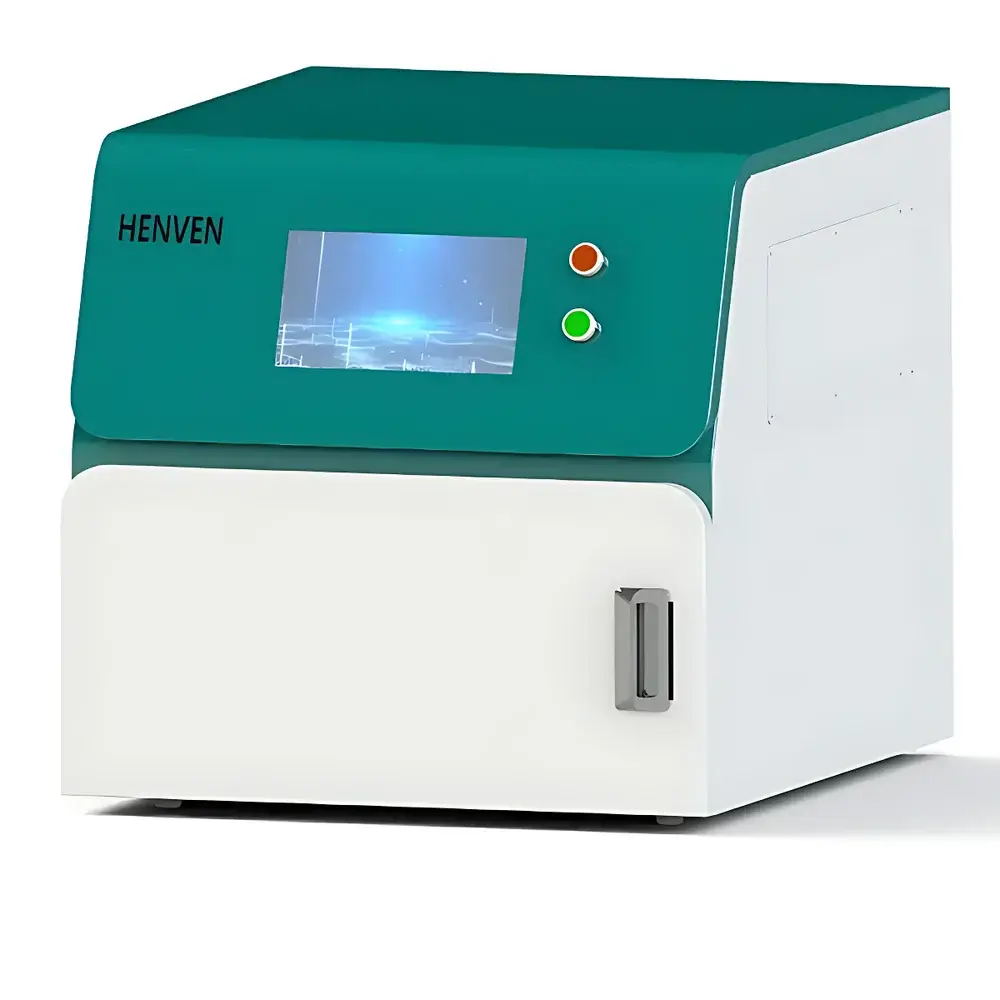
Henven HDR-1 Steady-State Thermal Conductivity Analyzer (Heat Flow Meter Method)
| Brand | Henven |
|---|---|
| Origin | Beijing, China |
| Manufacturer Type | Direct Manufacturer |
| Instrument Type | Heat Flow Meter Method |
| Sample Capacity | Single Sample per Test |
| Test Environment | Ambient Temperature |
| Thermal Conductivity Range | 0.001–5 W/m·K |
| Accuracy | ±3% |
| Repeatability | ±1% |
| Temperature Control Range | 0–90 °C |
| Sample Dimensions | 300 × 300 × (2–50) mm or 200 × 200 × (2–50) mm |
| Thickness Adjustment | Motorized, Auto-Calibrating |
| Applied Load Range | 0–1500 N |
| Thickness Measurement | High-Precision Displacement Sensor with Zeroing & Calibration Function |
| Compliance Standards | GB/T 10295-2008, ASTM C518, ISO 8301:1991 |
Overview
The Henven HDR-1 Steady-State Thermal Conductivity Analyzer is a precision-engineered heat flow meter (HFM) system designed for the accurate and reproducible determination of thermal conductivity in solid and composite insulating materials under steady-state conditions. Based on the fundamental principle of Fourier’s law of heat conduction, the instrument measures the one-dimensional heat flux through a homogeneous or layered sample sandwiched between two temperature-controlled plates — a guarded hot plate and a cooled cold plate. Dual heat flux sensors (thermopile-based) are embedded symmetrically within the guard ring and main heating zone to minimize edge losses and ensure high spatial uniformity of heat flow. This architecture enables robust compliance with internationally recognized test standards including ASTM C518, ISO 8301:1991, and GB/T 10295-2008, making it suitable for accredited laboratories operating under GLP or ISO/IEC 17025 frameworks.
Key Features
- Motorized, closed-loop thickness adjustment mechanism with real-time displacement feedback, enabling precise control of sample compression (0–1500 N) and automatic compensation for thermal expansion during testing.
- Integrated high-resolution linear displacement sensor (resolution ≤1 µm) with user-accessible zeroing and calibration routines to ensure traceable dimensional metrology independent of operator input.
- Touchscreen HMI interface supporting intuitive test setup, live parameter monitoring (temperature gradients, heat flux, thickness, load), and immediate diagnostic alerts for thermal equilibrium validation.
- Optimized thermal guard design with active temperature tracking ensures lateral heat loss remains below 2% across the full operational range (0–90 °C), meeting strict ASTM C518 acceptance criteria for guard efficiency.
- Single-sample configuration optimized for routine quality control workflows — typical steady-state acquisition time is ≤90 minutes per condition, with multi-point thermal resistance mapping achievable in under 60 minutes using automated ramp-and-hold protocols.
Sample Compatibility & Compliance
The HDR-1 accommodates rigid, semi-rigid, and flexible low-conductivity solids with nominal planar dimensions of either 200 × 200 mm or 300 × 300 mm, and thicknesses adjustable from 2 to 50 mm. It is validated for use with heterogeneous composites such as aerogel blankets, mineral wool (rockwool/glass wool), expanded polystyrene (EPS), phenolic foams, rubber-insulated elastomers, refractory ceramics, and multilayer architectural insulation panels. All mechanical and thermal calibrations are traceable to national standards; certified reference materials (CRMs) including NIST SRM 1450c (fiberglass board) and ISO 8301 reference specimens are routinely used for performance verification. The system supports audit-ready documentation aligned with FDA 21 CFR Part 11 requirements when paired with optional compliant software modules.
Software & Data Management
Embedded firmware provides real-time calculation of thermal conductivity (λ), thermal resistance (R-value), and apparent density (derived from applied load and measured thickness). Raw data — including thermocouple voltages, heat flux outputs, displacement readings, and PID controller logs — are timestamped and stored in CSV format for external analysis. Optional PC-based software enables advanced reporting (ASTM-compliant test certificates), batch processing of historical datasets, statistical process control (SPC) charting, and export to LIMS environments via secure API endpoints. Audit trails record all user actions, parameter modifications, and calibration events with immutable timestamps — fully satisfying ISO/IEC 17025 clause 7.7 and GLP data integrity mandates.
Applications
- Quality assurance of building envelope insulation materials in accordance with EN 12667 and ASTM C177.
- R&D evaluation of next-generation aerogels and nano-porous composites for aerospace and cryogenic applications.
- Thermal certification of fire-rated assemblies and passive fire protection systems per UL 1715 and ASTM E119.
- Validation of thermal performance claims for green construction products under LEED v4.1 MR Credit 2.
- Comparative benchmarking against imported HFM systems (e.g., TA Instruments QTM-500, Netzsch HFM 436 series) using interlaboratory round-robin protocols.
FAQ
What international standards does the HDR-1 comply with?
The instrument is engineered and verified to meet ASTM C518, ISO 8301:1991, and GB/T 10295-2008 for steady-state thermal conductivity measurement using the heat flow meter method.
Can the HDR-1 measure anisotropic or layered materials?
Yes — its dual-sensor architecture and uniform temperature field enable reliable characterization of directionally dependent conductivity and effective R-values of laminated structures when oriented perpendicular to the heat flow axis.
Is thickness calibration required before each test?
No — the motorized stage performs automatic thickness initialization at the start of each run; however, users may manually trigger zeroing and sensor recalibration using built-in metrological routines.
Does the system support automated multi-temperature testing?
Yes — programmable temperature ramps allow sequential measurements at up to five discrete setpoints (e.g., 10 °C, 23 °C, 40 °C, 60 °C, 85 °C) with automatic equilibrium detection and data logging.
What maintenance is required for long-term accuracy?
Annual verification using NIST-traceable CRMs and biannual inspection of heater/cold plate surface flatness (±2 µm) and thermocouple drift (<±0.1 °C) are recommended per ISO/IEC 17025 Clause 6.4.



