
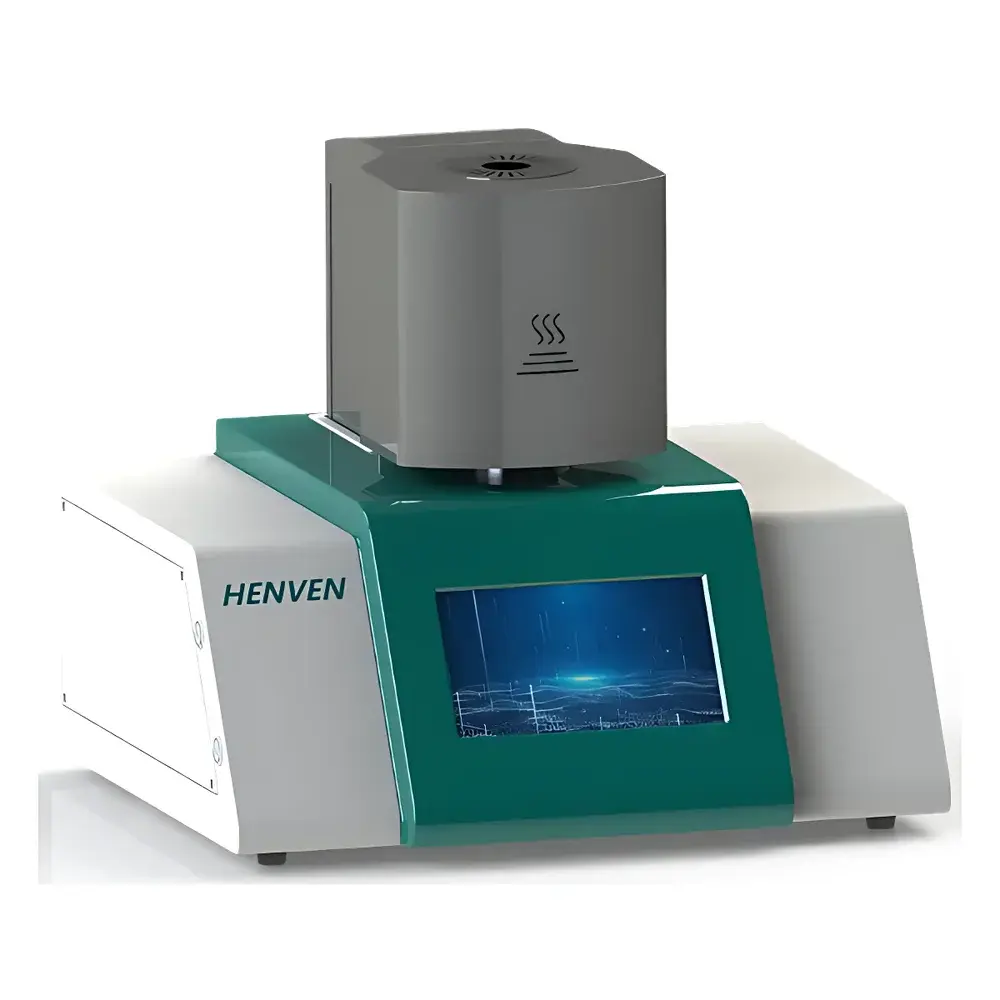
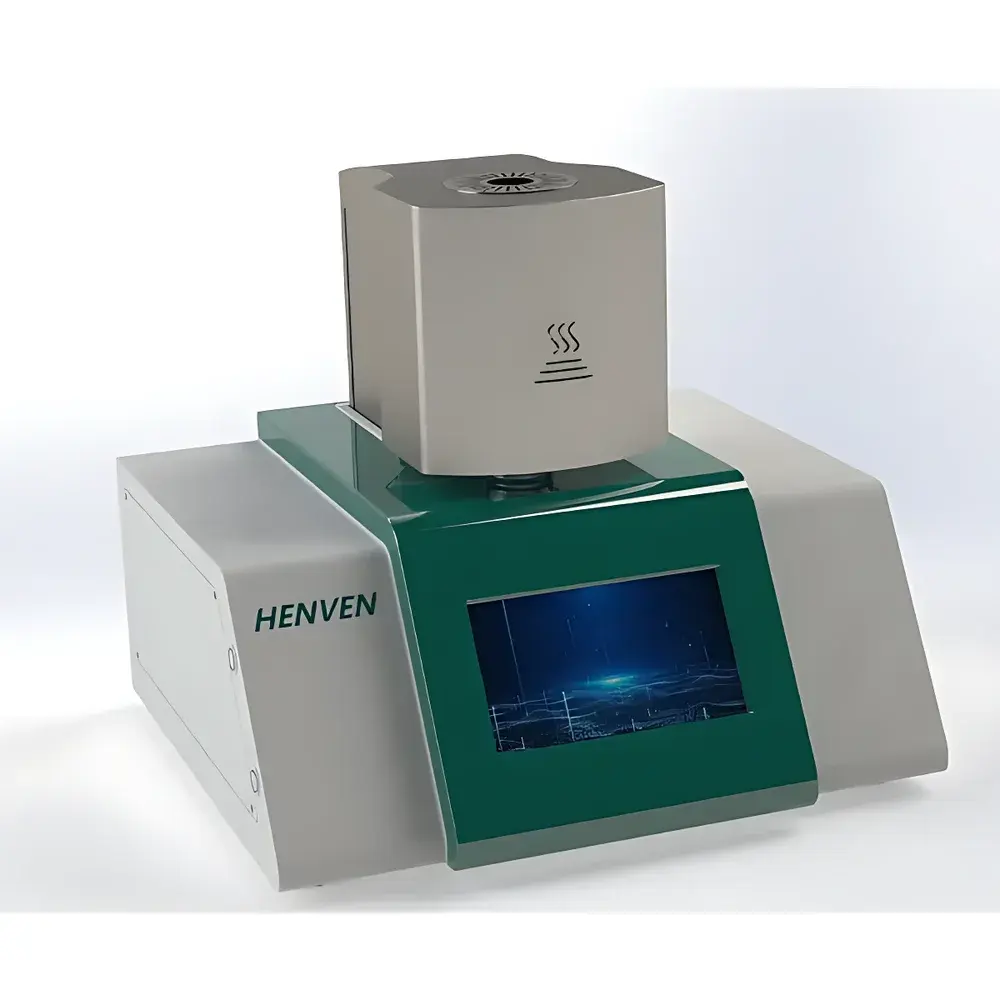
Henven HFM-DSC Series Magnetic Field Differential Scanning Calorimeter
| Brand | Henven |
|---|---|
| Origin | Beijing, China |
| Manufacturer Type | Direct Manufacturer |
| Instrument Type | DSC |
| Temperature Range | Ambient to 1200 °C |
| Programmable Temperature Control | Heating & Isothermal Hold |
| Temperature Accuracy | ±0.1 °C |
| Heating/Cooling Rate | 0.1–80 °C/min |
| Temperature Precision | ±0.1 °C |
| DSC Signal Range | ±500 mW |
| Temperature Stability (Drift) | ±0.1 °C |
| Minimum Heat Flow Resolution | 0.1 µW |
| Power Noise Level | <0.1 µW |
| Crucible Volume | 0.06–0.12 mL |
Overview
The Henven HFM-DSC Series Magnetic Field Differential Scanning Calorimeter is a high-temperature, field-integrated thermal analysis system engineered for precise quantification of heat flow associated with physical and chemical transitions under controlled magnetic environments. Unlike conventional DSC instruments, the HFM-DSC integrates a programmable electromagnet or permanent magnet assembly directly into the furnace module—enabling simultaneous application of static or variable magnetic fields (up to 1.5 T, configurable) during thermal scanning. This architecture supports fundamental investigations into magneto-thermo-responsive behavior, including field-dependent glass transitions in magnetic polymer composites, Curie temperature shifts in ferrites, magnetic phase separation kinetics, and magnetocaloric effect (MCE) characterization. The instrument operates on the principle of heat-flux differential scanning calorimetry, measuring the differential power required to maintain identical temperatures between a sample and inert reference crucible as both are subjected to identical linear or stepwise thermal programs. Its robust ceramic-furnace design, coupled with dual thermocouple referencing and active temperature stabilization, ensures high reproducibility across extended high-temperature cycles (up to 1200 °C).
Key Features
- Integrated magnetic field module with field strength calibration traceability to NIST-traceable standards; field homogeneity ±2% over 5 mm Ø sample zone.
- High-stability dual-sensor furnace architecture with real-time drift compensation, delivering ±0.1 °C temperature accuracy and <0.1 µW baseline noise over 72-hour continuous operation.
- Programmable heating/cooling rates from 0.1 to 80 °C/min, with isothermal hold capability up to 100 hours at any temperature within range.
- Large-format backlit LCD interface with real-time display of heat flow, temperature, magnetic field intensity, gas flow rate, and system status diagnostics.
- Mass-flow-controlled atmosphere system (N2, Ar, O2, synthetic air) with digital mass flow meters (±0.5% full scale accuracy) and optional humidity control.
- Self-calibration suite with certified reference materials (In, Zn, Sn, Bi, Al, KCl) enabling user-performed multi-point temperature and enthalpy calibration per ASTM E794 and ISO 11357-1.
Sample Compatibility & Compliance
The HFM-DSC accommodates standard alumina, platinum, and gold crucibles (0.06–0.12 mL volume), supporting solid powders, thin films, bulk metallic glasses, and encapsulated reactive samples. Optional high-pressure crucibles (up to 10 bar) and magnetic shielding inserts are available for specialized applications. The system complies with core international thermal analysis standards including ASTM E1269 (heat capacity), ASTM E1356 (glass transition), ISO 11357 series (general DSC practice), and USP <1151> for pharmaceutical thermal stability profiling. Data acquisition and reporting meet GLP/GMP audit requirements, with full 21 CFR Part 11-compliant electronic signatures, audit trails, and user-access-level controls available via optional software licensing.
Software & Data Management
ThermoAnalyst™ v4.2 software provides full instrument control, real-time visualization, and advanced post-processing—including peak deconvolution (Gaussian/Lorentzian fitting), baseline subtraction (tangent, polynomial, spline), oxidative induction time (OIT) calculation per ASTM D3895, crystallinity estimation via enthalpy ratio, and magnetic-field-correlated transition mapping. Raw data is stored in vendor-neutral ASCII (.txt) and universal HDF5 formats. Batch processing, report templating (PDF/Excel export), and API integration (Python SDK) support automated QA/QC workflows in regulated laboratories. All software modules undergo annual verification against NIST SRM 3450a (indium) and SRM 720e (sapphire) reference datasets.
Applications
- Determination of Curie temperature (TC) and magnetic ordering transitions in spinel ferrites, rare-earth intermetallics, and molecular magnets.
- Quantification of field-modulated enthalpy changes during martensitic transformations in Ni-Mn-Ga shape-memory alloys.
- Thermal stability assessment of magnetic nanofluids and ferrofluids under oxidative atmospheres (OIT analysis).
- Crystallization kinetics modeling of amorphous magnetic ribbons under applied field, using isoconversional methods (Friedman, Ozawa-Flynn-Wall).
- Validation of thermal aging effects on magnetic polymer composites used in EV motor insulation systems.
- Calorimetric screening of magnetocaloric materials for near-room-temperature refrigeration cycles.
FAQ
What magnetic field strengths are supported, and how is field uniformity ensured?
The standard configuration delivers up to 1.5 T with ±2% spatial homogeneity over a 5 mm diameter central zone. Field calibration is performed using a Hall-effect probe traceable to NPL standards, and field maps are supplied with each instrument.
Can the system operate under reducing or corrosive atmospheres?
Yes—optional quartz or sapphire furnace liners and corrosion-resistant gas manifolds enable use with H2/Ar mixtures, H2S, or SO2 up to 800 °C, subject to crucible compatibility and safety interlocks.
Is third-party software integration possible?
The instrument supports TCP/IP-based remote control and data streaming via SCPI protocol; Python, MATLAB, and LabVIEW drivers are provided under NDA.
How often does calibration require verification?
Per ISO/IEC 17025 guidelines, temperature and enthalpy calibration should be verified before each critical measurement series or at minimum every 72 operational hours when operating above 800 °C.
What safety certifications does the system hold?
CE-marked per EN 61010-1:2019, with integrated overtemperature cutoff, magnetic field emergency shutoff, and gas leak detection compliant with EN 60079-29-1 for laboratory use.



