
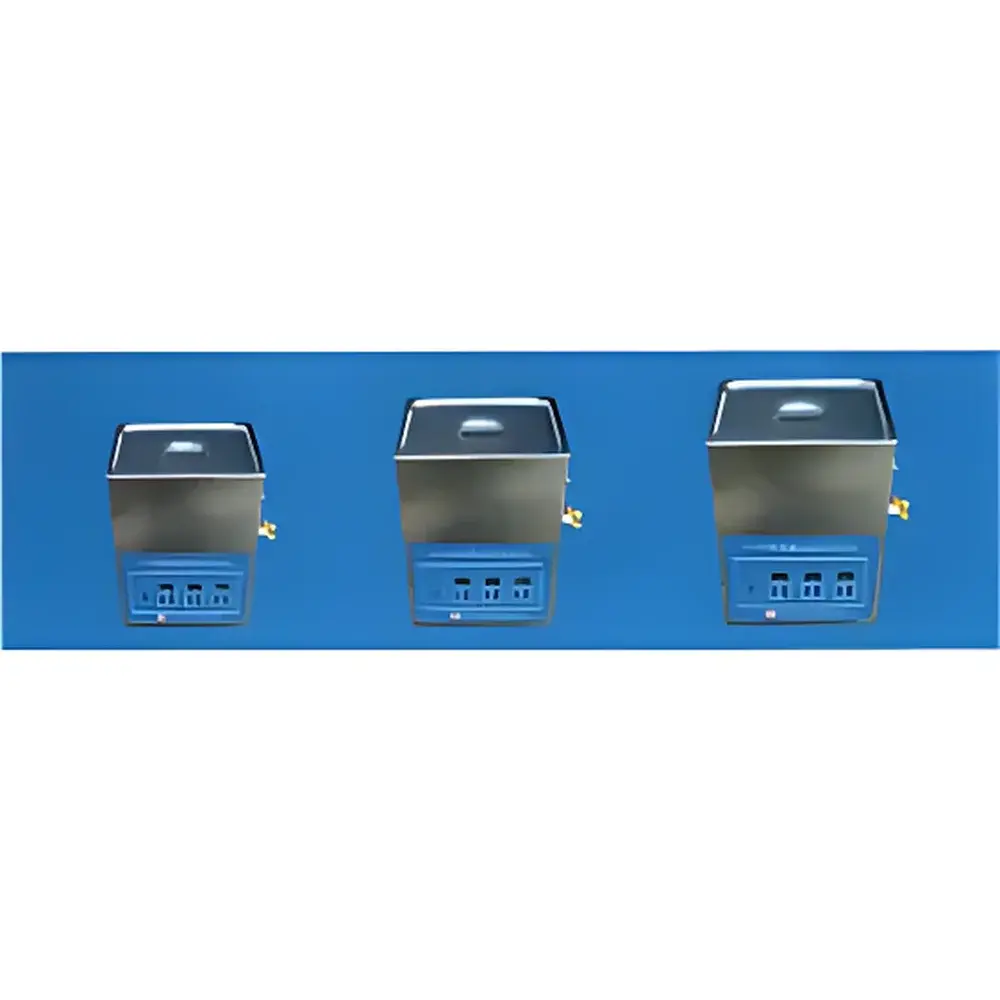
HePu TH-200BQ Digital Ultrasonic Cleaner
| Brand | HePu |
|---|---|
| Origin | Shandong, China |
| Model | TH-200BQ |
| Capacity | 10 L |
| Ultrasonic Frequency | 40 kHz |
| Ultrasonic Power | 200 W |
| Power Adjustment Range | 40–100% |
| Heating Power | 400 W |
| Temperature Control Range | 10–80 °C |
| Timer Range | 1–199 min |
| Sound-Dampening Lid | Yes |
| Manual Fill/Drain | Yes |
Overview
The HePu TH-200BQ Digital Ultrasonic Cleaner is an integrated benchtop system engineered for precision cleaning, degassing, dispersion, emulsification, and cell disruption in regulated laboratory environments. It operates on the principle of piezoelectric transduction, generating high-frequency (40 kHz) acoustic cavitation within aqueous or compatible solvent media. This controlled cavitation produces localized micro-jets and shockwaves that effectively remove particulate contaminants, biofilms, and residual solvents from delicate instrumentation parts, glassware, surgical tools, and analytical sample containers—without mechanical abrasion or thermal degradation. Designed to meet routine demands in pharmaceutical quality control, academic research, and chemical synthesis labs, the TH-200BQ features a monolithic stainless steel tank (300 × 240 × 150 mm internal dimensions) with fully digital parameter control, ensuring reproducible process conditions across multiple users and shifts.
Key Features
- Digital LED interface with independent real-time displays for set time, actual elapsed time, target power (%), actual ultrasonic output, set temperature, and measured bath temperature
- Precision power regulation (40–100% in 1% increments) enabling optimization for sensitive substrates or viscous media
- Programmable heating system (400 W) with ±1 °C accuracy over 10–80 °C range, supporting temperature-dependent processes such as solvent-assisted extraction or enzymatic decontamination
- Integrated sound-dampening lid constructed from reinforced polymer with stainless steel frame, reducing ambient noise to ≤55 dB(A) at 1 m distance
- 304 stainless steel tank, lid, and outer housing—resistant to corrosion from common cleaning agents including alkaline detergents, ethanol, and isopropanol
- Manual fill-and-drain configuration with threaded drain port and ergonomic hand valve, facilitating rapid solution exchange between cycles
Sample Compatibility & Compliance
The TH-200BQ accommodates standard laboratory ware up to 220 mm in height—including beakers, flasks, pipette tips, HPLC vials, filter holders, and small-volume reaction vessels. Its 10 L capacity supports batch processing of multiple items simultaneously while maintaining uniform energy distribution across the tank volume. The unit complies with IEC 61000-6-3 (EMC emission standards) and IEC 61000-6-2 (immunity). While not certified for sterile processing per ISO 13485 or FDA 21 CFR Part 820, it is routinely deployed in GLP-compliant laboratories where cleaning validation protocols are established per internal SOPs. Users performing critical applications (e.g., residue analysis, bioburden reduction) are advised to validate cycle parameters against ASTM D2603 (Standard Test Method for Sonic Shear Stability of Lubricating Oils) or USP (Cleaning Validation of Laboratory Equipment) guidelines.
Software & Data Management
The TH-200BQ operates via embedded firmware without external PC dependency. All operational parameters are stored in non-volatile memory and retained after power cycling. While no proprietary software or USB/RS-232 connectivity is provided, the device supports audit-ready documentation through manual logbook entry of cycle parameters (time, power %, temperature setpoint, start/end timestamps). For laboratories requiring electronic records, integration with third-party LIMS or ELN systems may be achieved using external timer relays or PLC-triggered start/stop signals (optional accessory). The digital display logs no historical run data; therefore, process traceability relies on user-initiated recording per GxP-aligned practices.
Applications
- Cleaning of HPLC columns, GC injectors, and mass spectrometry source components prior to calibration or maintenance
- Removal of organic residues from quartz cuvettes, optical lenses, and semiconductor wafers in materials science labs
- Cell lysis and homogenization of bacterial cultures or tissue samples for nucleic acid isolation workflows
- Degassing of mobile phase solvents and casting solutions prior to filtration or thin-film deposition
- Dispersing nanomaterials (e.g., graphene oxide, metal oxides) in aqueous or polar organic suspensions
- Pre-cleaning of surgical instruments and dental prostheses in teaching hospitals and biomedical engineering facilities
FAQ
Is the TH-200BQ suitable for cleaning delicate optics or MEMS devices?
Yes—when operated at reduced power (40–60%) and low temperatures (<35 °C) with deionized water or low-surface-tension solvents, the unit minimizes pitting or etching risks. Always verify compatibility with substrate manufacturer specifications.
Can this unit be used with flammable solvents?
No. The TH-200BQ lacks explosion-proof certification and heating elements are not intrinsically safe. Only aqueous or non-flammable, low-volatility solvents (e.g., ethanol/water mixtures below 40% v/v) should be used under strict ventilation.
Does the device support automatic shut-off upon completion?
Yes—the timer triggers full ultrasonic and heater deactivation at the end of the programmed cycle, accompanied by an audible alert.
What maintenance is required for long-term reliability?
Monthly inspection of transducer adhesion integrity, quarterly descaling of the tank using 5% citric acid solution, and annual verification of temperature sensor calibration using a NIST-traceable thermometer.
Is the stainless steel tank electropolished?
No—the interior surface is mechanically polished 304 stainless steel (Ra ≤ 0.8 µm), sufficient for general lab use but not classified as pharmaceutical-grade electropolished finish.



