
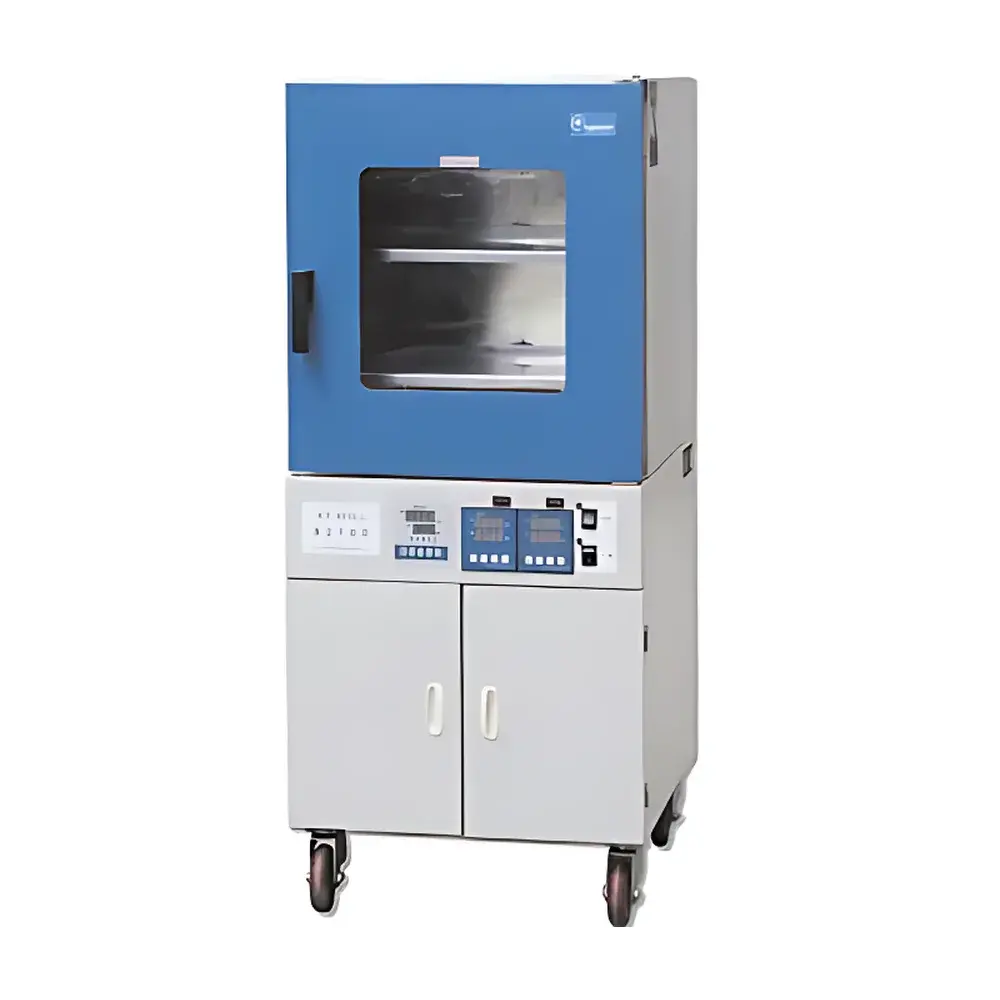
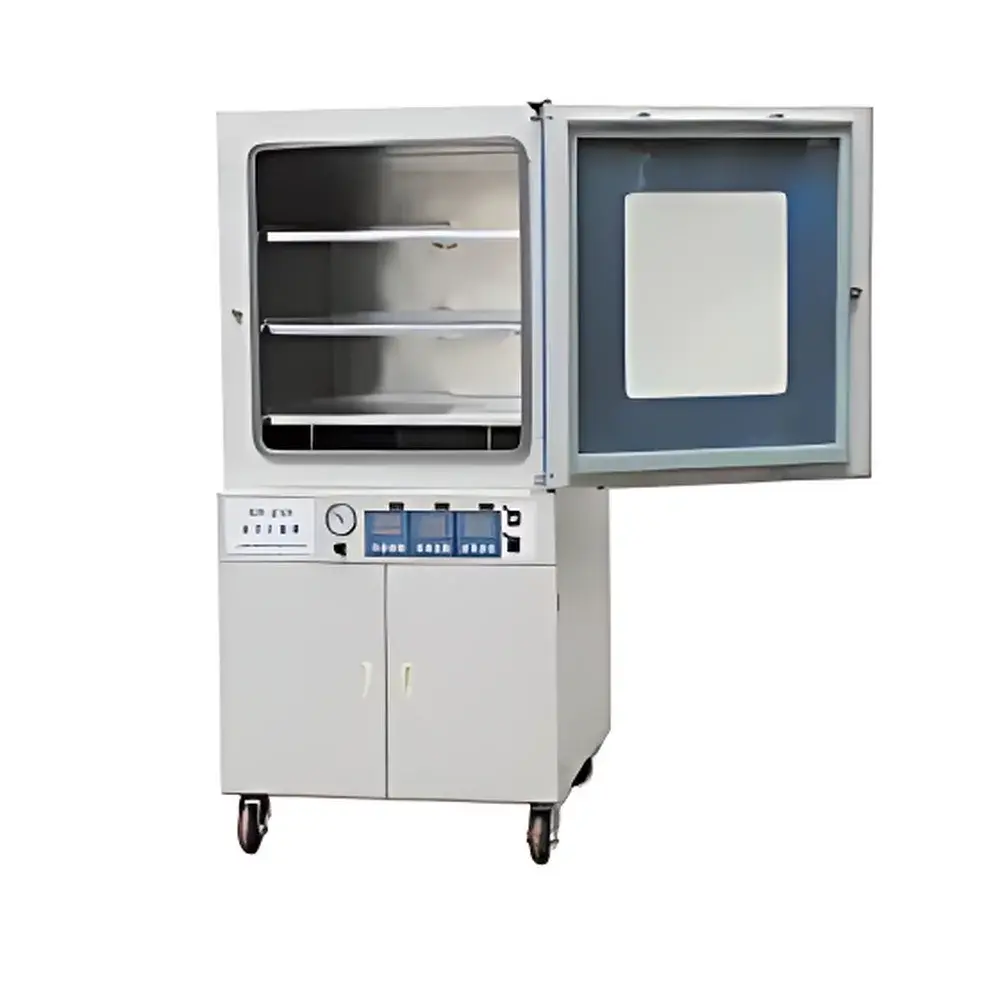
HePu DZF-6090 Vacuum Drying Oven
| Brand | HePu |
|---|---|
| Origin | Shandong, China |
| Model | DZF-6090 |
| Instrument Type | Vacuum Oven |
| Temperature Range | +10 °C to 250 °C |
| Temperature Uniformity | ±1 °C |
| Chamber Dimensions (W×D×H) | 450 × 450 × 450 mm |
| External Dimensions (W×D×H) | 610 × 660 × 1400 mm |
| Chamber Material | Stainless Steel (AISI 304 equivalent) or Galvanized Steel |
| Heating Method | Forced-Air Convection with Vacuum Compatibility |
| Vacuum Level | <133 Pa (achieved with integrated vacuum pump) |
| Power Supply | 220 V, 50 Hz |
| Input Power | 1450 W |
| Timer Range | 1–9999 minutes |
| Control System | Microprocessor-Based Digital Controller with 10-Step Programmable Logic (D-Series), Optional Vacuum Pressure Display (LC-Series) |
Overview
The HePu DZF-6090 Vacuum Drying Oven is an engineered solution for the controlled thermal dehydration of heat-sensitive, oxidation-prone, and chemically labile materials under reduced-pressure conditions. Operating on the principle of vacuum-assisted evaporation—where lowering ambient pressure reduces the boiling point of solvents and moisture—the DZF-6090 enables drying at lower temperatures while minimizing thermal degradation, decomposition, and oxidative side reactions. This makes it particularly suitable for pharmaceutical active pharmaceutical ingredients (APIs), hygroscopic electronic components, catalyst precursors, polymer intermediates, and botanical extracts where residual solvent removal, structural integrity preservation, and batch-to-batch reproducibility are critical. The chamber is fully sealed and rated for sustained operation at pressures below 133 Pa, supporting inert gas purging (e.g., N₂ or Ar) to further suppress oxidation during processing.
Key Features
- Microprocessor-controlled digital temperature regulator with 0.1 °C resolution and ±1 °C uniformity across the chamber volume—calibrated per ISO/IEC 17025 traceable procedures.
- Rectangular stainless steel (AISI 304-grade) or galvanized steel working chamber (450 × 450 × 450 mm) offering high corrosion resistance and long-term dimensional stability under repeated thermal cycling.
- Double-layer tempered glass observation window with silicone rubber gasket seal—designed for visual monitoring without compromising vacuum integrity or operator safety.
- Adjustable door-latching mechanism with compression-tuned silicone door seal ensures consistent vacuum retention over extended cycles (≥8 h typical).
- Forced-air convection heating system optimized for uniform heat distribution under vacuum; fan remains operational during evacuation to prevent localized cold spots and promote solvent vapor transport.
- Integrated 10-segment programmable controller (D-series) enabling multi-stage drying protocols—including ramp-soak-hold sequences—for complex sample matrices such as layered composites or multi-solvent formulations.
- Optional LC-series configuration includes real-time vacuum pressure display (0–1000 Pa range) with analog output for external data logging systems.
Sample Compatibility & Compliance
The DZF-6090 accommodates a broad spectrum of sample formats: powder-filled trays, vials on perforated shelves, coated wafers, membrane filters, and pre-weighed crucibles. Its chamber design supports standard laboratory glassware up to Ø150 mm and permits stacking of up to two independent stainless steel shelves (included). The unit complies with general-purpose laboratory equipment safety standards including IEC 61010-1 (Electrical Safety) and GB/T 28850–2012 (Chinese National Standard for Vacuum Ovens). While not certified for Class A cleanroom use or explosion-proof environments, its construction meets baseline requirements for GLP-compliant documentation workflows when paired with external audit-ready calibration records and maintenance logs. For regulated pharmaceutical applications, users may configure the controller to generate time-stamped event logs (power-on, setpoint change, vacuum activation, timer completion) compatible with 21 CFR Part 11–aligned data management platforms via RS-485 interface (optional).
Software & Data Management
The DZF-6090’s embedded controller does not include proprietary PC software but provides native support for serial communication (RS-485 Modbus RTU protocol) enabling integration into centralized laboratory information management systems (LIMS) or SCADA networks. All operational parameters—including actual chamber temperature, setpoint, elapsed time, and (in LC models) real-time vacuum pressure—are accessible via ASCII command queries. Internal non-volatile memory retains the last 10 program profiles and cycle history (start time, duration, final vacuum level) for post-process verification. When used in quality control laboratories adhering to ISO 17025 or USP , routine calibration checks against NIST-traceable thermocouples and vacuum gauges are recommended every six months or per internal SOPs.
Applications
- Residual solvent removal from lyophilized biologics and small-molecule APIs prior to packaging (per ICH Q5C stability guidelines).
- Drying of lithium-ion battery cathode slurries and electrode coatings without binder migration or particle agglomeration.
- Moisture conditioning and outgassing of optical substrates and MEMS devices prior to thin-film deposition.
- Accelerated aging studies of polymer films and adhesives under controlled humidity-vacuum cycling.
- Preparation of anhydrous reagents and air-sensitive catalysts in fine chemical synthesis.
- Herbal extract concentration and volatile oil recovery in traditional medicine R&D settings.
FAQ
Does the DZF-6090 include a vacuum pump?
Yes—the DZF-6090 model is supplied with an integrated two-stage rotary vane vacuum pump capable of achieving ≤133 Pa base pressure under no-load conditions.
Can the chamber be purged with inert gas?
Yes—dual-port gas inlet/outlet fittings (¼″ BSP) are standard, allowing continuous nitrogen or argon purge during vacuum hold phases.
Is the temperature controller validated for GMP environments?
The controller itself is not 21 CFR Part 11–certified, but its event log outputs and external calibration traceability support IQ/OQ/PQ validation protocols when documented per user-defined SOPs.
What is the maximum load capacity for uniform drying performance?
For optimal thermal uniformity and vacuum stability, total loaded mass should not exceed 15 kg, with samples distributed evenly across the shelf surface area.
How often does the silicone door seal require replacement?
Under normal use (≤5 cycles/day), the FDA-grade silicone gasket maintains sealing performance for ≥24 months; visual inspection for compression set or cracking is advised quarterly.



