
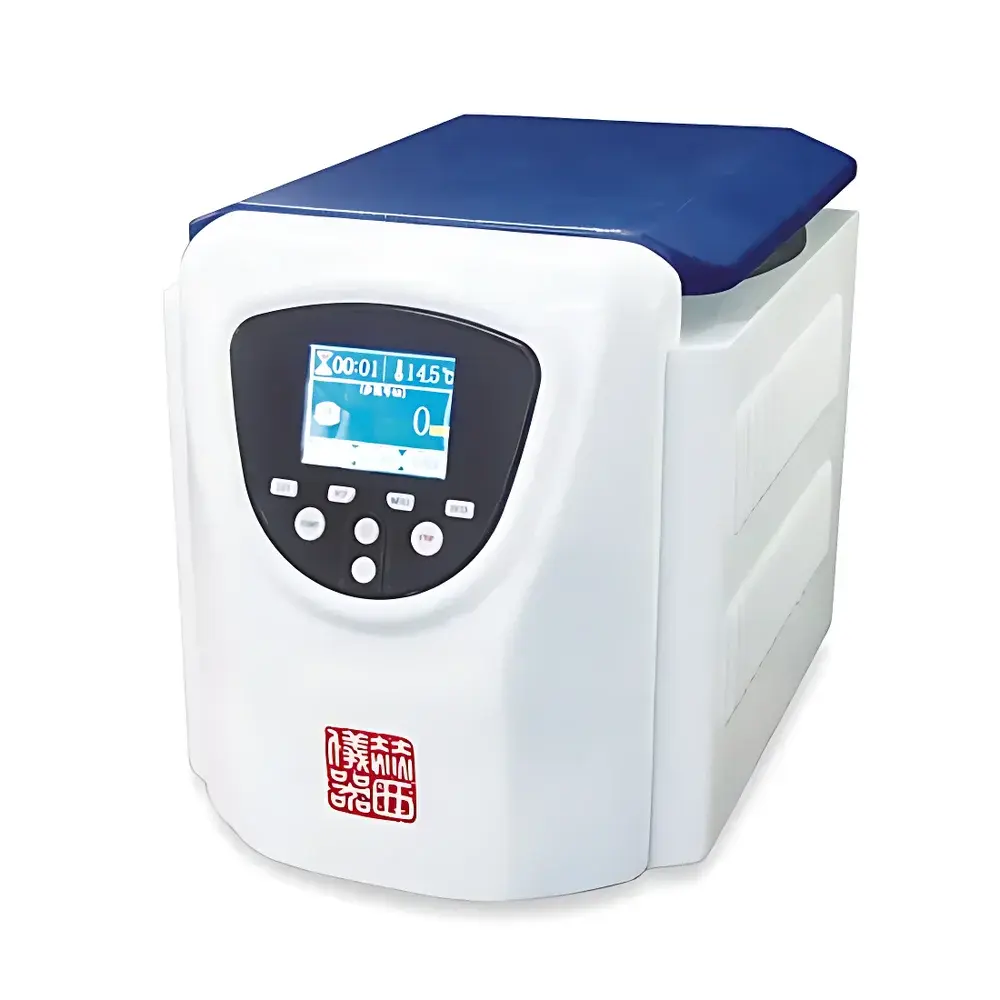
Hercy CGF-TD4 Variable-Speed Dental Centrifuge
| Brand | Hercy |
|---|---|
| Origin | Hunan, China |
| Model | CGF-TD4 |
| Instrument Type | Benchtop Centrifuge |
| Speed Range | 0–3100 rpm |
| Max RCF | 3100 × g |
| Max Capacity | 8 × 10 mL |
| Rotor Type | Fixed-Angle Rotor |
| Application Class | Cellular/Bacterial Separation |
| Dimensions (L×W×H) | 380 × 260 × 310 mm |
| Weight (incl. rotor) | 17 kg |
| Power Supply | AC 220 V, 50 Hz |
| Speed Accuracy | ±30 rpm |
| Noise Level | ≤60 dB(A) |
| Operating Environment | 5–40 °C, RH ≤80%, non-corrosive/non-explosive atmosphere |
| Compliance | Designed for GLP-aligned dental regenerative workflows |
| Software Features | 4 pre-programmed CGF protocols (CGF-S1×4), A-PRF-S2, i-PRF-S3, PGRF-S4, auto-RCF calculation, parameter memory, TFT color touch interface |
| Drive System | Brushless DC inverter motor with PWM speed control |
| Safety | Interlocked motorized door, automatic imbalance detection & auto-balance compensation, steel chassis with epoxy powder coating |
Overview
The Hercy CGF-TD4 Variable-Speed Dental Centrifuge is an engineered benchtop centrifuge specifically optimized for the preparation of autologous platelet concentrates used in oral and maxillofacial regenerative procedures—including Concentrated Growth Factors (CGF), Advanced Platelet-Rich Fibrin (A-PRF), Injectable PRF (i-PRF), and Polymerized Growth Regenerative Fibrin (PGRF). Unlike general-purpose laboratory centrifuges, the CGF-TD4 implements a precisely calibrated low-speed, multi-step deceleration protocol architecture grounded in the biomechanical principles of fibrin polymerization kinetics and leukocyte/platelet stratification under controlled gravitational fields. Its operational envelope—0–3100 rpm, up to 3100 × g—aligns with empirically validated clinical centrifugation curves that preserve fibrin matrix integrity while maximizing growth factor retention and cellular viability. The unit operates on a brushless DC inverter motor platform, eliminating carbon brush wear, electrical arcing, and particulate contamination—critical requirements for sterile surgical suite integration and ISO 13485-aligned device handling.
Key Features
- Four dedicated, factory-calibrated CGF programs (CGF-S1 series) with sequential speed ramping (2600 → 2300 → 2600 → 2850 rpm) and timed deceleration profiles—designed to replicate published clinical protocols for dense fibrin clot formation.
- Three additional fixed-speed programs (A-PRF-S2 at 2450 rpm / 4 min; i-PRF-S3 at 2850 rpm / 4 min; PGRF-S4 at 3100 rpm / 3 min) supporting standardized preparation across international consensus guidelines (e.g., Choukroun et al., Dohan Ehrenfest et al.).
- PWM-controlled brushless DC motor enabling high-resolution speed regulation (±30 rpm accuracy) and silent operation (≤60 dB[A])—essential for proximity to clinical workspaces and compliance with WHO ambient noise recommendations for healthcare facilities.
- Integrated auto-balance compensation system utilizing dual-axis vibration damping mounts and real-time rotor load asymmetry detection—ensuring mechanical stability even with minor tube volume discrepancies (±0.5 mL).
- TFT true-color capacitive touchscreen interface with intuitive icon-driven navigation, password-protected parameter editing, and non-volatile memory for ≥100 user-defined protocols.
- Motor-integrated electromagnetic door lock with hardware-enforced interlock: centrifugation initiates only when lid closure is verified via dual-position Hall-effect sensors—meeting IEC 61010-2-020 safety requirements for laboratory centrifuges.
- Rigid cold-rolled steel chassis with epoxy-polyester powder coating (thickness ≥75 µm) providing corrosion resistance against saline, EDTA, and citrate anticoagulant exposure during routine decontamination cycles.
Sample Compatibility & Compliance
The CGF-TD4 accommodates standard conical 10 mL glass or polymer blood collection tubes (e.g., Terumo, Sarstedt, Greiner Bio-One) in its fixed-angle rotor configuration (8-place, 30° angle). It supports both sodium citrate and ACD-A anticoagulated whole blood processing without modification. While not certified as a medical device under FDA 21 CFR Part 820 or EU MDR Annex II, the instrument is routinely deployed in dental clinics and ambulatory surgery centers operating under local GLP-equivalent quality frameworks. Its programmable logic controller (PLC) architecture logs all run parameters—including start time, final speed, duration, RCF, and error codes—with timestamped records exportable via USB for internal audit trails. Environmental operation conforms to IEC 60601-1 collateral standard clauses for non-invasive equipment in Class IIb clinical environments.
Software & Data Management
The embedded firmware implements deterministic real-time scheduling for centrifugation sequences, with onboard EEPROM storing protocol definitions, calibration offsets, and cumulative runtime statistics. Each executed run generates a metadata-rich log file (.csv format) containing: date/time stamp, selected program ID, actual vs. setpoint rpm history (sampled at 100 Hz), total elapsed time, final RCF, and thermal drift estimate (via thermistor feedback loop). No cloud connectivity or remote access is implemented—data sovereignty is maintained locally per HIPAA-compliant institutional policies. Audit-ready reports may be generated manually via USB mass-storage mode and imported into LIMS platforms supporting CSV ingestion (e.g., LabWare, STARLIMS).
Applications
- Preparation of CGF membranes and plugs for ridge preservation, sinus augmentation, and peri-implant defect repair.
- Generation of A-PRF exudates for socket healing and soft-tissue graft stabilization.
- Production of i-PRF injectables for intraosseous delivery in early-stage peri-implantitis management.
- Isolation of PGRF matrices with enhanced tensile strength for guided bone regeneration (GBR) barrier applications.
- Research-scale fractionation of peripheral blood mononuclear cells (PBMCs) and platelet lysates under reproducible low-shear conditions.
FAQ
Does the CGF-TD4 comply with FDA or CE regulatory requirements for clinical use?
The CGF-TD4 is classified as a general-purpose laboratory centrifuge and is not registered as a medical device. Its use in clinical settings follows institutional risk assessment and falls under local regulatory discretion—not FDA 510(k) or CE-IVDR pathways.
Can I modify the pre-set CGF-S1 speed profile?
Yes—user-defined protocols may be created and saved via the touchscreen interface, subject to administrator-level password authentication.
What maintenance intervals are recommended?
No scheduled lubrication is required. Annual verification of rotor balance, speed calibration, and door interlock function is advised using traceable reference standards (e.g., NIST-traceable tachometer, vibration analyzer).
Is rotor autoclaving supported?
The fixed-angle aluminum rotor is compatible with steam sterilization at 121 °C for 20 minutes; however, repeated autoclaving may affect anodized surface integrity—chemical disinfection (70% ethanol or 0.5% sodium hypochlorite) is preferred.
How does the auto-balance system respond to gross imbalance?
If detected imbalance exceeds 50 g·cm, the unit halts acceleration, displays “UNBALANCE ERROR”, and engages dynamic braking—no manual intervention is required for safe rotor arrest.



