
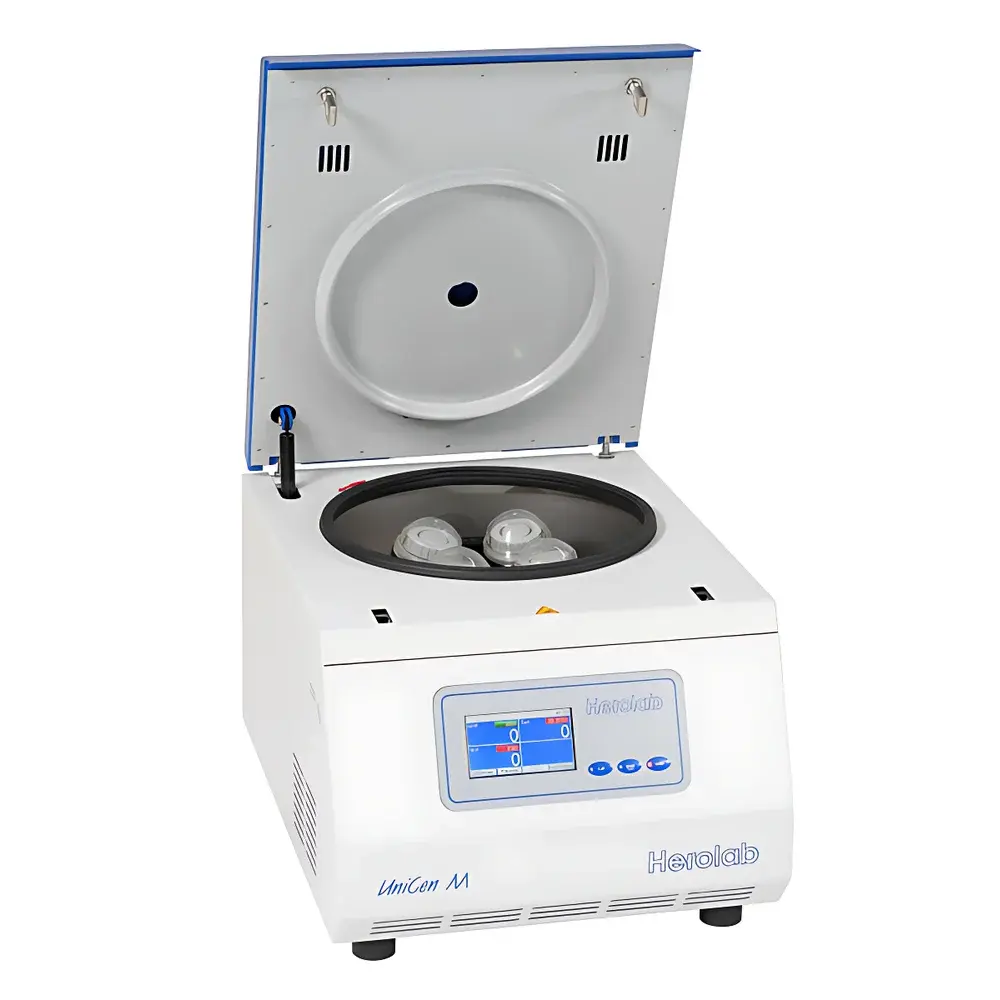
Herolab UniCen M 800 mL Benchtop High-Speed Centrifuge
| Brand | Herolab |
|---|---|
| Origin | Germany |
| Model | UniCen M |
| Centrifuge Type | Benchtop High-Speed Centrifuge |
| Speed Range | Up to 18,000 rpm |
| Max RCF | 25,356 × g (angular), 12,927 × g (swing-out) |
| Max Capacity | 6 × 100 mL (angular rotor), 4 × 200 mL (swing-out rotor) |
| Dimensions (W×D×H) | 41.2 × 55.0 × 36.0 cm |
| Weight (net) | 45.0 kg |
| Drive System | Maintenance-free high-speed induction motor with auto-centering |
| Rotor Recognition | APRITM™ automatic rotor identification and imbalance detection |
| Braking System | Dynamic reverse magnetic resistance deceleration |
| Temperature Control | Ambient (non-refrigerated) |
| Power Supply | 230 V, 50–60 Hz |
| Total Rotor Options | 17 (incl. 13 angular, 3 swing-out, 1 capillary hematocrit) |
Overview
The Herolab UniCen M is a precision-engineered benchtop high-speed centrifuge designed for routine and advanced separation tasks in life science, clinical diagnostics, and quality control laboratories. Operating on the principle of sedimentation under controlled centrifugal force, the UniCen M delivers reproducible separations across a broad range of biological and synthetic samples—including subcellular organelles, viruses, macromolecular complexes, and particulate suspensions. Its non-refrigerated architecture ensures stable operation at ambient temperature, making it ideal for applications where thermal sensitivity is not a primary concern—such as plasma separation, cell pellet recovery, polymer clarification, or routine sample preparation prior to downstream analysis (e.g., HPLC, PCR, or ELISA). With a maximum rotational speed of 18,000 rpm and peak relative centrifugal force (RCF) of 25,356 × g using angular rotors, the UniCen M bridges the performance gap between standard benchtop units and floor-standing ultracentrifuges—without compromising footprint, safety, or operational simplicity.
Key Features
- Maintenance-free high-speed induction motor with auto-centering capability ensures long-term rotational stability and minimizes mechanical wear over thousands of cycles.
- Flexible shaft drive system enables precise rotor centering during acceleration, reducing vibration and enhancing rotor lifetime—even at high speeds.
- APRITM™ intelligent rotor recognition system automatically identifies installed rotor type, validates compatibility with selected speed/RCF parameters, and halts operation if imbalance exceeds ISO 15887-compliant thresholds.
- Dynamic reverse magnetic resistance braking provides smooth, controllable deceleration—reducing sample resuspension and enabling rapid turnaround between runs.
- “At Set RPM” timing function initiates countdown only after target speed is reached, eliminating variability caused by acceleration phase differences—critical for GLP- and GMP-aligned protocols requiring strict process repeatability.
- Compact footprint (41.2 × 55.0 × 36.0 cm) and 45 kg net weight support flexible placement in biosafety cabinets, laminar flow hoods, or shared instrumentation benches without structural reinforcement.
Sample Compatibility & Compliance
The UniCen M supports a wide spectrum of sample containers—from standard 15 mL and 50 mL conical tubes to specialized formats including blood collection tubes, microcentrifuge tubes (0.2–2.0 mL), and hematocrit capillaries. Its 17-rotor ecosystem includes 13 angular rotors optimized for high-RCF pelleting (e.g., mitochondrial isolation), 3 swing-out rotors for high-volume processing (up to 4 × 200 mL per run), and 1 dedicated capillary rotor for hematocrit determination per CLSI H12-A3 guidelines. All rotors are certified to ISO 15887:2017 (safety requirements for centrifuges) and manufactured from aerospace-grade aluminum alloys with corrosion-resistant anodized finishes. The unit complies with IEC 61010-1:2010 (safety of laboratory equipment) and carries CE marking under the EU Machinery Directive 2006/42/EC.
Software & Data Management
While the UniCen M operates via an intuitive membrane keypad interface with LED status indicators, its embedded firmware supports full audit trail functionality required for regulated environments. All parameter changes—including speed, time, brake profile, and rotor ID—are timestamped and stored in non-volatile memory. Optional RS-232 or USB-C connectivity allows integration into LIMS or ELN platforms for automated protocol logging and electronic record retention compliant with FDA 21 CFR Part 11 Annex 11 principles. User profiles can be password-protected, and method locking prevents unauthorized modification of validated SOPs—supporting ISO/IEC 17025 accreditation workflows.
Applications
- Isolation of mitochondria, lysosomes, and other large organelles from mammalian cell homogenates (using 18,000 rpm angular rotors).
- Clarification of bacterial cultures, yeast lysates, and viral supernatants prior to ultracentrifugation or filtration steps.
- Routine plasma/serum separation in clinical labs (compatible with Vacutainer® and similar evacuated tube systems).
- High-yield pelleting of microorganisms for genomic DNA extraction or protein expression studies.
- Preparative separation of nanoparticles, colloidal suspensions, and polymer emulsions in materials science research.
- Hematocrit measurement in veterinary and point-of-care settings using capillary rotor configuration.
FAQ
Is the UniCen M suitable for use with infectious or biohazardous samples?
Yes—when used with sealed buckets, aerosol-tight rotors, and appropriate biosafety containment (e.g., centrifuge safety cups), the UniCen M meets BSL-2 containment requirements per NIH Guidelines and WHO Laboratory Biosafety Manual (4th ed.).
Does the unit support rotor calibration verification?
Each rotor is supplied with a unique serial-numbered calibration certificate traceable to national standards (DKD/DAkkS-accredited lab); users may perform periodic RCF validation using calibrated tachometers per ISO 21501-4.
Can third-party rotors be used with the UniCen M?
No—APRITM™ enforces strict OEM rotor authentication; only Herolab-certified rotors with embedded RFID tags are recognized and permitted to operate.
What maintenance intervals are recommended?
Beyond routine cleaning and visual inspection of rotor threads and chamber seals, no scheduled lubrication or bearing service is required due to the brushless induction motor design—typical mean time between failures exceeds 25,000 operating hours.



